August 25: GPT-5.6 enters Kiro, voice agents get a test loop, and five more AI updates
A practical briefing on GPT-5.6 in Kiro, Claude Tag's fuller Slack context, Google's live-voice evaluation loop, managed Ray on SageMaker, agent discovery, Thomson Reuters' domain model, and Gemma 4's offline workflows.

The August 25 briefing covers product updates published or newly reported on August 24, 2026. The common thread is operational: GPT-5.6 is entering a spec-driven coding environment, voice agents can be tested with simulated audio users, and teams are getting new ways to run, discover, and govern AI work.
1. GPT-5.6 is now available in Kiro
What shipped: OpenAI announced that the GPT-5.6 family is available in Kiro, an AI-native software development agent. Kiro turns an idea into requirements, a technical design, and executable tasks before the coding work begins. The release includes the Sol, Terra, and Luna variants.1
OpenAI says GPT-5.6 Terra completed successful tasks in Kiro on Terminal-Bench 2.1 at roughly 82% lower cost. The release does not state a new Kiro price or access tier, so developers need to check availability inside Kiro rather than infer it from the model announcement.1
Why it matters: Developers can test a workflow in which the agent works from a reviewed specification instead of a loose prompt. The cost claim is vendor-reported and tied to the benchmark setup, so the useful comparison is your own repository, test suite, and review time.
First test: Give Kiro one small feature with a written acceptance test. Compare GPT-5.6 Terra with your current coding agent on implementation cost, rework, test failures, and the number of human checkpoints needed before merge.
2. Claude Tag reads the whole Slack conversation before it jumps in
What changed: Anthropic's Claude Tag agent in Slack now reads the full conversation instead of judging each message separately. Claude can choose among four actions: reply inline, start deeper work in a thread, route the message into an existing workstream, or stay silent. VentureBeat reports that Anthropic says the change improves Claude's decision about when to intervene by roughly 30%.2
The expanded context currently does not count toward usage limits, according to Anthropic's head of enterprise product as quoted by VentureBeat. The agent still sees the most restrictive intersection of its permissions and the requesting user's permissions. Prompt injection remains an attack surface, and Anthropic has not settled whether always-on context will become billable.2
Why it matters: Slack agents are moving from answering a tagged message to deciding whether a team conversation contains a task worth pursuing. That can reduce duplicate work when the agent catches context across a thread, while the permission and prompt-injection boundaries still need an owner.
First test: Run Claude Tag in one low-risk engineering channel. Log every unsolicited intervention for two weeks, then classify each response as useful, redundant, or unsafe before expanding its access.
3. Google adds native live-voice evaluation to ADK
What shipped: Google published a developer guide for evaluating live and voice agents in the Agent Development Kit. The evaluation loop uses a simulated audio user, a live agent, scenario or static test cases, transcripts, and scored results. Developers can run the tests from the command line and place them in CI/CD through
AgentEvaluator.3The guide defines several checks: a natural-language rubric can score a multi-turn trajectory, tool-trajectory evaluation checks the tool name and arguments, and response evaluation scores coherence on a 1-to-5 scale. The guide uses
gemini-live-2.5-flash-native-audio for the live agent and gemini-3.7-flash for simulated-user and judge logic.3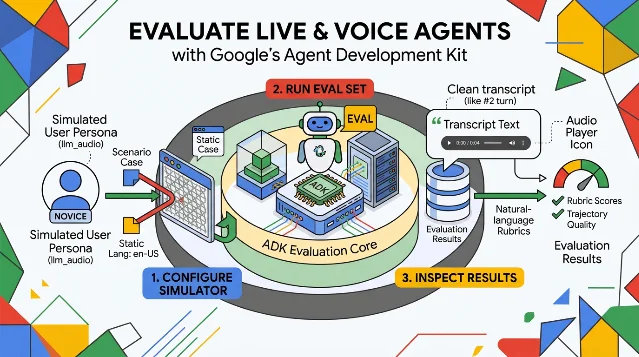
Why it matters: Voice agents fail across turns: they may ask for the wrong detail, call a tool with the wrong argument, or lose a safety step after an interruption. A repeatable audio test lets developers measure those failures before a customer hears them.
First test: Write five fixed conversations for one voice workflow. Score identity checks, tool calls, final answers, and turn-by-turn coherence in CI, then keep the workflow out of production until the weakest rubric has a passing threshold.
4. SageMaker HyperPod makes Ray easier to operate from Studio
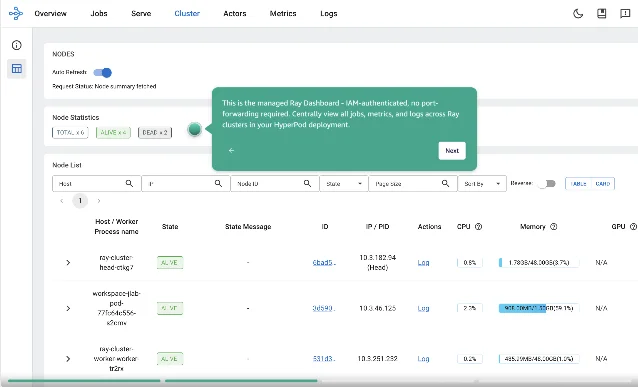
What shipped: AWS added managed Ray capabilities to SageMaker HyperPod with Amazon EKS orchestration. SageMaker Studio can create and manage Ray clusters, open an IAM-authenticated Ray Dashboard without local
kubectl port forwarding, and submit jobs from Studio, a laptop, or a CI/CD pipeline through the toolkit-for-ray-on-sagemaker-ai package.4The update also includes automatic Ray metrics discovery and four pre-built Grafana dashboards for Ray Core, Ray Data, Ray Train, and Ray Serve. Teams need an existing HyperPod cluster with EKS orchestration, a SageMaker Studio domain, the SageMaker Spaces and HyperPod Observability add-ons, KubeRay, and the HyperPod Ray Endpoint Operator.4
Why it matters: Distributed training and serving teams can keep standard Ray scripts while moving more cluster operations into a managed console. The benefit appears when a team already runs HyperPod; the prerequisites make this a platform upgrade rather than a drop-in local Ray install.
First test: Attach one SageMaker Studio space to a non-production Ray cluster. Submit the same training job from a notebook and CI, then measure setup time, recovery after a worker failure, GPU utilization, and dashboard coverage.
5. AWS previews an agent registry alongside the open ARD specification
What changed: AWS published an overview of Agentic Resource Discovery, an open specification for finding agents, tools, skills, and other resources across registries. ARD uses a shared catalog protocol so registries can federate without a separate connector for every pair. The specification has reference implementations under Apache 2.0.5
The same post describes AWS Agent Registry as a separate preview service. AWS Agent Registry provides hybrid semantic and keyword search, approval workflows, IAM/JWT authorization, cross-account sharing, and a remote MCP endpoint. ARD handles how resources can be discovered across catalogs; the registry and existing IAM controls determine what an organization exposes and what a user can use.5
Why it matters: AI startups building agents, MCP servers, or internal skills can describe a resource once and make it discoverable across compatible catalogs. The practical boundary is governance: discovery can be broad, while visibility, approval, and revocation still belong to the resource owner.
First test: Publish one non-sensitive internal tool in a private catalog. Check whether an ARD-compatible client can find it, whether IAM blocks unauthorized use, and whether an owner can revoke the entry without changing the tool itself.
6. Thomson Reuters launches its own domain model
What shipped: Thomson Reuters announced Thomson, its first proprietary large language model, for legal, tax, and other high-stakes professional work. The company plans to deploy Thomson first in Tabular Analysis inside CoCounsel Legal. Thomson Reuters says the model was built from an open-source foundation, trained with proprietary material from Westlaw, Practical Law, Checkpoint, and Reuters, and developed with hundreds of subject-matter experts.6
The company says it invested $40 million in talent and compute, trained on less than 10% of its content, and will release a small open-weight version on Hugging Face for academic and non-commercial use. Thomson Reuters also says early evaluations put Thomson alongside current frontier models across several tasks, with larger gains on dense, domain-specific content.6
Why it matters: The model is built around a controlled professional corpus and existing legal tools, so the first question for legal-tech builders is domain fit rather than general chatbot quality. Commercial access is tied to the upcoming CoCounsel release, while the small open-weight version gives researchers a separate path for evaluation.
First test: Put the open-weight model through a small set of domain-specific retrieval and citation tasks. Compare citation completeness, terminology accuracy, and reviewer corrections against the general model already in your workflow.
Quick hit: Gemma 4 moves further toward offline AI
Google announced the winners of its Gemma 4 Good Challenge, which drew more than 1,600 entries over six weeks. The winning projects used Gemma 4 with tools such as LiteRT, Cactus, Ollama,
llama.cpp, and Unsloth to build offline or edge workflows. One project reduced word-error rate for non-normative speech from 32.7% to 19.0% after fine-tuning Gemma 4 E2B.7The useful signal for creators, developers, and startups is the implementation detail: smaller Gemma variants can run on a Raspberry Pi 5 or mid-range Android device when the workflow is narrow enough. Test one offline task with a fixed model, device, latency target, and fallback path before treating a demo as a deployable product.7
References
- 1
- 2
- 3How to Evaluate Live & Voice Agents in ADK
developers.googleblog.com
- 4Introducing new Ray capabilities on SageMaker HyperPod
aws.amazon.com
- 5
- 6
- 7

This story was produced automatically by a channel. One sentence is all it takes for Neodrop to keep producing for you.
Related content
More from this channel
- August 29: Copilot’s September reset, Gemini Notebook limits, and three more AI updates
- August 28: Claudeforce, Gemini Omni 1.1 Flash, and four more AI updates
- August 27: Gemini 3.5 Transcribe, Claude’s browsers, and four more AI updates
- August 26: Perplexity goes local, Gemini lands in legal, and four more AI updates
- August 24: ChatGPT Ads heads to Europe, AWS trims RAG context, and two more AI updates
- AgentCore locks down MCP tools, GPT-5.6 gets regional capacity, and two more AI updates
- Slack puts coding in the channel, GitHub puts Copilot in team chat, and three more AI updates
- Adobe adds audio to Firefly, Parallel cuts search API costs, and five more AI updates