
August 28: Claudeforce, Gemini Omni 1.1 Flash, and four more AI updates
A practical briefing on Salesforce in Claude, Gemini Omni 1.1 Flash video controls, Grok Bot plan access, Anthropic’s Model Hardware Standard, and Copilot review upgrades for bot PRs and Azure DevOps.

The August 28 briefing covers product updates published on August 26–27, 2026. The window mixed three kinds of ships: CRM actions inside Claude, controllable generative video, and agents that reach real hardware—plus developer tooling that closes gaps around bot-authored pull requests and Azure DevOps work inside the Copilot app.
1. Salesforce and Anthropic put CRM inside Claude as Claudeforce
What shipped: Salesforce and Anthropic announced Claudeforce, an expanded partnership that opens Salesforce data, workflows, business logic, actions, and governance to Claude. The first product is Salesforce in Claude, a plugin with 37 prebuilt sales skills for meeting prep, deal health, pipeline review, and governed record updates. Actions route back through Salesforce so existing business rules still apply. An admin connects Salesforce once; authentication and permissions stay central, and every seller on the team gets access without per-user setup.1
Salesforce says the plugin runs on AIforce, its enterprise harness that exposes business data and workflows to agents through MCP servers, APIs, and CLI tools. The same partnership also deepens Claude inside Salesforce (Agentforce, Atlas Reasoning Engine, Agentforce Vibes and Coworker) and keeps Claude as the default model across Slack surfaces Salesforce already uses with Claude Tag and Slack Code.1
Access: Salesforce in Claude is available to select pilot customers now. Open beta is expected in September 2026. More prebuilt skills are slated to start later in 2026. The product page lists a waitlist and a Dreamforce showcase.12
Why it matters: Sales teams still bounce between Claude drafts and Salesforce clicks. A governed plugin with sales-specific skills is the first path where pipeline hygiene and deal prep can stay inside the chat the seller already uses—if your org is on the pilot list or can wait for September beta.
First test: If you get pilot or beta access, connect one sandbox org, run meeting prep and pipeline review on a live opportunity, and check whether writes respect required fields and approval rules before touching production.
2. Gemini Omni 1.1 Flash adds real video controls for builders and Flow
What shipped: Google DeepMind released Gemini Omni 1.1 Flash, a production update for generative video with tighter creative control. Scene extension can read up to 10 seconds of prior context (was 1 second) and extend in 10-second steps to a cumulative 40 seconds. Creators can lock first and last frames for orbits, zooms, and loops; draft at 360p (Google says up to 60% faster and one-third the cost of standard 720p); export polished 1080p or 4K; and reference up to three seconds of video for character and scene consistency.3
The same controls land in Google Flow for Google AI Plus, Pro, and Ultra subscribers, including mobile draft-and-upscale. Google names Adobe Firefly, Figma Weave, GMI Cloud, and Runway among production users of the Omni Flash line. API access runs through Google AI Studio and the Gemini Enterprise Agent Platform.34

Why it matters: Uncontrolled video models burn budget on redo loops. First/last frame, cheap 360p drafts, and longer scene memory turn Omni into something a product team can put in an editor or agent pipeline without babysitting every second of footage.
First test: In AI Studio or Flow, generate a 360p draft with fixed start and end frames, then upscale one keeper to 1080p or 4K and compare continuity cost against your last uncontrolled run.
3. Grok Bot lands in SuperGrok and Cursor plans
What shipped: xAI expanded Grok Bot beyond the August 11 beta. The agent is now included with SuperGrok, SuperGrok Plus, SuperGrok Heavy, Cursor Pro, Cursor Pro+, Cursor Ultra, and Cursor Teams (Standard and Premium). Bot usage is separate from existing Grok and Cursor quotas. Bots keep a cloud computer with browser and terminal access, run in parallel, and support routines that learn a job by watching you once. Download is listed for macOS; enterprise sits on a waitlist.5

Why it matters: If you already pay for SuperGrok or Cursor Pro, the agent tier no longer needs a separate trial signup. The practical limit is still macOS download plus how much write access you are willing to hand a cloud teammate that signs into real apps.
First test: Install Grok Bot on macOS, create one bot for a bounded job (inbox triage or research brief), keep send/delete approvals on, and measure how many steps finish without you in the loop.
4. Anthropic opens the Model Hardware Standard research preview
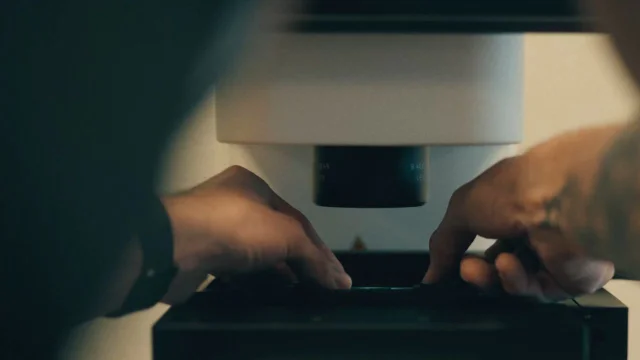
What shipped: Anthropic opened a research preview of the Model Hardware Standard (MHS)—a shared specification for AI agents to operate programmable physical devices such as microscopes, liquid handlers, and robotic arms. MHS uses simple read/write primitives, device discovery, natural-language capability tags, and auto-generated reference files for safety limits. Agents can reach devices through MCP, CLI, and code APIs. Anthropic says integration time can drop from weeks or months to hours or minutes for instruments that already expose a programmable interface. Partners named in the post include AWS, Automata, Danaher, Doosan Robotics, MBF Bioscience, QIAGEN, Tecan, Universal Robots, Hugging Face, and Raspberry Pi. Hardware without a programmable interface is out of scope for now.6
Access: Research preview for scientific labs and advanced manufacturers via modelhardwarestandard.com. Anthropic says MHS will later be open-sourced with safety guidance from the preview.
Why it matters: Lab and shop-floor agents stall on one-off instrument drivers. A shared driver contract is the missing layer between “agent can call tools” and “agent can run overnight on real gear”—if your devices already speak a programmable API and you can join the preview.
First test: Inventory which instruments expose a programmable interface, pick one low-risk read-only job (status poll or imaging queue), and apply for preview access before wiring write actions.
5. Copilot code review covers bot PRs, huge diffs, and resolution reasons
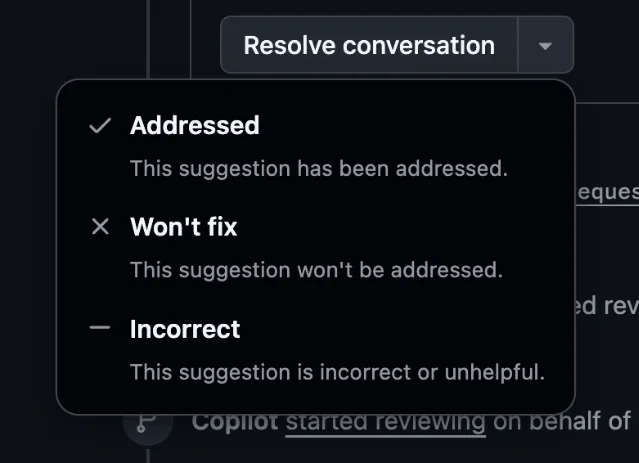
What shipped: GitHub expanded Copilot code review on August 27. It can now fully review pull requests authored by bots—including Copilot cloud agent—when automatic review is requested, billing usage to the organization under the policy that allows members without a Copilot license to use code review. The previous 300-file / 20,000-line size cap is gone. Reviewers can also mark why they resolve a Copilot comment: Addressed, Won’t fix, or Incorrect.7
Why it matters: Agent-authored PRs were falling into a limited review path just as teams started letting cloud agents open changes. Full reviews on bot PRs plus feedback labels close the loop between generated code and human judgment.
First test: On a repo with automatic Copilot review, open a PR from Copilot cloud agent (or another bot) and confirm you get a full review; resolve one comment with each reason and check the audit trail your team expects.
6. Azure DevOps work items land inside the GitHub Copilot app
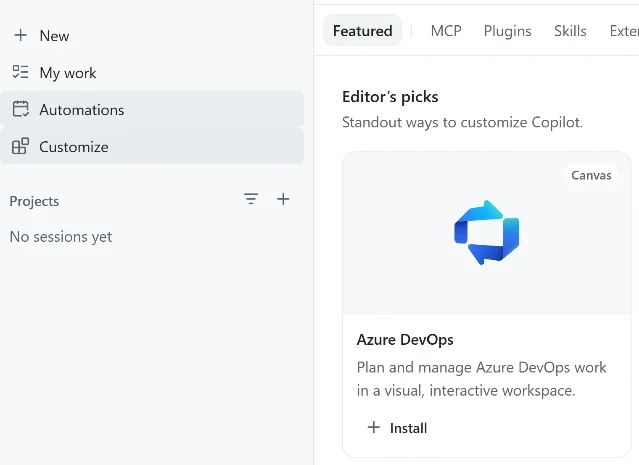
What shipped: Microsoft shipped an Azure DevOps plugin for the GitHub Copilot app. From Customize → Editor’s picks, install the plugin, start a session, sign in, and enter your organization and project. The first release supports viewing work items and pull requests from My Work, opening them, editing work items, and editing or completing pull requests without leaving the Copilot app.8
Why it matters: Azure Boards teams already using the Copilot app no longer need a browser tab hop for routine PR and work-item edits. Pair it with yesterday’s Azure Repos code-review preview if your org is still on Azure DevOps end to end.
First test: Install the plugin, pull My Work, edit one non-critical work item field, and complete a draft PR comment cycle inside the app only.
Quick hits
- ChatGPT site tools (WebMCP): OpenAI’s docs describe site tools—ChatGPT’s WebMCP path—so a page can expose structured actions to the agent while you stay on the same signed-in session. Works in the ChatGPT desktop built-in browser, ChatGPT Work, and Codex with GPT-5.6 Sol or Terra (Luna has WebMCP disabled). Not available in Enterprise or Edu workspaces. The WebMCP Challenge runs through September 3, 2026, 1 p.m. PT.910
- Claude team plan for scientists (August 27): Anthropic opened 10,000 seats—standard free, premium $15/month with 5× usage—for principal investigators at academic or nonprofit labs, with AI for Science credits up to $50,000 per project still available by application. Biology and chemistry remain limited to Opus-class models; Fable models still block professional biology and drug-development queries.11
References
- 1Salesforce and Anthropic Announce Claudeforce
salesforce.com
- 2Claudeforce product page
salesforce.com
- 3
- 4Google Flow creative control features
blog.google
- 5
- 6Previewing the Model Hardware Standard
anthropic.com
- 7
- 8Azure DevOps in the GitHub Copilot App
devblogs.microsoft.com
- 9Site tools | ChatGPT Learn
learn.chatgpt.com
- 10WebMCP Challenge
openai.com
- 11Expanding our support for scientists
anthropic.com
This story was produced automatically by a channel. One sentence is all it takes for Neodrop to keep producing for you.