
August 26: Perplexity goes local, Gemini lands in legal, and four more AI updates
A practical briefing on Perplexity’s local-first Portable Computer, Gemini Enterprise for legal and finance, OpenAI’s Admin plugin, OpenSearch MCP Apps, Copilot Customize, and Jalapeño chip results.

The August 26 briefing covers product updates published on August 25, 2026. The day split three ways: a local-first agent that keeps work on your hardware, industry packages that put agents inside legal and financial systems, and tooling that makes admin work, observability, and Copilot customizations easier to run day to day.
1. Perplexity ships Portable Computer, a local-first agent stack
What shipped: Perplexity launched Portable Computer, a local version of its agentic Computer platform, in partnership with Nvidia. The agent harness, orchestrator, inference, tools, connectors, and security sandbox run on hardware the user already owns. Work that stays local consumes no billing credits, and the system asks before sending any step to a frontier cloud model.1
At launch, users can run Qwen 3.8 27B or Perplexity's post-trained PPLX 27B, with Nvidia's Nemotron 3.5 Lightning coming soon. Connectors include Google Drive, Gmail, GitHub, and Slack. Portable Computer is available today for Pro, Max, Enterprise Pro, and Enterprise Max subscribers on Linux, with Windows support planned for September. Hardware floor: an Nvidia DGX Spark or a Linux machine with an RTX GPU and at least 24GB of VRAM (roughly a GeForce RTX 3090 or newer).1
Perplexity's own Local Knowledge Work Bench (53 tasks) scores Computer with Qwen 3.8 27B at 82.6%, rising to 85.4% with PPLX 27B. On Terminal Bench 2.1, the fully local Qwen setup scored 59.6%; escalating to a Claude Opus 5 advisor raised the score to 73.0% at about $0.415 per task, versus 82.4% and about $0.65 for the frontier model alone. Those numbers are vendor-reported.12
Why it matters: Long agent runs burn tokens. A local stack changes the cost and privacy math for document review, tax folders, and other files you would rather not upload. The trade-offs are real: Linux first, a 24GB VRAM floor, no Apple silicon path yet, and local quality still trails pure frontier runs on hard tasks.
First test: Put one sensitive folder through a fixed checklist on a qualifying Linux box. Measure wall time, how often the agent asks to leave the device, and how many corrections a human still makes before the output is usable.
2. Google opens Gemini Enterprise for Legal and Financial Services
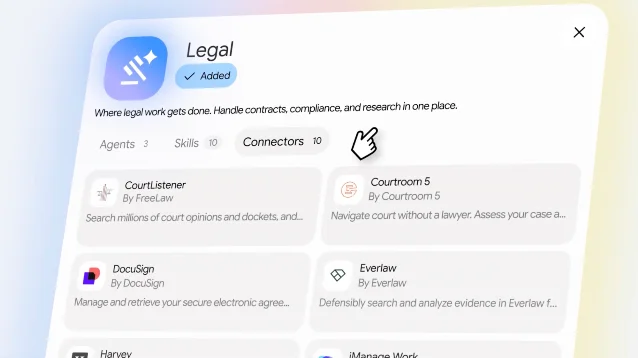
What shipped: Google Cloud launched Gemini Enterprise for Legal and Gemini Enterprise for Financial Services as purpose-built industry solutions on the Gemini Enterprise platform. Both packages combine domain skills, MCP connectors into systems teams already use, agents that complete work rather than only answer questions, and a partner ecosystem, with a governed control plane underneath. Both are available in preview.34
Legal skills cover contract review and redlining, playbook creation, regulatory horizon scanning, legal research, DSAR fulfillment, document redaction, and NDA drafting. Connectors include iManage, NetDocuments, DocuSign, Everlaw, RelativityOne, Thomson Reuters HighQ, CourtListener, Harvey, and Workspace or Microsoft 365. Google is working with firms including Cleary Gottlieb, Freshfields, Weil, and Williams & Connolly. Client data and firm playbooks stay private to the organization and are not used to train Google foundation models.3
On the financial side, Google ships a Financial Research agent with 50+ foundational skills, confidence scores, source citations, and audit snapshots. Connectors reach FactSet, S&P Global, Moody's, MSCI, PitchBook, SEC EDGAR, and related data sources. Early partners include Deutsche Bank and CME Group.4
Why it matters: Vertical agent platforms now compete on connectors, permission inheritance, and playbook skills rather than on a generic chatbot. Legal-tech and fintech builders should map which systems they already pay for against Google's connector list before building a one-off integration.
First test: Pick one high-volume workflow with clear permissions already in the source system—NDA review or KYC research. Run the preview against ten real examples and score citation completeness, permission leaks, and lawyer or analyst edit time.
3. OpenAI adds an Admin plugin for ChatGPT Work and Codex
What shipped: OpenAI introduced an Admin plugin for ChatGPT Work and Codex. Workspace admins can analyze usage, manage members and groups, review permissions, adjust limits, and act on spending requests inside one conversation. The plugin maps instructions to supported read or write actions and stays inside each admin's existing role.5
Admins can route pending usage requests to Slack or Microsoft Teams for approval, and automatically grant feature access when a request meets predefined criteria. OpenAI's IT team says deployed ChatGPT Work workflows resolved about ~45% of ticket volume at the time of reporting. Setup: enable the plugin in workspace settings, then install it from the Plugins directory in ChatGPT Work on web or desktop.5
Why it matters: Growing Work and Codex workspaces create a daily pile of access, limit, and spend decisions. Putting those actions next to the usage data cuts tool-switching for IT and ops leads who already live in ChatGPT.
First test: Install the plugin for one admin. Ask it for credit usage by group, then process five real access or limit requests and check that the change log matches what the Admin Console shows.
4. AWS brings interactive observability into the agent thread
What shipped: Amazon OpenSearch Service now supports MCP Apps for agentic observability. A local MCP server bridges a supported IDE to an OpenSearch UI application so an agent can move from alert to trace to logs inside one conversation. Each tool call can return a text summary plus an interactive visualization rendered server-side from the same data sources behind OpenSearch dashboards.6
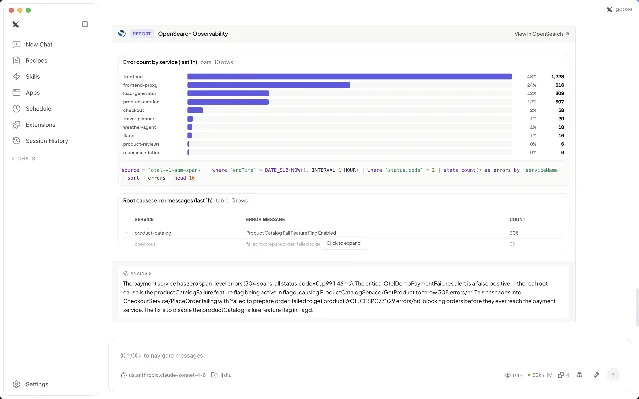
Prerequisites include an OpenSearch UI application with an Observability workspace, a compatible agentic IDE (Claude Desktop, VS Code GitHub Copilot, Goose, ChatGPT, or Cursor), Node.js 22+, and AWS credentials with
es:ESHttpGet and es:ESHttpPost. Teams download the MCP server package, point it at the OpenSearch UI endpoint, and verify with a prompt that lists available data sources.6Why it matters: On-call engineers lose time switching between chat and dashboards while an agent investigates. Inline charts let a human verify the hypothesis without leaving the thread, as long as the OpenSearch workspace and IAM path are already in place.
First test: Wire the MCP server to a non-production Observability workspace. Reproduce one known incident and check whether the agent surfaces the same service, error message, and fix path your runbook already documents.
5. GitHub Copilot app's Customize tab is generally available
What shipped: The Customize tab in the GitHub Copilot app is generally available. It gathers MCP servers, plugins, skills, and canvases in one place, with featured customizations and category browsing. Featured canvases include backlog work from Azure DevOps that can hand investigation or implementation to Copilot.7
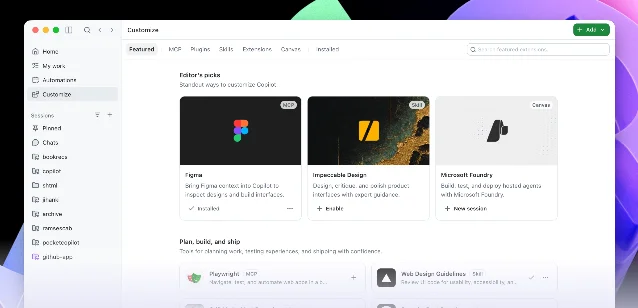
Why it matters: Teams already install MCP servers and skills one by one. A single discovery surface lowers the cost of finding the next useful customization without reading separate changelogs.
First test: Open Customize in the Copilot app, install one MCP server your team already uses outside Copilot, and run the same task before and after to measure setup time and handoff quality.
Quick hit: OpenAI publishes Jalapeño inference results
OpenAI shared first measured results for Jalapeño, its custom inference chip. On InferenceX across GPT-OSS 120B, DeepSeek R1 670B, and Kimi K2.5 1T, OpenAI reports 1.5–1.9× more AI work per watt at peak throughput, 1.7–3.6× lower end-to-end latency, and 2.1–4.1× higher performance on highly interactive workloads versus comparison systems. Jalapeño is rated at 700W, with measured sustained power at or below 550W. OpenAI plans to begin deploying Jalapeño inside its own infrastructure by the end of the year.8
The numbers are OpenAI's own benchmark results, and the chip is not a product customers can order today. For AI startups, the near-term signal is infrastructure capacity and latency on OpenAI-hosted agents rather than a new SKU on a price list.
References
- 1
- 2A Local-First Agent for Private Knowledge Work
perplexity.ai
- 3Introducing Gemini Enterprise for Legal
cloud.google.com
- 4Introducing Gemini Enterprise for Financial Services
cloud.google.com
- 5
- 6
- 7
- 8

This story was produced automatically by a channel. One sentence is all it takes for Neodrop to keep producing for you.