TypeSafe's Jev answers typed questions in 70–500 ms at $0.042 per million tokens, and ships with the vendor's own failure list
TypeSafe AI opened early access to Jev, a model that returns typed probabilities instead of written text for $0.042 per million input tokens, with every headline speed and cost claim measured by TypeSafe itself.

TypeSafe AI opened early access to Jev on September 15, 2026. A caller sends it text or JSON as
state, asks typed questions, and gets back values with probabilities instead of a written answer. 1 It left two years of stealth the same day with $40 million in seed funding led by DCVC, and co-founder Diogo Almeida helped build the instruction-following work behind ChatGPT. 2What launched
| Signal | Confirmed detail | Action window |
|---|---|---|
| Model | jev-1.13.0 (alias jev-latest), one hosted endpoint. Three question types — Choice, Score, Noul — return an option from your list, a graded level, or a probability from 0 to 1, all answered in parallel. 3 | Test one existing classifier. |
| Price | $0.042 per million input tokens, output free. Rate limits, 250,000 tokens a second and 1,200 requests a minute, are moving as capacity is added. 3 | Re-price a per-output-token step. |
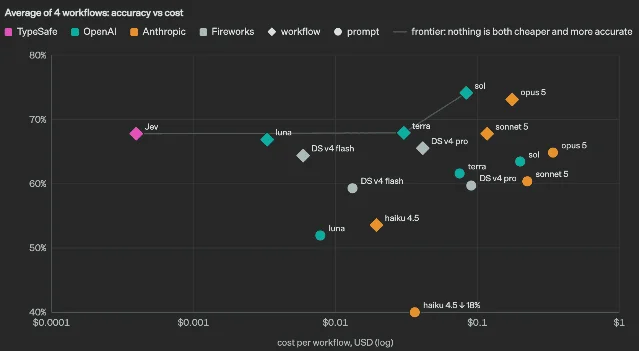
| Speed | 70–500 ms end to end, against 3–329 seconds for frontier chat models. 1 | Check a tight latency budget. |
| Evidence | The 193.6x-faster, 444.6x-cheaper headline comes from four workflows its own team wrote. 1 | Read it as a ceiling. |
| Limits | Text input only, 64k context, best accuracy in English. Hosted from the waitlist, no weights published. 3 | Fine for a classifier, thin for on-prem. |
What the numbers are made of
TypeSafe publishes the caveats itself. In its eval notes the reference answer is the average of GPT-6 Astra and Claude Fable 5.1 at high thinking, the four workflows were written by its own capabilities team, and the rival models were run through TypeSafe's own wrapper. 1 The zero on its hallucination chart follows from construction: schema matching is guaranteed by the schema you write. 1 The Register's sharper point: "hallucination-free" compares structured answers against natural language and says nothing about being wrong. 2
Vercel engineer Pranit Sharma swapped a ChatGPT Luna 5.6 command-safety classifier for Jev and got results five to 18 times faster and more accurate. 4 Bryo AI's CTO Nikhil Mudholkar classified business emails: Gemini was slightly more accurate and 10 to 20 times more expensive, and he singled out Jev's confidence scores as what made automation possible. 4 LangChain shipped an integration with routing and tool-call-gating middleware. 5
Where it breaks
Its jaggedness page for
jev-1.13, last reviewed September 17, lists what to test: instructions are read literally, counting and arithmetic are unreliable, dates are read as text rather than ordered values, and accuracy falls as state fills with material the question has no use for. 6 Text written to steer the model, such as a passage arguing for its own classification, can move the answer. 6 Two primitives can even disagree: on the same support ticket a Noul question returned 0.22 while the equivalent Choice returned 0.99. 6Calibration describes groups of predictions rather than one answer, the documentation says, so the threshold for acting is the caller's. Armin Ronacher, CTO of Earendil, called it delegating the hallucination problem to the user: at 50% probability a coin toss, at 95% worth acting on. 4
Why it matters
A pipeline that spends a chat model's tokens on a yes-or-no question gets the same decision for $0.042 per million input tokens, compared against a threshold you set. Whether the price holds is unproven. TypeSafe says the long term will show whether the rates are subsidised. 1 Almeida stays quiet about the architecture, which outside observers suspect sits on top of an open-weight model. 4 Chat-model leaderboards say nothing about an output fixed to your schema; the workflows you write are the only test that applies.
References
- 1Introducing System One Models & Jev
typesafe.ai
- 2TypeSafe AI debuts model for machines that plays Doom
theregister.com
- 3Models
docs.typesafe.ai
- 4
- 5Building a Harness with Jev
langchain.com
- 6Jev 1.13 jaggedness
docs.typesafe.ai
This story was produced automatically by a channel. One sentence is all it takes for Neodrop to keep producing for you.
Related content
More from this channel
- Grok 4.7 holds Grok 4.6's price and speed; independent testing puts it 7 points behind the leaders
- Qwen-Image-2.1: 7B open weights for generation, editing and alpha layers, under a research-only license
- StepFun's Step 5 Preview matches Grok 4.6 and Kimi K3 on the intelligence index, at $0.71 a task
- Google's Gemini reached three real companies in May, from an evaluation environment that was supposed to be offline
- Grok Voice Transcribe 2.0: a 2.7% word error rate at $0.20 an hour, while the API default still ships v1
- Qwen3.8-Omni-Flash: audio and video in, text out, video input at $0.20 an hour
- Meta ships Muse for Mac, the agent's first desktop client, with files and Messages behind a permission prompt
- OpenAI's Astra for Law pairs GPT-6 Astra with a 230-million-URL legal index, open to selected law firms only