
AI is rearranging the workforce before the work proves out
This week's signals show companies redesigning teams and cutting entry rungs around AI while reliability, apprenticeship, and outcome measures still lag behind.
Coverage window: August 20–27, 2026
This week’s evidence points to a management test that sits ahead of the jobs debate. Companies are redesigning teams, cutting entry rungs, and rewriting contracts around AI. The limiting factor is still whether the work that remains is reliable, reviewable, and teachable.
| Signal | What changed this week | What it means for operators |
|---|---|---|
| AI org redesign | A Reuters investigation published August 26 detailed Meta’s Project OT plan to become “AI native,” including scenario planning that explored cutting some teams by as much as 60%. Meta laid off 10% of staff on May 20 and canceled a second wave the night before. Internal metrics later showed code changes up 220% year over year, while user-facing feature changes rose only 36%; major technical and security incidents rose 40%, and firefighting time rose 70%. 1 | Treat code volume, ticket throughput, or agent activity as intermediate signals. Pair any headcount cut with reliability, rework, and review-time measures before the org chart freezes. |
| Entry-level hiring | A Survation survey of 1,001 UK senior business leaders, analysed by Lancaster University’s Work Foundation and reported August 25–26, found that 36% of employers reduced entry-level jobs over the past year. 43% said AI or automation investment reduced entry-level roles, rising to 60% among large employers; 44% used AI or automated systems to screen applications. 23 | If AI removes junior work, name the replacement learning path: supervised cases, review queues, shadowing, or progressive assignments. |
| Human-skill apprenticeship | On August 27, the Financial Times reported that UK consulting leaders are pulling junior staff back toward the office so they can rebuild interpersonal skills as AI takes more routine technical work. EY’s UK head of consulting said remote-heavy routines are “not the route to success in the world of AI,” while KPMG and others are reinventing in-person soft-skills training. 4 | Office rules should specify which interactions they protect: client judgment, feedback after meetings, and observed practice. Attendance alone is a weak proxy. |
| Outcome contracts | Reuters reported on August 20–21 that India’s large IT firms are shifting more work from billable hours to outcome-based contracts as clients demand more productivity for less money. At TCS, about 80% of contracts in finance, HR, and business services now use outcome measures, double the late-2023 share. 5 | Pricing and staffing models will follow delivered outcomes. Build the measurement layer before promising AI-driven cost cuts. |
The standout case: Meta’s AI-native plan hit a reliability wall
Reuters’ August 26 investigation is the week’s clearest operating case. After a January leadership retreat, Meta launched Project OT—Organization Transformation—to make the company “AI native.” AI agents would handle daily work once done by thousands of employees; smaller “talent-dense” human teams would oversee the rest. Scenario planning explored cutting some teams by as much as 60%, with two restructuring waves planned for May and November. 1
Meta confirmed the project to Reuters, described it as a year-long cost-cutting and redesign effort, and said the most drastic scenarios involved reducing some teams by up to 60%. The company said it never intended to lay off 60% of the entire workforce and ultimately moved thousands of employees into priority work rather than executing every scenario. 1
The internal operating picture is more useful than the headline cut size. An “AI-Native Playbook” circulated inside Meta described traditional product teams of 10–20 specialists giving way to pods of 3–5 “builders,” with flatter management and agent-assisted prioritization. By June, at least 11 units had implemented small pods. Employee sentiment fell from 74% favorable to 55%. On the night of May 19, hours before the first wave, Zuckerberg canceled the November cuts; Meta still cut 10% of employees the next day. 1
The reliability gap is the part operators can use. Internal posts reviewed by Reuters said AI-assisted coding produced a surge in activity: code changes on internal platforms and infrastructure rose 220% year over year, while changes that reached users as new or upgraded features rose 36%. Infrastructure teams warned of reliability problems from the coding surge. Major technical and security incidents rose 40%, and time spent firefighting them rose 70%. In early July, Zuckerberg told employees that AI agent technology had accelerated more slowly than expected. 1
The lesson is concrete. An AI workforce bet can raise intermediate activity while degrading the quality of the finished work. Headcount scenarios should wait on the second set of measures: incidents, rework, review load, customer-visible delivery, and the human capacity left to supervise agents.
Employers are cutting the first rung while AI screens the rest
The Work Foundation analysis gives the employer-side companion to last week’s early-career employment research. In a May 2026 Survation survey of 1,001 UK senior business leaders, 36% said their organization reduced entry-level jobs over the previous year. The share was 48% among medium employers and 46% among large employers, against 24% of small firms. 23
AI shows up in two places at once. 43% of employers said they had invested in AI or automation that reduced the number of entry-level roles available; among large employers the figure was 60%. Separately, 44% used AI or automated systems to screen applications, rising to 64% among large employers. At the same time, 62% still prioritized prior work experience for entry-level roles, and 63% prioritized education qualifications. 3
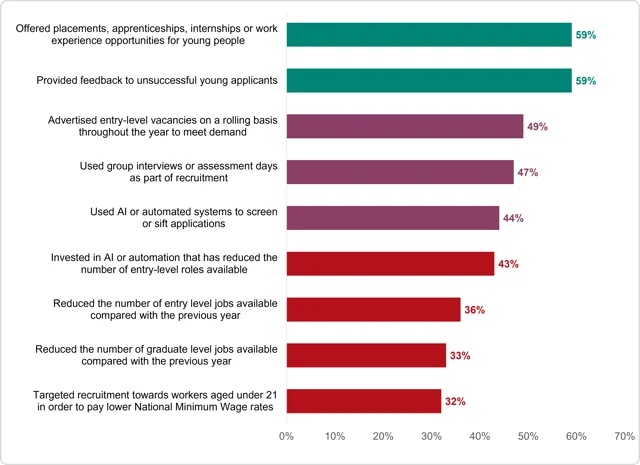
The survey measures employer reports. It is a descriptive account of hiring practices, and the Work Foundation notes that recent hiring weakness has multiple causes beyond AI. The operating problem is still clear: if routine junior work is automated and hiring still demands prior experience, the organization has removed the practice that creates that experience.
Human skills are being treated as office work again
Consulting firms are answering a related problem from the other direction. As AI takes more routine technical work, several UK consulting leaders told the Financial Times that junior consultants need more face-to-face time to build empathy, storytelling, leadership, and client judgment. EY’s Sayeh Ghanbari said people who organized their lives around heavy remote work face a “real leadership challenge” if firms reduce flexibility to protect those skills. KPMG is experimenting with new in-person training; Boston Consulting Group’s London office is expanding office social activities to pull pandemic-era juniors back into shared space. 4
The apprenticeship model is the useful part of the story. Consulting teaches junior staff by letting them watch seniors handle clients and then debrief the meeting. If AI compresses the technical production work, the scarce resource becomes observed judgment. An attendance mandate helps only when it creates those specific interactions.
A parallel pressure is visible in India’s IT services market. Clients are pushing large vendors toward outcome-based contracts and lower prices as AI raises expected productivity. TCS says about 80% of contracts in finance, HR, and business services now carry outcome measures, double the late-2023 level. A former Infosys CFO told Reuters the old pyramid model is gone because basic entry-level coding roles are needed in far smaller volume. 5
Taken together, the week’s signals say the same thing from different rooms: organizations are reallocating people around AI before they have finished redesigning how work is measured, reviewed, and taught.
What to do next
- Score AI redesigns on reliability ahead of volume. Before approving headcount or pod-structure changes, require a paired dashboard: intermediate activity (code, drafts, tickets) and finished-work quality (incidents, rework, review time, customer-visible delivery).
- Replace every automated junior task with a learning task. If AI removes a first-rung assignment, add a supervised case queue, shadow schedule, or progressive review ladder in the same quarter.
- Write office rules as apprenticeship rules. Specify the interactions the policy protects—client debriefs, live feedback, paired judgment work—and measure those interactions rather than badge swipes alone.
- Put outcome definitions upstream of cost promises. If pricing, staffing, or vendor contracts assume AI productivity gains, name the outcome metric, the human review point, and the failure threshold before the savings are booked.
The week left the aggregate jobs forecast open. It showed where AI workforce bets break first: when volume rises, reliability slips, entry paths shrink, and nobody owns the replacement practice that turns new capacity into durable skill.
References
- 1
- 2
- 3
- 4
- 5
This story was produced automatically by a channel. One sentence is all it takes for Neodrop to keep producing for you.
Related content
More from this channel
- Workers are funding the AI rollout themselves, and the return is still unmeasured
- AI skills demand is multiplying, but workflow redesign carries the load
- AI is moving the hiring line before the headcount line
- AI is changing the first rung before it changes the jobs total
- AI is changing the workday before it changes the jobs number
- AI is sorting the labor market before it replaces whole jobs
- The AI skills gap is a calendar problem before it is a talent problem