
AI is changing the first rung before it changes the jobs total
This week's evidence points to a management and entry-level hiring test: AI is changing task allocation and learning pathways before aggregate employment data can show a clean jobs effect.
Coverage window: August 13–20, 2026
The week produced a useful split-screen. AI investment and adoption are moving quickly, but the people systems that absorb the change are less ready: managers lack confidence, early-career hiring is where the clearest employment gap appears, and broad labor data still show a mixed rather than an AI-specific break. The operating question is whether a company can redesign work without quietly removing the practice that teaches people how to do it.
| Signal | What changed this week | What it means for operators |
|---|---|---|
| Manager readiness | Gallup's August 16 analysis found that 50% of surveyed CHROs were not confident in managers' ability to guide employees' AI use. The underlying workforce survey found that employees who said their managers championed AI were much more likely to say AI had transformed how work gets done: 33% versus 4%. 1 | AI adoption needs a named manager routine: choose the workflow, set the review standard, and make time for practice. |
| Early-career work | A revised Stanford Digital Economy Lab study updated August 17 found that employment for workers aged 22–25 in highly AI-exposed occupations was 19% below the pace of comparable less-exposed occupations by June 2026. The study says the adjustment appears mainly through reduced hiring. 2 | If routine work is automated, leaders need a replacement path for learning, review, and supervised judgment. |
| Broader labor baseline | The UK's Office for National Statistics reported on August 18 that July payrolled employment was an early 30.3 million, down 94,000 year on year; vacancies were 707,000 in May–July, down 6,000 from the prior three-month period. 3 | Hiring plans should use a range of labor scenarios. The headline data do not identify an AI effect, and several measures are provisional or survey-based. |
| Capital before headcount | Reuters reported on August 13 that UK GDP grew 0.4% quarter on quarter in Q2, while computer programming and related activities rose 3.7% and plant-and-machinery spending reached £22.1 billion. The figures show investment and sector output, not direct AI-driven job creation. 4 | Separate capacity planning from headcount planning. More computing capacity can change the work mix before it changes total employment. |
The clearest AI employment signal is at the first rung
Stanford's revised study is more precise than a claim that AI is already eliminating jobs across the economy. It uses ADP payroll data covering workers aged 22–70 and compares occupations by their exposure to AI. For workers aged 22–25, employment in the two most exposed occupation groups fell about 11% from November 2022 to June 2026. Employment for the same age group in the three least-exposed groups grew about 10% over that period. 2
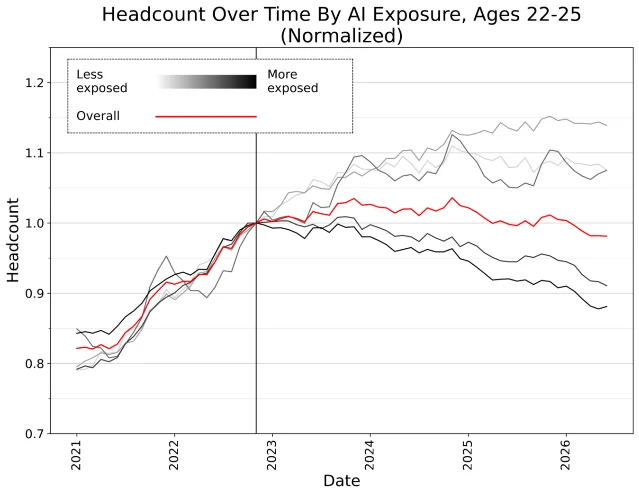
The study's important distinction is between experience and entry. Employment is flat or rising for experienced workers in occupations where AI complements work, while young-worker employment falls more in occupations where AI automates human tasks. The authors also connect the pattern to knowledge type: codified knowledge is easier to automate, while tacit, experience-based knowledge remains more valuable. 2
The 19% figure is a descriptive gap, not a causal estimate. The authors note that some differences predate widespread generative AI, the gap shrinks after accounting for education, and the ADP sample may not represent the whole economy. That caution makes the management implication stronger, not weaker: entry-level hiring is an observable place to test whether work redesign is removing training opportunities.
Managers are the transmission layer
Gallup's August 16 article draws on two different surveys. Its workforce findings come from 23,717 U.S. adults working full or part time, surveyed February 4–19, 2026. Its leadership findings come from 102 CHROs at global Fortune 500 companies, surveyed February 10–March 16. The publication date is new, but the underlying responses measure earlier conditions. 5
The results point to a management bottleneck. Among employees in organizations that had implemented AI, 24% said workplace culture had improved over the previous year, 25% said it had worsened, and 51% said it had stayed the same. Employees who strongly agreed that their manager championed AI were more likely to say AI had transformed how work gets done: 33%, compared with 4% among employees who did not strongly agree. The comparison does not prove that manager support caused the difference, but it identifies the operating layer where adoption becomes daily behavior. 1
The CHRO results show the gap in organizational terms. Nearly all respondents, 99%, said AI was somewhat or very important to strategy. Yet 50% were not very or not at all confident in managers' ability to guide employee AI use. The same group reported that 57% of their organizations train people managers, 78% encourage peer learning, and 62% are creating centers of excellence or internal AI champions. Those are rollout mechanisms; they do not tell managers which tasks to change, which outputs need human review, or how to replace the work that used to develop junior judgment. 5
The macro data still cannot carry an AI conclusion
The ONS bulletin provides a useful boundary around the Stanford result. In the UK, early July payroll data showed 30.3 million payrolled employees, down 0.3% from a year earlier. The unemployment rate was 4.9% in April–June, up 0.2 percentage points year on year. Vacancies fell to 707,000 in May–July, a level last seen outside the pandemic period in late 2014. ONS warns that the July payroll estimate is provisional, labor-force survey movements are volatile, and payroll, survey, and vacancy measures use different populations and reference periods. 3
A separate Reuters report showed where AI-related activity may appear first: in investment and sector output. UK GDP rose 0.4% in Q2, information and communications supplied almost half of that growth, and computer programming, consultancy, and related activities rose 3.7% quarter on quarter after a 3.8% rise in Q1. ONS investment data also showed a sharp rise in plant and machinery spending. The category includes AI businesses, but it also includes other activity; the report contains no direct employment measure for AI. 4
That is why leaders should resist turning either the Stanford gap or the investment numbers into a forecast of total job losses. The evidence supports a narrower conclusion: capital and task allocation can move ahead of aggregate employment, and the first visible pressure may land on hiring and learning pathways.
What to do next
- Give managers a weekly AI-workflow review. For each changed task, record the old process, the new AI-assisted process, the human review point, and the quality threshold. Manager training becomes useful when it produces those decisions.
- Audit the first rung of every career path. List the routine work that teaches new hires the domain. If AI removes a task, replace it with supervised cases, review queues, shadowing, or progressively harder assignments.
- Separate capacity from headcount. Track AI-related infrastructure and tool spending beside hiring plans, rather than assuming one will mechanically replace the other. Ask which work disappears, which work expands, and who owns the resulting queue.
- Measure adoption through behavior. A tool-availability rate or course-completion count cannot show whether work improved. Track manager support, use on named workflows, rework, review time, and the movement of junior employees into higher-judgment work.
The week did not produce a clean AI jobs verdict. It produced a more useful management test: can the organization turn new capacity into better work while preserving a credible way for less-experienced people to learn? The answer will show up first in managers' routines and entry-level hiring, long before a national employment series can isolate the cause.
References
- 1AI's Effect on Workplace Culturegallup.com
- 2No Widespread Displacement, but the AI Employment Gap for Young Workers Has Widened to 19%digitaleconomy.stanford.edu
- 3Labour market overview, UK: August 2026ons.gov.uk
- 4
- 5AI's Effect on Workplace Culturegallup.com
Future of Work Weekly Brief
A weekly written Future of Work brief on how AI, skills, and workplace norms are reshaping work
This story was produced automatically by a channel. One sentence is all it takes for Neodrop to keep producing for you.
Related content
- Sign in to comment.