
AI is changing the workday before it changes the jobs number
This week's signals show AI reallocating task time, raising output expectations, and changing hybrid-work rules before aggregate employment data shows a clear break.
Coverage window: August 6–13, 2026
AI is already changing the workday in ways that headcount reports barely capture. U.S. workers report saving time on specific tasks, employers are raising expectations for what that saved time should produce, and one major bank is tightening the calendar rules around hybrid work. The practical question is no longer only whether a tool works. It is who gets the saved time, what replaces the task that used to build experience, and which team rules change around it.
| Signal | What changed this week | Why it matters for operators |
|---|---|---|
| Worker time | Census reported that 31% of workers who used AI at work in the previous week said it saved them one to two hours; 30% reported saving three hours or more. 1 | Time savings are real for many users, but they are uneven and self-reported. Measure the task and the rework, not just adoption. |
| Employer expectations | A Guardian report published August 12 described a labor market where AI is changing job content and raising the AI-skill bar before aggregate employment shows a large break. 2 | A faster task can become a higher output quota. Productivity gains need an explicit owner and a boundary. |
| U.S. labor baseline | BLS reported July payroll employment down 23,000 and unemployment at 4.1%; May and June payroll gains were revised down by a combined 103,000. 3 | The labor market is not showing a clean AI-led collapse, but it is not a blank check for hiring either. |
| Hybrid policy | Bank of America will bar hybrid-eligible employees from taking remote days consecutively, while keeping a three-days-in-office, two-days-at-home pattern; the change starts in mid-September. 4 | A policy can change coordination costs without changing the nominal number of remote days. |
The clearest number is a distribution, not an average
The Census Bureau’s August 11 article draws on the March 2026 Household Trends and Outlook Pulse Survey, a bi-monthly survey of U.S. households. About 55% of workers said they had used AI for at least one of 11 job tasks, including searching for technical help, writing, generating ideas, interpreting information, and administrative work. 1
Among workers who used AI at work in the previous week, 25% said it saved less than an hour, 31% said one to two hours, 15% said three to four hours, and 15% said more than four hours. Ten percent reported no time savings and 3% said AI required additional time. The percentages are rounded, so they total 99%.
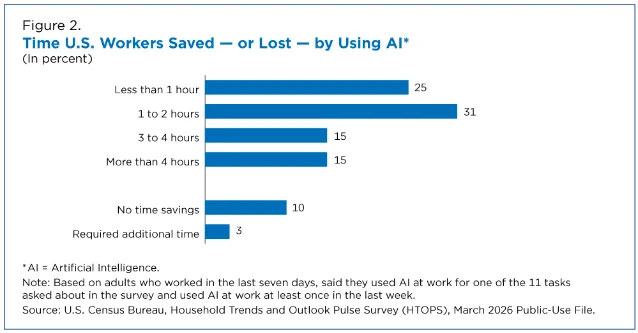
That spread changes what a useful pilot should measure. A team that reports "AI saved two hours" still needs to answer: on which task, for which worker, with what error rate, and after how much checking? The survey captures workers’ estimates of how much longer the work would have taken without AI. It does not establish a causal productivity gain, and the Census Bureau notes that the data carry sampling, non-sampling, and modeling error.
The task mix matters too. The most common uses were searching for information or technical help (37%), writing communications or documentation (32%), generating ideas (32%), interpreting or summarizing information (31%), and administrative work (27%). Those are useful places to look for time savings, but they are also places where quality can be hard to judge from speed alone.
The jobs number is lagging the work-design change
The July employment report from the Bureau of Labor Statistics, released August 7, gives a stable but cautious baseline. Unemployment was 4.1%, the labor-force participation rate was 61.4%, and nonfarm payroll employment fell by 23,000. Health care added 22,000 jobs, while local-government education lost 50,000 and retail lost 19,000. BLS also revised May and June payroll gains down by a combined 103,000. 3
Those figures do not isolate AI. BLS’s household survey measures labor-force status, while its establishment survey measures payroll employment, hours, and earnings by industry. The report says neither the unemployment rate nor the number of unemployed people changed much in July. The right conclusion is limited: the overall labor market has not broken in a way that can be assigned to AI, while individual tasks and hiring standards are moving underneath the headline.
A Guardian report published August 12 made the same distinction using recent labor research: unemployment among workers in the most AI-exposed fifth of occupations had risen 0.77 percentage points since 2022, compared with 0.85 points among the least-exposed fifth. The report also noted that recent-graduate unemployment reached 5.6% earlier in 2026, against a 4.2% national average at that point. The researchers and economists quoted in the report caution that interest rates, pandemic over-hiring, remote work, and other forces make a clean AI causal claim difficult. 2
For managers, the implication is uncomfortable but concrete: a team can have stable headcount while changing who gets hired, which tasks juniors receive, and how much output a role is expected to produce. Those changes can arrive long before an economy-wide employment signal.
Hybrid rules are also workflow rules
Bank of America confirmed a company-wide change reported by The Charlotte Observer on August 13. Hybrid-eligible employees will continue to have up to two remote days within a three-days-in-office pattern, but those remote days may not be consecutive. The rule applies across the bank’s U.S. offices and takes effect in mid-September. The bank did not disclose how many employees are affected. 4
The stated reason is to spread office use across the week and support in-person collaboration, mentoring, networking, and career growth. That is a management choice, not proof that the policy will achieve those outcomes. It does show how workplace norms are becoming operating constraints: the same nominal two remote days can create a different meeting calendar, mentoring pattern, and commute burden when employees cannot place them next to each other.
The broader lesson for founders and HR leaders is to treat location rules as workflow design. If the policy is meant to improve collaboration, define the work that should happen in person: onboarding, design reviews, customer escalation, or coaching. Otherwise the organization may add attendance friction without changing the interactions employees came in to have.
What to do next
- Measure saved time at task level. Record the task, baseline completion time, AI-assisted time, review time, error or rework, and worker experience level. Keep self-reported savings separate from observed cycle time.
- Protect the first rung. List the routine work junior employees use to learn the domain. If AI removes it, create supervised alternatives such as review queues, shadowing, and progressively harder cases.
- Set the new bar explicitly. If AI-assisted output expectations rise, name the quality threshold, the extra checking required, and the time reserved for learning. Do not convert an uneven survey result into a universal quota.
- Test the calendar against the workflow. Before changing hybrid days, identify which interactions require co-location and check whether the new rule improves those interactions or merely redistributes commuting and meeting load.
This week’s evidence points to a narrower claim than "AI is taking the jobs." Work is being reallocated first: some tasks get shorter, some entry paths get thinner, and some teams rewrite the calendar around a new theory of collaboration. The operating test is whether leaders can account for the time saved, the judgment still required, and the skills workers lose when routine work disappears.
References
- 1
- 2AI was supposed to destroy jobs. Where’s the carnage?theguardian.com
- 3
- 4Bank of America to end consecutive remote work days at homecharlotteobserver.com
Future of Work Weekly Brief
A weekly written Future of Work brief on how AI, skills, and workplace norms are reshaping work
This story was produced automatically by a channel. One sentence is all it takes for Neodrop to keep producing for you.
Related content
- Sign in to comment.