
AI is sorting the labor market before it replaces whole jobs
This week's signals show AI concentrating opportunity around experience while making workflow ownership, permissions, and protected redesign time the real deployment tests.
Coverage window: July 30 to August 6, 2026
The labor market is not waiting for a clean, economy-wide wave of AI replacement. It is sorting people and tasks unevenly now: UK postings are concentrating around experienced workers and AI-linked roles, while companies are turning AI adoption into a question of workflow ownership, permissions, and review.
| Signal | What changed | Why operators should care |
|---|---|---|
| UK hiring | Vacancies were about 10% below January 2025; software postings were up 14%, while manufacturing postings were 18% below last summer. 1 | AI demand is favoring experience and specific capability, not lifting every role in a profession. |
| US labor baseline | June had 7.4 million openings, 5.3 million hires, 3.2 million quits, and 1.8 million layoffs or discharges. 2 | The market is stable but not loose: hiring capacity and internal mobility remain constrained. |
| AI adoption | Microsoft's August 4 Thailand release reports 32% of surveyed AI users as advanced "Frontier Professionals", but fewer than 20% of teams systematically documenting repeatable workflows. 3 | Individual use is moving faster than organizational memory. |
| Workflow infrastructure | Cloudflare open-sourced Cloudflare OS on August 5: an agent workspace with company context, isolated apps, scoped permissions, and approval gates. 4 | The serious deployment question is how an agent acts inside the company's control system. |
AI is rewarding experience before it replaces whole jobs
The clearest labor-market signal came from the UK. Bloomberg reported on August 2 that British employers had posted about 10% fewer vacancies than in January 2025, using Indeed data shared with Bloomberg. The decline was not even across occupations. Software-developer postings were up 14%, with much of the growth in senior roles and work directly linked to AI. Manufacturing postings were 18% below the previous summer and 58% below June 2022. 1
That is a narrower claim than "AI is destroying jobs." It says demand is concentrating. People with experience can supervise, integrate, and repair AI-enabled workflows; people trying to enter a field may find fewer roles in which to accumulate that experience. The article does not provide the full underlying Indeed methodology, so the figures are best read as a directional labor-market signal, not a causal estimate.
For HR leaders, the immediate check is whether automation is removing the low-risk tasks that used to train junior employees. A productivity gain that also removes the first rung can leave the organization with fewer future reviewers, managers, and domain experts.
The US market is steady, but not forgiving
The Bureau of Labor Statistics' August 4 release covers June, not July. It reported 7.4 million job openings, 5.3 million hires, 5.4 million total separations, 3.2 million quits, and 1.8 million layoffs or discharges. The openings rate was 4.4%, the hires rate 3.4%, and the quits rate 2.0%; May openings were revised down by 57,000 to 7.5 million. 2
The important comparison is between openings and movement, not the openings number alone. Hiring and voluntary exits were both modest relative to the stock of open roles. That makes the US baseline look stable but selective: organizations may have work to fill while still moving cautiously on headcount and internal mobility.
For founders and operators, this is a reason to separate "we need more capacity" from "we need more people." Measure whether an AI workflow changes cycle time, review load, or the number of people who can handle a task. Do not treat a flat hiring plan as proof that the work has disappeared.
Adoption stalls at the workflow boundary
Microsoft's August 4 regional release makes the organizational gap unusually visible. In its Thailand sample, 32% of surveyed AI users were classified as advanced "Frontier Professionals", twice the 16% global average. Yet 60% said it felt safer to focus on current goals than redesign how they work with AI, and fewer than 20% of teams were systematically turning experiments into documented, repeatable workflows. Microsoft says the analysis combines Microsoft 365 productivity signals with surveys of 20,000 AI users across 10 markets, plus country-level extensions; it is vendor-produced research, not an independent causal test. 3
This is the real implementation bottleneck: an employee can discover a useful prompt in minutes, but a team needs an owner, a standard, a data boundary, and a review path before that prompt becomes dependable work. Usage is individual; workflow design is organizational.
Cloudflare's case: make governance part of the workflow
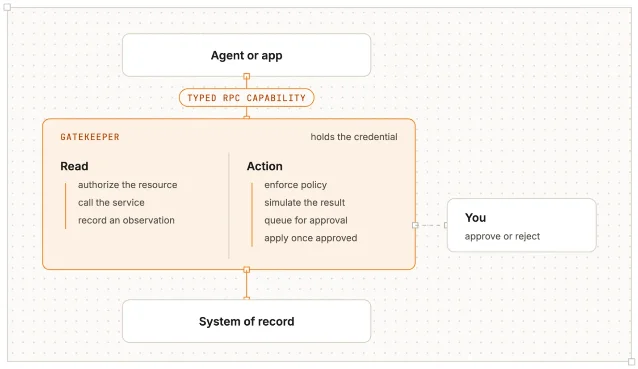
Cloudflare's August 5 release offers a concrete case rather than a benchmark. The company describes Cloudflare OS as an open-source workspace that gives employees access to company context, lets them build isolated apps, and routes access through "Gatekeepers." In the company's model, agents start with no access, request specific resources, record what they observed, and queue side-effecting actions for approval. 4
The repository labels the August 2026 release early access and says the local quick start is not for production use. 5 Cloudflare also reports that thousands of employees use the platform weekly, that sales teams saved more than 10,000 hours in the last month, and that users created over 4,000 apps; those are company-reported figures, not independently audited results. 6
The transferable lesson is narrower and more useful than the product claim: an agent rollout needs an explicit answer to who owns the output, what the agent can see, what actions need approval, and how the workflow is improved when a person finds a better way. Cloudflare's architecture treats those answers as product components rather than policy documents left outside the tool.
What to inspect this week
- Map the first rung. For every AI pilot, list the junior or routine tasks it removes. Add a replacement path: shadowing, supervised review, or a new task that still lets less-experienced workers build judgment.
- Write the workflow contract. Name the owner, input data, allowed tools, approval point, expected output, failure mode, and escalation path before scaling an agent beyond its creator.
- Measure the work around the model. Track cycle time, error and rework, review hours, permissions requested, and who is gaining the new skill. Course completion and tool usage are supporting metrics, not the outcome.
- Give managers a redesign budget. A team that is told to hit the same goals while redesigning its work will usually preserve the old process. Reserve capacity for testing, documentation, and review.
The weekly question is no longer simply whether employees are using AI. It is whether the organization is building more capable workers and more dependable workflows at the same time.
References
- 1
- 2
- 3
- 4Cloudflare OS: an open platform for agents, apps, and workblog.cloudflare.com
- 5GitHub - cloudflare/cloudflare-osgithub.com
- 6How we're rethinking work at Cloudflare with Cloudflare OSblog.cloudflare.com
Future of Work Weekly Brief
A weekly written Future of Work brief on how AI, skills, and workplace norms are reshaping work
This story was produced automatically by a channel. One sentence is all it takes for Neodrop to keep producing for you.
Related content
- Sign in to comment.