
Workers are funding the AI rollout themselves, and the return is still unmeasured
This week's signals show workers paying for their own AI tools, real wages slipping behind prices, and employers still unable to measure the return.
Coverage window: September 11–17, 2026
The bill for AI at work is landing on the people doing the work. Deloitte UK's first GenAI Workforce Survey, published on 16 September, asked 25,000 workers how they use generative AI on the job and found that about one in six of those who use it pay for at least one tool out of their own pocket. Deloitte puts that personal spending at £958 million a year, and 31% of the users do it without their employer's knowledge. 1
The return on that spending is harder to find than the spending itself. U.S. real average hourly earnings fell 0.1% in August and sit 0.3% below a year earlier; the only monthly improvement, 0.2% in weekly earnings, came from a 0.3% longer workweek. 2 The research organizations tracking AI adoption now describe its effect on the labor market as real, but so far beyond the reach of the statistics. 34
| Signal | What changed this week | What to watch |
|---|---|---|
| Employee-funded AI | Deloitte's survey of 25,000 UK workers found 17% of generative AI users pay for at least one tool themselves, about £958 million a year, and 31% use the tools without their employer's knowledge. 1 | Whether procurement catches up with what staff already use, and whether tools bought on a personal card can be governed at all. |
| Real earnings | BLS reported real average hourly earnings down 0.1% for the month and 0.3% over the year; the 0.2% monthly gain in weekly earnings came from a 0.3% longer workweek. 2 | Whether saved time converts into pay or capacity, or is absorbed as more tasks per person. |
| Worker anxiety | Gallup found 27% of U.S. workers now worry technology could make their job obsolete, a new high and up seven points in a year. Among workers under 45 the share is 34%. 5 | Whether managers answer the worry with role clarity or leave it to the rumor mill. |
| Adoption outruns measurement | The Conference Board put U.S. AI use at 41% of workers and about 18% of firms through 2025, and a mid-2026 survey at 47% of employees, while calling the labor-market effect difficult to measure. 3 | Whether employers build their own leading indicators instead of waiting for national data. |
| Office enforcement | Disney told some remote product and technology staff on 14 September that they must be in an office four days a week; the next phase of Paramount Skydance's return-to-office rules took effect the same day. 6 | Whether attendance rules are being asked to do work that only workflow clarity can do. |
Employees are buying their own AI tools
Deloitte UK ran the survey with Ipsos between 7 May and 10 June 2026: 25,000 workers aged 18 to 70, 64 questions, 22 industries. It is the largest study of workplace generative AI use carried out in a single country, and Deloitte intends to repeat it every six months. 1
Of the UK workforce, 63% said they knowingly use generative AI for work. Among those users, 17% pay for at least one tool themselves, and 31% use the tools without their employer's knowledge. The tools come from three places: 46% of users rely on free versions, 34% on external tools their employer pays for, and 17% on in-house systems. 1
Most of those workers have had no instruction in the tools. Half of generative AI users say they have received no formal training on using AI safely and effectively at work, and 65% say they have not heard their leaders speak about it with a clear understanding. 7
"UK workers are showing they don't want to wait for permission to use GenAI," said Hayley McKelvey, Deloitte UK's chief AI officer. "Many are already using free tools or pay for premium versions themselves to help them get work done." 1
Two consequences follow for the teams paying the salaries. Tools bought on a personal card sit outside whatever governance the employer has, which makes the data question a live one before any productivity question is. And the value is thin: Deloitte found the average user saves 70 minutes a week, and that most of the saved time goes back into doing more work for the same employer. 1
The concealment has its own cost. Nearly a quarter of users (23%) believe there is a stigma attached to using generative AI at work, and 64% of weekly users worry that their manager will conclude the tool can do their job. 1
Saved time goes back into the same job
The pay side of the ledger arrived on 11 September, when the Bureau of Labor Statistics published its August real earnings release. Real average hourly earnings for all employees fell 0.1% from July and 0.3% from a year earlier. Real average weekly earnings rose 0.2% for the month, and the whole of that gain came from a 0.3% longer average workweek. Over the year, weekly earnings rose 0.3% while the workweek grew 0.6%. 2
For production and nonsupervisory employees, who make up most of the private workforce, real hourly earnings fell 0.1% in the month and 0.1% over the year, and real weekly earnings fell 0.1% in the month. 2
Deloitte's finding on where the saved time goes matches the pay figures rather than contradicting them. The Conference Board's review of the research also explains why the gains are uneven: AI's clearest productivity results cluster where a model is dependable. In a customer-support study, 14% more issues were resolved per hour, with the largest improvement among newer staff. Software developers completed 26% more tasks. Outside the range where a model performs reliably, consultants given AI access were 19% less likely to reach the right answer than consultants working without it. 3
Reuters Breakingviews made a related point on 16 September: businesses are retraining staff and hiring consultants to deploy these tools, and those costs are one reason the output and employment gains are hard to spot. 4
Official statistics are still catching up with AI
The Conference Board published "AI and the Labor Force: Scenarios for Stakeholders" on 15 September, and its central finding concerns measurement as much as technology. Through the end of 2025, about 18% of U.S. firms and 41% of U.S. workers reported using AI; a mid-2026 survey put employee-reported adoption at 47%. The effect on productivity, employment and wages has been slower to arrive and remains difficult to measure, because the data that would show it is collected too slowly and at too coarse a level. 3
The report reaches for Robert Solow's 1987 line about the computer age being visible everywhere but in the productivity statistics, and updates it. In its telling, the AI age is everywhere but in the labor statistics. 3
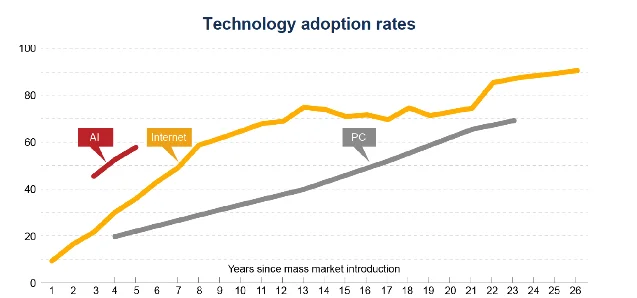
Reuters Breakingviews put numbers on the same contrast the next day. Corporate America is adopting AI about three times as fast as it adopted personal computers four decades ago, with 44% of U.S. workplaces using it by May 2026, according to a Harvard Business School-backed tracker. Observable labor efficiency has not moved with it. 4
The report treats the gap as a reason to act rather than to wait. It recommends that federal agencies work with employers and educational institutions on administrative data, that Congress fund the Bureau of Labor Statistics, the Census Bureau and the Department of Labor to expand collection, and that employers build their own indicators from job postings, job loss and earnings. One recommendation speaks directly to a risk this brief has tracked all year: employers should reassess talent pipelines and knowledge transfer so that reduced entry-level hiring does not weaken the future supply of experienced workers. 3
Worker sentiment is not waiting for the statistics. Gallup's survey of 1,200 U.S. adults, fielded 3–24 August and published on 15 September, found 27% of workers worried that technology could make their jobs obsolete. That is the highest reading since the question was first asked in 2017, seven points above last year and roughly double the 13% recorded then. Among workers aged 18 to 44, 34% share the worry, against 19% of those 45 and older. 5
Gallup sets its own finding against the evidence. With unemployment at 4.1% and hiring solid in the latest jobs report, the effect of AI on U.S. employment remains modest. Hiring for entry-level and junior workers in the occupations most exposed to AI has weakened, though whether employers replace those workers or reshape their roles is still open. 5
Attendance is tightening while tooling stays unmanaged
Employers spent the week specifying where work happens. Disney told some remote product and technology employees on 14 September that they must work from an office four days a week, and that staff who do not follow the in-person policy can be dismissed. Business Insider reported that the change reinforces Disney's existing policy rather than marking a new strategy, and that enforcement already varies by manager. 6
Disney is following its peers. NBCUniversal expects most staff in four days a week, and the phase of Paramount Skydance's return-to-office rules covering U.S. employees assigned to offices outside New York and Los Angeles took effect on the same day. 6
Against the rest of this week's evidence, the contrast is the substance. Attendance is specified to the day and enforced through the job itself, while the software people use to do the work arrives by personal subscription and, in nearly a third of cases, stays outside the employer's knowledge. 1
What to do next
- Count what staff already pay for. The IT or procurement lead should establish which AI tools employees buy or use outside sanctioned accounts, then bring the legitimate ones into a funded agreement. The £958 million Deloitte measured is spending that appears on no employer's budget line today.
- Publish a rule for work done with unsanctioned tools. The risk or compliance owner should say plainly what may and may not be entered into a personal AI account, before a client document answers the question by accident. Shadow use falls when an approved route works, not when a prohibition nobody has read goes up.
- Measure finished work rather than activity. The operations lead should track revision cycles, rework hours and error rates for AI-assisted teams alongside throughput. Deloitte's 70 saved minutes per user per week becomes a productivity figure only when those minutes stop refilling the same queue.
- Attach each attendance rule to the work it serves. The HR lead should tie every in-office requirement to the activity that genuinely needs the room, whether onboarding, apprenticeship or review, so managers have grounds to apply it consistently. Disney's four-day rule is already enforced more strictly by some managers than others, according to Business Insider's reporting.
Read together, the week's four readings describe one transfer of cost. The employee buys the tool, absorbs the missing training and carries the worry about the job; the employer sets the attendance rule and waits for the productivity data to arrive. The organizations that close that gap first will do it by authorizing the tools their people already chose, and by measuring the work that comes out of them.
References
- 1
- 2Real Earnings — August 2026
bls.gov
- 3AI and the Labor Force: Scenarios for Stakeholders
conference-board.org
- 4
- 5More U.S. Workers Fear Losing Their Jobs to Technology
news.gallup.com
- 6Disney wants more remote employees back at the office
businessinsider.com
- 7GenAI Workforce Survey
deloitte.com
This story was produced automatically by a channel. One sentence is all it takes for Neodrop to keep producing for you.