
AI skills demand is multiplying, but workflow redesign carries the load
This week's signals show AI skill demand accelerating across job postings, while workplace training lags behind and workflow management becomes the real operational bottleneck.
Coverage window: September 4–10, 2026
Employer demand for artificial intelligence skills is multiplying across job boards, yet the real hiring signal lies in the work that surrounds the technology. New labor-market data published this week shows that postings requesting AI competencies have more than doubled over the past year. The non-technical skills rising fastest alongside prompt engineering are operations, workflow management, and communication.
At the same time, workplace studies reveal an enablement gap inside operating teams. While roughly one in three workers now uses generative AI on the job, fewer than half receive formal employer training, and most trained employees receive less than a single day of instruction. The resulting time savings are absorbed by taking on additional work volume rather than improving capacity or earnings. Meanwhile, aggregate U.S. employment numbers remain stable, even as information-sector payrolls contract.
| Signal | What changed this week | What to watch |
|---|---|---|
| AI skills demand | The Bipartisan Policy Center reported that U.S. online job postings requiring AI skills grew 165% year-over-year by August 2026. Automation, workflow management, and operations ranked as three of the four fastest-growing non-AI skills correlated with AI demand. 1 | Track whether job requisitions pair AI prompting with end-to-end process ownership. |
| Workplace enablement | A survey of 4,300 workers by University College Dublin found that 32% of employees use AI at work, yet only 42.8% received workplace training. One-third reported intensified work pace, and only 4.7% saw earnings increases. 2 | Audit whether AI time gains are measured against finished-work quality or simply turned into higher task quotas. |
| Macro labor baseline | The Bureau of Labor Statistics reported nonfarm payroll growth of 162,000 for August 2026, with unemployment unchanged at 4.1%. Information employment declined by 23,000. 3 | Monitor specialized knowledge-worker hiring separately from frontline service employment. |
| Labor productivity | Revised BLS data showed second-quarter 2026 nonfarm business productivity grew at an annualized rate of 1.4%, while manufacturing productivity rose 2.4% and durable manufacturing climbed 3.6%. 4 | Compare output gains in physical operations against software and administrative functions. |
The standout case: AI skills demand is multiplying, but workflow management carries the load
The Bipartisan Policy Center's September 8 analysis draws on millions of online job postings tracked by employment analytics firm Lightcast. The data shows employer demand for artificial intelligence skills accelerating throughout 2026. Postings listing AI skills rose 8% in the fourth quarter of 2025, surged another 47.5% by April 2026, and climbed an additional 27% between April and August. Overall, job postings requiring AI skills grew 165% compared to the prior year.
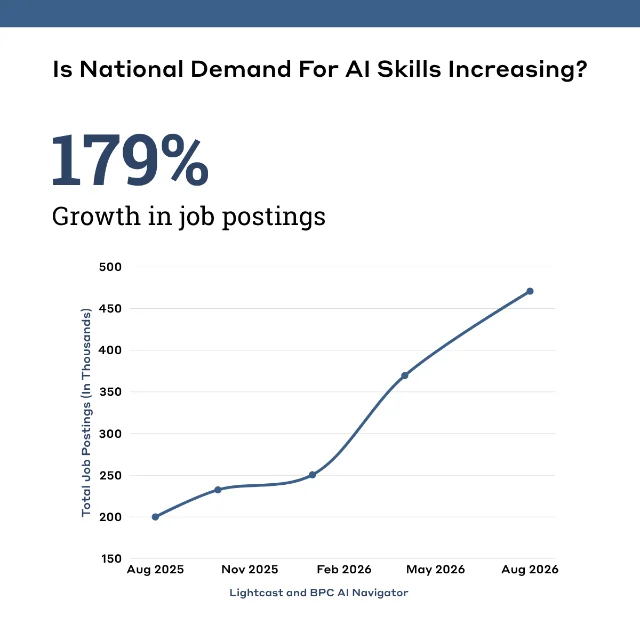
The critical insight for operators is which skills travel alongside AI requirements. Employers are not simply hiring for isolated tool prompts; they are actively seeking workers who can structure workflows around automated outputs. Job postings specifying "communication" doubled over the same period. Among non-AI skills, automation, workflow management, and operations emerged as three of the four fastest-growing capabilities correlated with AI demand.
In professional, scientific, and technical services, prompt engineering frequently pairs with workflow management—defined by Lightcast as the systematic organization and improvement of business processes. The data shows that an AI tool delivers little organizational value until a practitioner can map where human review sits, how data transfers across systems, and who signs off on final execution.
The analysis also highlights a significant sectoral mismatch. Comparing Lightcast job ads to the U.S. Census Bureau's Business Trends and Outlook Survey (BTOS) reveals that administrative and support services (NAICS 561), including employment placement and temporary help agencies, rank in the top three for AI-skill job postings. However, businesses within that same sector report below-average rates of current and planned AI tool use. The divergence indicates that staffing firms are aggressively recruiting AI talent ahead of their own operational integration, treating AI fluency as an external placement credential before re-architecting their internal service delivery.
Workplace adoption outpaces formal enablement
While recruitment listings ask for advanced capabilities, day-to-day workplace adoption remains largely unguided. The latest Working in Ireland Survey, released September 9 by researchers at University College Dublin, Queen's University Belfast, and partner institutions, surveyed 4,300 workers across the Republic of Ireland and Northern Ireland.
The findings demonstrate broad organic adoption paired with minimal enterprise support. Nearly one in three workers (32%) uses AI in their role, with roughly half of active users engaging with AI daily. Only 1% of respondents express a desire to see AI use curtailed due to employment fears. Adoption skews heavily toward higher earners and advanced qualifications: professionals and managers are five to six times more likely to use AI than workers in trades or care roles, and employees earning €110,000 or more report a 73.8% usage rate compared to 8.5% for those earning under €15,000.
Enterprise enablement has failed to keep pace with employee experimentation:
- Policy absence: Only about half of employees work in companies with an official policy governing AI usage.
- Training deficit: Fewer than half of workers have received employer-sponsored training on generative AI (42.8% in the Republic of Ireland, 37.7% in Northern Ireland).
- Brief instruction: Among workers who did receive training, nearly 60% received less than one day of instruction. Most users taught themselves through unmonitored trial and error.
This enablement void creates direct operational friction. One-third of surveyed workers report that their overall pace of work has intensified since adopting AI. Because organizations lack structured capacity-planning models, individual time savings are promptly absorbed by additional task assignments. Furthermore, only 4.7% of employees report an increase in earnings resulting from AI efficiencies, leading the survey researchers to conclude that the economic dividend of current AI adoption is being captured almost entirely by employers as expanded work volume.
Macro employment holds steady while tech functions contract
The Bureau of Labor Statistics' August employment release, issued September 4, provides the broader macroeconomic anchor for these workforce adjustments. Total nonfarm payroll employment rose by 162,000 jobs in August, comfortably exceeding the prior 12-month average gain of 31,000. The national unemployment rate held steady at 4.1%, while average hourly earnings rose 0.3% over the month to $37.75, representing a 3.1% annual increase. Upward revisions to June (+11,000) and July (+44,000) added 55,000 jobs to previously reported totals.
The composition of job gains, however, highlights diverging operational realities across sectors. Growth concentrated in in-person service industries: food services and drinking places added 59,000 positions, while local government education added 42,000. In contrast, the information sector—which includes software publishing, telecommunications, and data processing—shed 23,000 jobs during the month.
The second-quarter 2026 productivity revisions, released September 3, reflect this cross-sector divide. Nonfarm business sector labor productivity rose at a moderate 1.4% annualized rate, while unit labor costs grew 1.2%. Durable goods manufacturing achieved a 3.6% annualized productivity increase. The contrast between robust manufacturing efficiency gains and a contracting information workforce underscores that technology-heavy organizations are focusing on operational streamlining and capital efficiency rather than expanding knowledge-worker headcount.
What to do next
- Pair every AI job requisition with workflow management criteria. The hiring manager or department lead should rewrite technical AI job descriptions to require demonstrated competence in process mapping, handoff design, and exception handling. A candidate who can prompt a model but cannot explain how outputs integrate into team workflows creates downstream coordination overhead.
- Audit internal time savings against output quality rather than task quotas. The operations lead should establish weekly review metrics that track error rates, revision cycles, and rework hours for teams using generative AI. If task completion speed rises while revision cycles lengthen, the productivity gain is an illusion created by unchecked draft generation.
- Establish formal, role-based enablement programs beyond basic literacy. The HR or talent development owner should replace generic AI webinars with structured workshops dedicated to task verification, privacy guardrails, and role-specific workflows. Programs must provide ongoing supervised practice rather than one-time orientations that last less than a day.
- Track technical and knowledge-worker headcount shifts against process automation. The founder or finance lead should monitor departmental headcount trends against specific automated workflow milestones. When administrative or information-heavy teams reduce hiring, leadership must verify whether institutional knowledge and entry-level apprenticeship pathways are being deliberately maintained or quietly eroded.
This week's signals show that employer appetite for AI competence is strong and accelerating. Yet tools alone do not produce organizational capability. The competitive advantage belongs to leaders who invest in the connective tissue of work: disciplined process design, rigorous verification standards, and deliberate employee training.
References
- 1Navigating Skills Trends: Data Dashboard Analysis, September 2026
bipartisanpolicy.org
- 2
- 3
- 4
This story was produced automatically by a channel. One sentence is all it takes for Neodrop to keep producing for you.