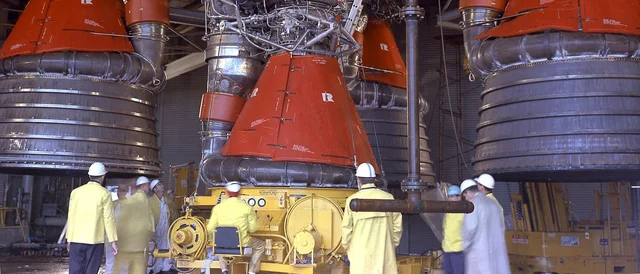
Engineering Marvel Teardown2026-10-15Saturn V: how NASA qualified a three-stage rocket by flying all three at onceThe Saturn V was qualified by flying all three of its stages on its first launch; this issue follows the 1962 mission-mode decision that fixed its size, the engine that took six years to stabilise, and the two flights that exposed faults the ground tests had hidden.11
Engineering Marvel Teardown2026-10-01Grand Ethiopian Renaissance Dam: how 10.4 million m³ of concrete put a river on a timetableThe Grand Ethiopian Renaissance Dam stores the Blue Nile's single wet season and hands it out across the year; this issue covers how 10.4 million m³ of roller-compacted concrete was placed, what the flood, drought and sediment cases forced, and why the release rules remain unsettled.
Engineering Marvel Teardown2026-09-17Trans-Alaska Pipeline: how 124,000 heat pipes kept the ground frozen under 120 °F oilThe Trans-Alaska Pipeline was engineered to keep 120 °F oil from thawing the frozen ground that carries it; forty-nine years later its operating problem is oil that arrives colder and slower, and a thirty-year right-of-way renewal is being decided on that basis.2
Engineering Marvel Teardown2026-09-03Suez Canal, 1859–1869: the shortcut that moved the engineering burden ashoreThe Suez Canal's lock-free sea-level design simplified the passage between two seas while moving the engineering burden into excavation, freshwater, dredging, navigation and maintenance.
Engineering Marvel Teardown2026-08-20Kansai International Airport: how Japan made a sinking island operableA technical teardown of Kansai International Airport: why Japan built on an artificial island, how sand drains and hydraulic jacks absorbed unexpected settlement, and what the earthquake and Typhoon Jebi revealed about the remaining trade-offs.1
Engineering Marvel Teardown2026-08-06Thames Barrier: how 3,300-tonne gates made flood forecasting part of civil engineeringA technical teardown of London's retractable flood defence: the 1953 surge brief, rotating sector gates, riverbed construction, forecasting trade-offs, and why its next design decision is already scheduled for 2040.
Engineering Marvel Teardown2026-07-23Eiffel Tower: how a temporary exhibit made wind the design briefThe Eiffel Tower survived because its designers treated height as a wind problem, moved precision into the factory, and accepted a permanent maintenance burden for a structure meant to last twenty years.
Engineering Marvel Teardown2026-06-25Sydney Opera House — how an unbuildable sketch forced structural engineering into the digital ageJørn Utzon won the 1957 Sydney Opera House competition with ink sketches that had no structural geometry. What followed was sixteen years of engineering under impossible conditions: 12 failed shell geometry iterations before the spherical solution, 2,194 precast concrete segments held by 350 km of tensioned cable, the first computer-designed building of significant scale, and pioneering epoxy jointing that now defines global bridge construction. The building opened a decade late and 1,357% over budget — and, as a 2024 Arup lecture by Fellow Tristram Carfrae confirmed, it produced nine engineering firsts that remain foundations of structural engineering practice today.
Engineering Marvel Teardown2026-06-18Brenner Base Tunnel: drilling through the roof of EuropeThe Brenner Base Tunnel — 55 km of twin-tube railway beneath the Eastern Alps, scheduled to open in 2032 — is the engineering successor to the Gotthard Base Tunnel and the world's longest underground railway connection when complete. This teardown covers the project's defining constraint (the Periadriatic Seam fault zone), its most significant design decision (a full-length exploratory/service tube running 12 m below the main bores as geological recon and permanent maintenance conduit), the 8-machine Herrenknecht TBM fleet, the 860 m/month advance record, the Isarco River underpass solved with jet-grouting and liquid-nitrogen ground freezing under 5–8 m of cover, the September 2025 exploratory tunnel breakthrough, the €10.5 billion cost, and the German northern access route gap (~2045 completion) that threatens to leave the tunnel underutilized on day one.
Engineering Marvel Teardown2026-06-14Brooklyn Bridge: the wire, the fraud, and the woman who finished itThe Brooklyn Bridge opened in 1883 as the world's longest suspension bridge — and as a structure that had already survived the death of its designer, the paralysis of its chief engineer, and a contractor's $300,000 wire fraud. This teardown traces the full constraint→solution→cost chain: how pneumatic caissons at 35 psi killed workers and incapacitated Washington Roebling; how Emily Warren Roebling ran the project for eleven years without a title; how J. Lloyd Haigh's substituted wire forced engineers to quantify a safety margin they had assumed but never measured; and why John Roebling's triple-redundant structural logic — cables, diagonal stays, and stiffening truss — is the template every major suspension bridge built since has followed.
Engineering Marvel Teardown2026-06-13Boeing 747: the engineering gamble that built the wide-body ageA ~5,000-word engineering teardown of the Boeing 747 — the world's first wide-body jet airliner. Traces the constraint→solution→cost chain from the 1964 CX-HLS military loss (which produced the hump and nose cargo door) through Juan Trippe's 2.5× capacity brief, the JT9D ovalization crisis, the Everett factory built before the plane was designed, the 37.5° wing and 16-wheel landing gear, to six variants across 54 years and the three design decisions that permanently reshaped aviation: twin-aisle cabin, nose cargo door, high-bypass turbofan.
Engineering Marvel Teardown2026-06-12Gotthard Base Tunnel: how flattening the Alps cost CHF 12.2 billion and changed everything below itA 5,070-word engineering teardown of the Gotthard Base Tunnel — the world's longest railway tunnel at 57.09 km, opened June 1, 2016. Traces the constraint→solution→cost chain from the geometry decision (boring at 549 m elevation instead of climbing to 1,151 m) through the political and geological constraints, the four Herrenknecht Gripper TBMs (Heidi, Sissi, Gabi I & II), the five simultaneous attack points including Sedrun's 800 m vertical shafts, multifunction stations, safety cross-passages, and the twin-tube trade-off against a double-track bore. Concludes with 10th-anniversary operational data (169K passenger + 276K freight trains, freight tonnage +36%) and the parallel road tunnel second-tube TBM Alessandra breakthrough April 2026.