
www.enr.com
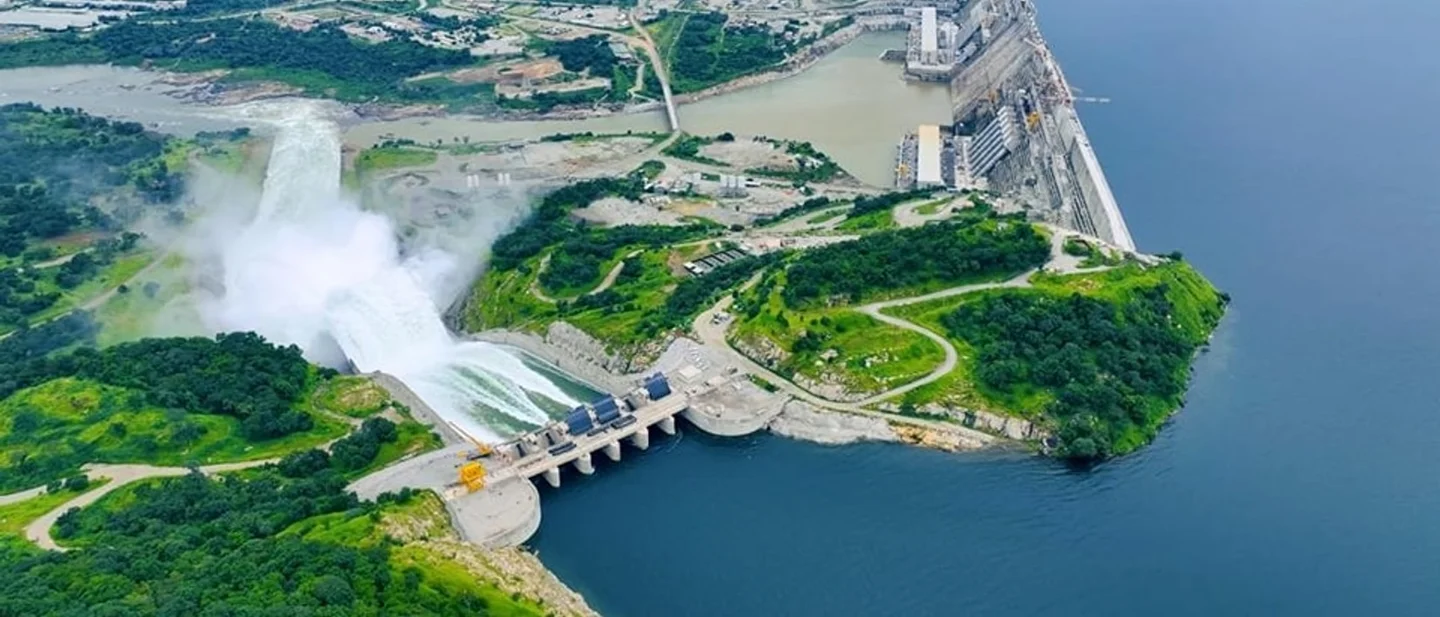
Grand Ethiopian Renaissance Dam: how 10.4 million m³ of concrete put a river on a timetable
The Grand Ethiopian Renaissance Dam stores the Blue Nile's single wet season and hands it out across the year; this issue covers how 10.4 million m³ of roller-compacted concrete was placed, what the flood, drought and sediment cases forced, and why the release rules remain unsettled.
On 21 September 2026, Egypt's minister of water resources and irrigation, Hani Sewilam, held a press briefing in Cairo and described the danger from the Grand Ethiopian Renaissance Dam in the language of timing. The dam is built and its reservoir is full. More than 98 percent of Egypt's renewable water arrives from outside its borders, Sewilam said, and its own renewable supply of about 56.8 billion cubic metres a year falls well short of estimated needs of 123 billion. Uncoordinated operation of the dam, he warned, could send sudden surges downstream that he called an "artificial flood", or cut releases into an "artificial drought", and either would disrupt the dams and canals that Egypt and Sudan run below it. 1
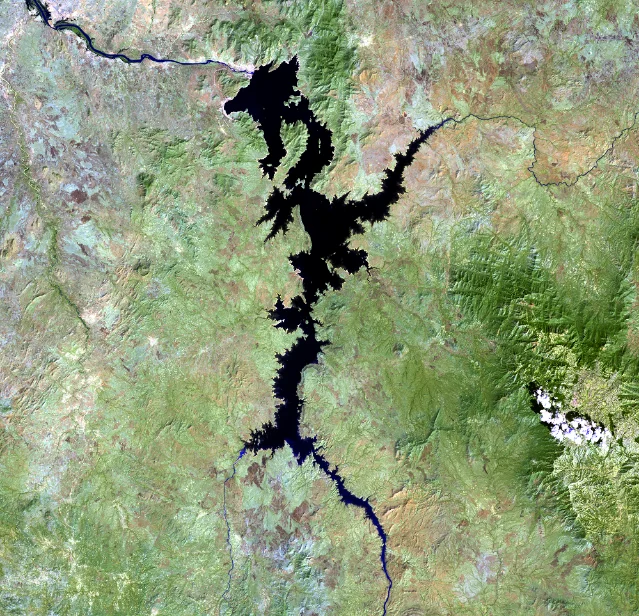
Hydropower takes water, drops it through a turbine and gives it back. What such a dam decides is when the water arrives. The Renaissance Dam sits on the Blue Nile, which delivers its flood between July and October and runs low for the rest of the year. The reservoir behind the dam holds 74 billion cubic metres at full supply, close to a year and a half of the river's average flow at the Sudanese border. Storing that much water converts a seasonal river into a regulated one, and regulation is what the argument downstream has been about since before the first concrete was placed. 23
This issue follows the dam from the constraint that fixed its form to the flood and sediment cases it has to survive, and it ends on the one part of the project its engineers could not design: an agreed rule for releasing water. Along the way it covers why the dam is made of roller-compacted concrete rather than the mass concrete of an earlier generation, how its reservoir became part of the construction schedule, and which parts of the design answer the flood, the drought and the sediment that the Blue Nile brings with it.
The dam at a glance
| What it is | The figure | What the figure forced |
|---|---|---|
| Purpose | Power for a country where fewer than a third of people had grid electricity in 2011, and exports to neighbours | A dam that stores the wet season and releases it across the year, which is where the dispute now sits 4 |
| Type and size | Roller-compacted concrete gravity dam, 145 m from the riverbed to the crest at 655 m above sea level, 1,780 m long | A gravity dam holds the water back with its own weight, so it needs sound rock rather than the arch's rock abutments; the designer gives the maximum structural height as 175 m, which counts the powerhouse section below river level 25 |
| Concrete | About 10.4 million m³ of roller-compacted concrete, by the utility's figures; the contractor's project page states 10.7 million | Placing that volume set the project schedule, and the annual placement record for the type 26 |
| Saddle dam | 4.9 km long, 50 m high, concrete-faced rockfill with about 16.5 million m³ of fill, roughly 3.5 km from the Sudan border | Closes the low ground beside the main dam and carries the emergency spillway 2 |
| Reservoir | 74 billion m³ total, 59.2 billion live and 14.8 billion dead; 1,874 km² at the full supply level of 640 m; 246 km long | Holds about a year and a half of the Blue Nile's average flow, 48.5 billion m³ a year at the El Diem gauge near the border 3 |
| Catchment | 172,250 km² of the Ethiopian highlands | The flow arrives in one wet season and carries the sediment of one of the most eroded basins in the world 23 |
| Flood case | Three spillways together sized for a probable maximum flood of 30,200 m³/s, routed at 18,000 m³/s; the gated spillway passes 14,700 m³/s through six gates | The gated spillway takes ordinary floods, the ungated one at full supply level takes the ten-year event, and the emergency spillway takes the thousand-year event 25 |
| Drought case | Two bottom outlets at 542 m, about 42 m above the riverbed | Water can be sent on to Sudan and Egypt while the reservoir sits below the level the turbines need 2 |
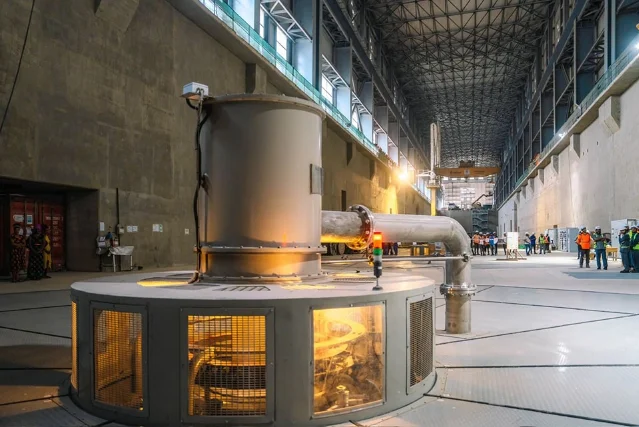
| Turbines | 13 Francis units, eleven at 400 MW and two at 375 MW, working on a head of 83 to 133 m | Installed capacity follows the dry-season flow, so the plant holds more generators than the river can keep busy 24 |
| Annual output | About 15,700 GWh in a typical hydrological year | Roughly a third of what 5,150 MW would produce running flat out 7 |
| Cost | A $4.8 billion contract in 2011, about $5 billion at completion; 91 percent financed at home through bonds and payroll contributions, with about $1 billion from China's Exim Bank for turbines and electrical works | The financing protected the schedule from lenders' conditions and tied it to the country's own cash flow 27 |
| Timeline | Foundation stone 2 April 2011; first power 20 February 2022; inaugurated 9 September 2025 | Fourteen years, against an early expectation that the first two turbines would run by 2015 2 |
| Operating rules | No binding agreement among Ethiopia, Sudan and Egypt on filling or operation | Releases are set by the operator alone, and the downstream states treat that as the risk 18 |
A river with a calendar and a country with almost no grid
The site was identified decades before anyone tried to build on it. Between 1956 and 1964 the United States Bureau of Reclamation surveyed the Blue Nile for Emperor Haile Selassie and recommended a cascade of dams for hydropower, including one at a location then called the border dam. The 1974 coup, the Ogaden war with Somalia in 1977–78 and a fifteen-year civil war kept the idea on paper until the early 2000s. Ethiopian survey teams returned to the gorge in 2009 and 2010, a design was submitted in November 2010, and on 31 March 2011 the government awarded a $4.8 billion contract without competitive bidding to Salini Impregilo, the Italian contractor now called Webuild. The foundation stone was laid on 2 April 2011. 24
Two facts about Ethiopia drove the design more than any geological survey. In 2011 fewer than a third of Ethiopians had access to electricity, and the country's hydro potential was estimated at about 45 GW. Both numbers describe a shortage of generation rather than of water. The Blue Nile leaves the Ethiopian highlands carrying the water that matters most to the countries downstream, and Ethiopia had never used it for power at any scale. 24
Published figures for the Blue Nile's share of the Nile differ by source, and each figure means what its own counting basis says. The ASCE account puts the Blue Nile's contribution at about 53 percent of the Nile's total flow. A Nile Basin atlas figure quoted by NASA puts it at 60 percent of the water flowing into the river. Egypt's 2026 briefing describes the Blue Nile as the source of about 85 percent of the water reaching Egypt. All three counts put the Blue Nile ahead of any other tributary, which is the point every one of them is used to make. 149
Why the dam is made of roller-compacted concrete
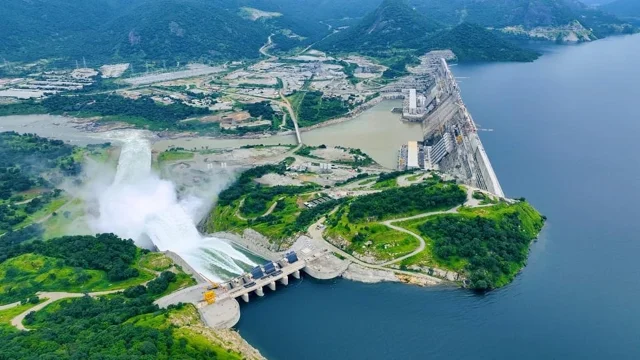
A concrete gravity dam works by being heavy. Each metre of its length has to weigh more than the water pushing against it, and the cheapest way to make a dam heavy is to pour a lot of concrete into a shape that is wide at the base. The material is ordinary; the difficulty sits in the placing. A mass-concrete dam of the older kind, poured in blocks with cooling pipes buried in the lift, spends years on the pour and years more waiting for the heat of hydration to leave. 2
Roller-compacted concrete removes most of that. The mix is stiff and lean, with less cement and more fly ash than structural concrete; it is spread in thin layers with the same dozers, dumpers and conveyors used to build an embankment, then compacted with vibratory rollers. Placing becomes an earthmoving operation, and an earthmoving operation can run at a rate that bucket-and-crane concrete cannot approach. On 27 and 28 December 2014, Webuild's crews placed 23,200 m³ of roller-compacted concrete in twenty-four hours, which the contractor put forward as a world record for the method. By the end of 2014, four years in, 2.25 million m³ of the dam's 10.2 million m³ had been placed. 511
The method's weaknesses follow from its speed. Thin lifts leave horizontal joint surfaces that water can follow, and a lean mix is less resistant to seepage than the rich concrete of an older dam. The Renaissance Dam manages that with drainage rather than with material alone. Four longitudinal galleries run up the upstream face at different elevations, with a bottom gallery at the downstream toe and cross galleries joining them; foundation drains and the galleries together collect the water that gets through and carry it away under control. Webuild developed mixes for the site's hot climate and embedded instruments through the dam body to read hydrostatic pressure, temperature, deformation and reservoir level. 48
The dam's dimensions changed as the design went along. The 2011 plan was for 15 generating units of 350 MW each, a 66 billion m³ reservoir and a 145 m dam. An independent panel of experts reviewed the project in 2013 and recommended changes for extreme floods: the crest went up by 10 m, the reservoir was enlarged to 74 billion m³, and the saddle dam gained 400 m of length, 5 m of height and 1.5 million m³ of fill. The generating equipment changed in the other direction. The design moved to 16 units of 375 MW, then to 14 units uprated to 400 MW for a nominal 6,450 MW, and finally, in October 2019, to 13 units totalling 5,150 MW. The plant the country inaugurated in 2025 is smaller than the plant it announced in 2011, and the reservoir is larger. 2
The reservoir was part of the construction sequence
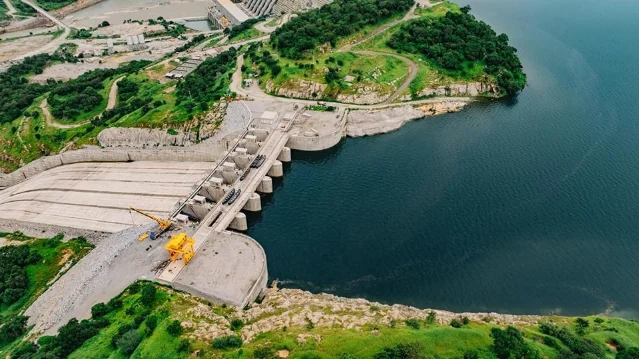
Most large dams are built first and filled afterwards. The Renaissance Dam was filled while it was being built, and the central section of the dam was the valve.
The two flanks of the dam, on the north-east and south-west sides of the river, were raised first to an elevation of 645 m, because they carry no steel. The central block, roughly 250 m of the dam's 1,780 m length, was left lower on purpose. With the central block low, water that arrived during the wet season could pass over it in a controlled way instead of overtopping an unfinished structure, and the operators could choose how much water to hold by raising the block in stages. The river had been diverted through four concrete culverts in 2016, and those culverts were plugged once the flows could be handled through the outlets. 45
Five fillings followed, one a year. The reservoir reached about 540 m in 2020 with a little under 4.9 billion m³ stored; 575 m in July 2021 with about 10 billion; 600 m in August 2022 with about 25 billion; 625 m in September 2023 with about 42 billion; and 640 m, the full supply level, in October 2024, when the 74 billion m³ reservoir was complete. The design also made generation possible early. Two of the sixteen penstocks embedded in the dam body sit at 540 m, below the intake level of the other eleven units, and they fed the first two turbines at a reservoir level of 560 m, about 30 m below the level at which the rest of the plant can run. The first unit delivered 375 MW to the grid on 20 February 2022. 245
The sequence went smoothly because the river cooperated. The fillings from 2020 to 2023 took place in wet and above-average years, so the water held back in Ethiopia came out of a surplus, and the ASCE authors note that reductions in flow downstream across those years were effectively absent. A five-stage fill planned with the same volumes would have looked very different had it coincided with a drought, which is the scenario the modelling literature has concentrated on. 49
Three spillways and one outlet below the power window
Flood provision on a river with a single violent wet season is sized by the worst storm the hydrologists can justify, and on the Blue Nile that is a probable maximum flood of 30,200 m³/s, routed through the reservoir to 18,000 m³/s at the dam. Three separate structures pass that water. 25
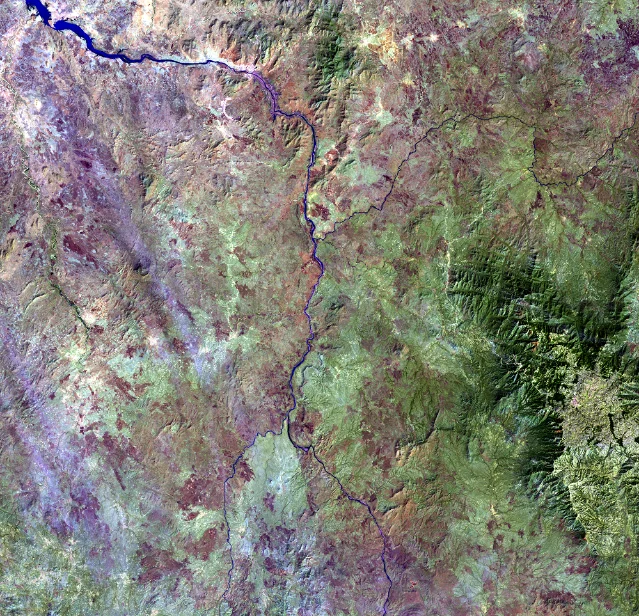
The main gated spillway sits to the left of the dam, 84 m wide at its outflow gates with a sill at 624.9 m above sea level, well below the full supply level. Six gates control 14,700 m³/s. An ungated auxiliary spillway occupies about 225 m in the centre of the main dam, with its base exactly at the full supply level of 640 m, so it begins to pass water only when the reservoir is full and the inflow exceeds what the gates can take; the dam crest is 15 m higher on either side of the opening. The third spillway lies at the right abutment of the saddle dam, with its base at 642 m and about 1,200 m of rim, and it discharges only above 18,000 m³/s, which the design treats as a one-in-a-thousand-year flow. Energy is dissipated by a stepped chute on the downstream face of the gated spillway and a stilling basin at the bottom. 24
The drought case is quieter and harder to design for. Turbines need head, and the Renaissance Dam's units work between reservoir levels of 590 m and 640 m, so a reservoir that draws down below the minimum operating level takes the plant out of service. Two bottom outlets at 542 m, about 42 m above the local riverbed, exist for exactly that condition: they can pass water on to Sudan and Egypt when the reservoir has fallen below what the powerhouses can use. The IHA's case study puts the reservoir's dead storage, the water below the minimum operating level of 590 m, at 14.8 billion m³, with 59.2 billion m³ live above it. A dry year is met from the live storage first, and the bottom outlets at 542 m are what remains once the reservoir falls below that level. 23
The plant itself is smaller than the river's flood and larger than its dry season. Thirteen Francis turbines, eleven rated at 400 MW and two at 375 MW, give 5,150 MW under a head that varies between about 83 m and 133 m as the reservoir moves through its operating range. The average annual flow available for generation at the dam is about 1,547 m³/s, and against that flow the plant is expected to produce around 15,700 GWh a year, a little over a third of what 5,150 MW would generate running flat out. The surplus capacity is deliberate: it lets the plant follow demand in the hours it can, and it is part of what Ethiopia intends to sell across its borders. Four 500 kV lines to Holeta, completed in August 2017, carry the output to the Addis Ababa area, and two 400 kV lines run to the Beles hydro plant. 27
What the water leaves behind
A reservoir with a large capacity relative to its inflow has one dominant long-term problem, and it is not the water. The Ethiopian highlands are among the most eroded landscapes on earth, and the Blue Nile carries that soil north. Sediment measurements at the El Diem gauge near the border showed a 61 percent rise in load between the 1980–1992 and 1993–2009 periods, from 91 to 147 million tonnes a year, and a sediment yield of about 835 tonnes per square kilometre per year across the tributary basin. 3
Against that load, the dam's 14.8 billion m³ of dead storage is the buffer that keeps the turbines clear of silt. At the recent measured yield and an assumed density of one tonne per cubic metre, the dead storage holds roughly a hundred years of sediment, which is the conventional criterion for a dam of this size. A modelling study by the Water and Land Resource Centre, unpublished and reported in the IHA case study, put the sediment entering the reservoir at about 287 million m³ a year, which against the same 14.8 billion m³ works out to a little over fifty years. The two numbers differ by a factor of two, and which one is right decides whether the reservoir is a century asset or a half-century one. 3
The structural options for dealing with sediment are limited on a reservoir this size. Flushing needs a drawdown that would cost the plant most of its annual output; dredging at this scale has never been done economically. The remaining in-reservoir method is the release of turbid density currents, the sediment-laden layer that slides along the reservoir bed during the flood, which requires deep low-level outlets positioned to catch it. The bottom outlets at 542 m were designed with downstream releases in mind. Whether they also work as a sediment pass-through has not been established publicly. The durable fix in the IHA's account sits upstream in the watershed: the Debre Yakob demonstration catchment of about 325 hectares in the Lake Tana sub-basin, where the intervention was not engineering but land use, replacing free grazing with enclosures and cut-and-carry fodder so that vegetation could hold the soil on the hillside before the rain moved it. 3
Seismicity is the subject on which the public accounts diverge. The ASCE authors, both water-resources engineers of Ethiopian origin, describe the dam site as far from any major seismic zone, while noting that the design still had to account for possible earthquakes and that the foundation conditions required extensive excavation and treatment. A February 2026 report on the project's regional politics describes the dam as sitting in the heart of the Rift Valley, an earthquake-prone zone, and cites a modelling study of a catastrophic failure that begins from that premise. EnginSoft has published a case study evaluating the main dam's seismic performance under seismic loads with a demand-capacity ratio procedure, which treats the earthquake case as a design load to be checked. The two accounts place the dam in different geologies. 41516
The failure study reports the consequences of a breach whose probability it leaves out. Researchers from universities in Egypt, Slovakia and Poland modelled a sudden breach of the dam and published the results in the journal Water in 2023. In their scenario, Khartoum becomes a lake within about ten days, flood depths exceed 11 m in some residential areas, the wave overtops the Roseires, Sennar and Merowe dams in Sudan by 11, 7 and 20 m, and Lake Nasser rises to 188 m above sea level, which the authors describe as a danger to the Aswan High Dam. The study's recommendation is an emergency plan and mitigation strategy for a failure that has not occurred; the likelihood of a breach sits outside its scope. 15
The trade-off nobody signed
The 1959 agreement between Egypt and Sudan divided the Nile's measured flow at Aswan, about 84 billion m³ a year, giving Egypt 55.5 billion and Sudan 18.5 billion. Ethiopia, which had been excluded from the talks that produced it, was left out of the division. The agreement has governed downstream abstraction for six decades, and it assumes that both of its signatories stand downstream of everything that matters. A dam built upstream of the two of them fell outside its terms, and the Renaissance Dam arrived in that gap. Egypt's position since 2011 has been that a binding agreement on filling and operation must come before the water is held back. Ethiopia's position is that a hydropower dam inside its own territory is a sovereign project, that the electricity it makes is available to its neighbours, and that nothing in the colonial-era agreements binds it. 12
There have been documents. In March 2015 the three countries signed a Declaration of Principles in Khartoum that committed them to negotiate the dam's operation. Talks continued with the United States Treasury facilitating in 2019 and 2020, then moved to the African Union, and in July 2021 the Security Council issued a statement backing the AU's mediation. A wider basin agreement, the Cooperative Framework Agreement, entered into force in October 2024 and establishes a permanent Nile Basin Commission; Egypt and Sudan are not parties to it. In January 2026 the United States offered to restart mediation. None of it produced a set of release rules that all three governments accept. 2415
Loading link preview…
Without agreed rules, the operator sets the release schedule alone. A release timed to the turbines' needs arrives in Sudan and Egypt as a change in river level that their own operators did not schedule; a hold-back during the wet season shows up as a lower gauge reading that nobody upstream has to explain. Sewilam's "artificial flood" and "artificial drought" are names for that asymmetry, and the technical remedies he proposes are the same ones the negotiations have been circling: rules for filling, rules for dry years, and a mechanism for sharing data before decisions are taken. 1
The dispute has widened in 2026. In August, Ethiopia's water and energy minister said publicly that his country intended to control the flow of the Nile to Egypt and Sudan, and Cairo responded with a statement that it would not tolerate the three further dams Ethiopia plans on the Blue Nile, each with storage of 30 to 40 billion m³ by Egyptian estimates. Egypt's own water strategy, presented in September, leans on reuse, drainage treatment, desalination and food imports: about 23.2 billion m³ of water reused a year and nearly 4.8 billion m³ of added annual capacity from treating agricultural drainage. Those projects change Egypt's water balance. The release schedule at the dam stays in Ethiopian hands. 117
What the case transfers
A faster construction method buys a shorter critical path, and the critical path may sit somewhere else. Roller-compacted concrete let crews place 23,200 m³ in a day and turned a ten-year concrete operation into a manageable one, yet the project still took fourteen years. The time went into design changes, the decision to enlarge the reservoir after the 2013 review, the replacement of a supplier after the 2018 change of government, and financing that depended on domestic bond sales and payroll contributions. RCC solved the placing problem and left the schedule problem untouched. 24
Staging the impoundment is a design decision with negotiating value. Leaving the central block low let the operator choose how much water to hold in each wet season, which made filling a sequence of annual decisions rather than a single event, and it let the first two turbines run at a reservoir level 30 m below the operating floor of the rest of the plant. The downstream states read those annual decisions as unilateral steps, because they were. A dam whose filling can be negotiated has more diplomatic uses than one that fills in a single season, and the same flexibility that let the operator start selling power early let it decline to sign anything first. 24
Sediment is a basin problem that a dam can only postpone. Ethiopia's dead storage was sized on a hundred-year criterion using measured loads at the border, and a more detailed model of the same watershed halved that estimate. The only durable answer in the IHA's account is upstream land management, which means the reservoir's operating life depends on how thousands of farmers across a 172,250 km² catchment treat their hillsides. Projects with long design lives are increasingly being judged on arrangements like this, where the engineering is sound and the maintenance regime is someone else's to run. 3
Sixteen years after the site was resurveyed, the Renaissance Dam generates electricity, spills floods, stores sediment and releases water to the downstream states through two outlets dropped below the power intakes for the purpose. Every physical problem on that list has an owner and an operating procedure. The release schedule, which the downstream states care about most, is the one item on the list with an owner and no procedure. A dam can be designed against a probable maximum flood of 30,200 m³/s and still have no answer for a question that only three governments can settle. 48
References
- 1The National, "Egypt sets out new case against Ethiopia in Nile dam dispute"
thenationalnews.com
- 2Wikipedia, "Grand Ethiopian Renaissance Dam"
en.wikipedia.org
- 3
- 4
- 5Studio Pietrangeli, "Grand Ethiopian Renaissance Dam"
pietrangeli.com
- 6Webuild, "Grand Ethiopian Renaissance Dam Project"
webuildgroup.com
- 7
- 8
- 9
- 10Wikimedia Commons, "GERD 3.jpg"
commons.wikimedia.org
- 11
- 12Wikimedia Commons, "GERD Dam.jpg"
commons.wikimedia.org
- 13
- 14Wikimedia Commons, "GERD Dam turbines 1.jpg"
commons.wikimedia.org
- 15
- 16
- 17
This story was produced automatically by a channel. One sentence is all it takes for Neodrop to keep producing for you.