
arstechnica.com
Saturn V: how NASA qualified a three-stage rocket by flying all three at once
The Saturn V was qualified by flying all three of its stages on its first launch; this issue follows the 1962 mission-mode decision that fixed its size, the engine that took six years to stabilise, and the two flights that exposed faults the ground tests had hidden.
On 1 April 2026, a Space Launch System rocket lifted off from Pad 39B at the Kennedy Space Center with four people aboard, flew them around the far side of the Moon and brought them home nine days later. It was the first crewed flight beyond low Earth orbit since Apollo 17 in December 1972, and the crew passed Apollo 13's record for the greatest distance a human has travelled from Earth. 1
The 2026 vehicle produced 39 meganewtons at liftoff and sent a little over 27 tonnes toward the Moon. The Saturn V produced 34.5 meganewtons and sent 43.5 tonnes the same way, and it did so 57 years earlier. 23
That comparison leads into the question this issue works through. Three decisions, all of them taken before the vehicle was drawn, fixed what it would be: the mission mode chosen in 1962, the first-stage engine that took six years to stop destroying itself on the test stand, and a flight-test policy that put a complete three-stage rocket on the pad for its first launch. The size then forced the details: a ring of electronics that steered the stack, three stages that had to travel by water, and a launch complex built around the vehicle. Two of its thirteen flights then produced problems that no ground test had been able to show, and the fixes for those problems are what made the ten crewed flights possible.
The rocket at a glance
| What it is | The figure | What the figure forced |
|---|---|---|
| Mission mode | Lunar orbit rendezvous, announced by NASA on 7 November 1962 | The landing craft flew separately and rejoined a mother ship in lunar orbit, which removed the need for a direct-ascent vehicle several times larger. 3 |
| Vehicle | 111 m tall, 10 m in diameter, about 2,970 t at liftoff | Payload was a small fraction of the launch mass; the S-IC stage alone was about 94 percent propellant. 3 |
| First stage | Five F-1 engines, 33,000 kN (7.5 million lbf) at sea level, about 150 seconds of burn | The five engines together produced roughly 1.2 times the loaded vehicle's weight, so the stack was held down by four points on its thrust structure until all five reached thrust. 3 |
| Second stage | Five J-2 engines burning liquid hydrogen, 4,400 kN in vacuum | Hydrogen's low density made the tank large and its insulation the difficult part; more than 90 percent of the loaded stage was propellant. 34 |
| Third stage | One restartable J-2, two burns of 165 and 312 seconds | The restart converted a parking orbit into a lunar trajectory, and it was the step that failed on Apollo 6. 35 |
| Payload | 140,000 kg to low Earth orbit, 43,500 kg toward the Moon | The low-orbit figure is still the largest of any rocket, and about 60 percent more than the 2026 vehicle sends toward the Moon. 23 |
| Assembly | Stacked in a building 160 m tall and 3,665,000 m³ in volume, then driven 5.535 km to the pad | Every stage had to reach Florida by water or by air, because the stages were too massive to move any other way. 36 |
| Flight testing | Two uncrewed flights, 9 November 1967 and 4 April 1968 | The first flew a complete vehicle and spacecraft; the second exposed two faults that ground testing had concealed. 57 |
| Flights | 13 launches, 12 successes, one partial failure | Nine of them carried crews toward the Moon between December 1968 and December 1972. 3 |
| Cost | $6.417 billion appropriated for development and flights from 1964 to 1973; $185 million per mission in 1969–71 | About $995 million per launch in 2024 dollars, spent against a deadline rather than a requirement. 3 |
The size was fixed before the design
In 1961 the Saturn programme was a family of rockets on drawing boards, and the lunar mission had no agreed shape. Three options were in play. Direct ascent would send one large spacecraft to land on the Moon and return, and it needed a rocket called Nova that nobody had designed. Earth orbit rendezvous would launch the parts on two smaller rockets and assemble them in orbit. Lunar orbit rendezvous would launch a mother ship and a small landing craft on a single rocket, and the crew would transfer in lunar orbit. 3
Langley Research Center's John Houbolt argued for the third option from 1960, on the grounds that it was the cheapest way to reach the surface within the decade. The Air Force's own lunar study put direct ascent at $7.5 billion by 1967, and NASA's early position was that both rendezvous methods were dangerous and impractical. Von Braun's team came round in June 1962, and the agency announced lunar orbit rendezvous as the Apollo mission mode on 7 November 1962. 3
The engineering consequence arrived before the announcement. Marshall Space Flight Center had approved the Saturn C-5 on 25 January 1962, a three-stage vehicle with five F-1 engines, five J-2 engines and a single J-2 on the third stage. The vehicle NASA ended up building was the one that a lunar-orbit mission required, and its payload was sized to the two spacecraft that mode needed rather than to a landing-and-return stack. 3
The engine came first
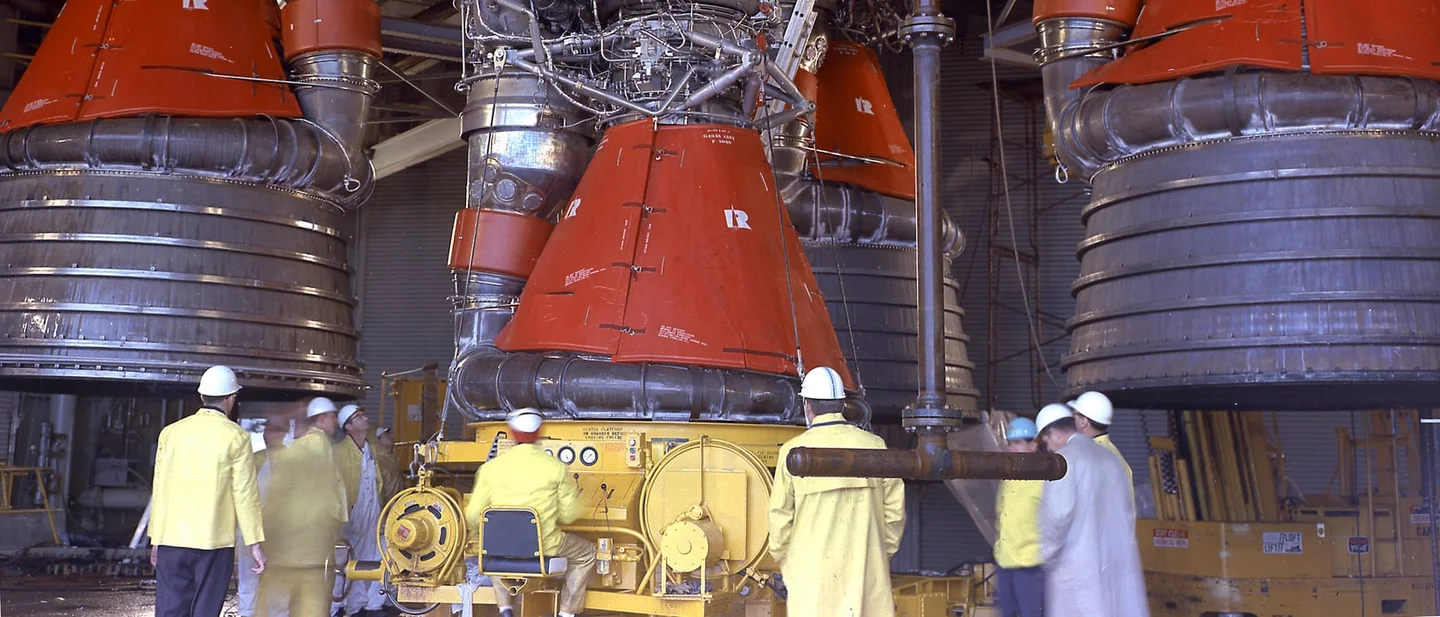
The F-1 began as an Air Force project. Rocketdyne developed it and the smaller E-1 against a 1955 requirement for a very large engine, and the Air Force dropped the F-1 after finding no mission that needed one. NASA took the design over and contracted Rocketdyne to finish it, and a full-stage developmental F-1 first fired on a test stand in March 1959. 8
The problem that consumed the next two years was combustion instability. A chamber of that size could settle into oscillations around 4 kHz, with harmonics reaching 24 kHz, and the excursions were violent enough to destroy engines on the stand. The instability was intermittent, which made it hard to study. Rocketdyne's engineers solved the measurement problem by detonating small charges — they called them bombs — on a tangential tube outside a firing chamber, so they could watch how a running engine answered a known pressure pulse. 8
With a repeatable test, the injector could be redesigned against a number instead of a suspicion. Between 1959 and 1961 Rocketdyne worked through coaxial injector layouts and added baffles to the injector face, and the final engine damped an induced instability within a tenth of a second. Each F-1 then delivered 6,770 kN at sea level, burned about 2,578 kg of propellant a second, and drove its turbopump at 5,500 rpm and 55,000 brake horsepower. 8
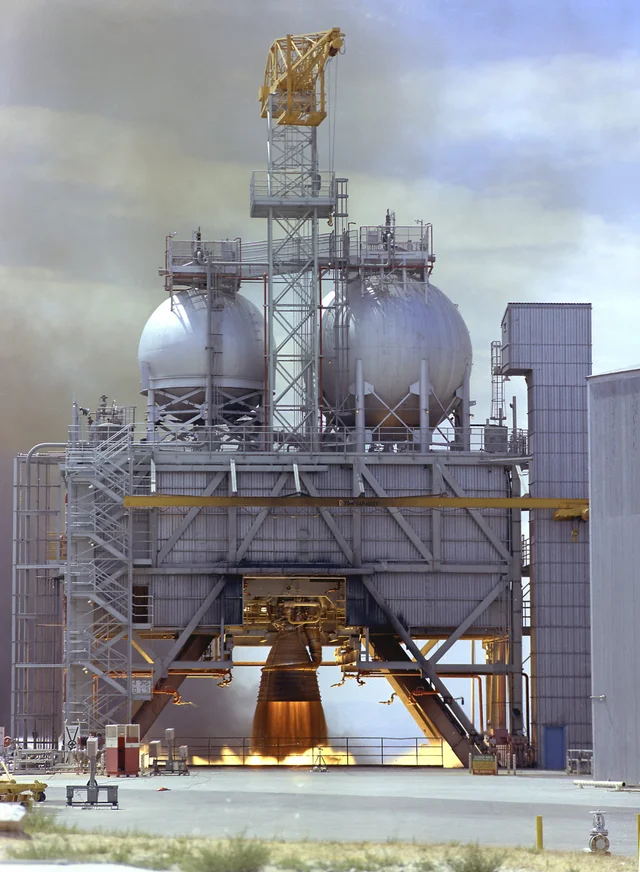
The F-1 remains the most powerful single-chamber liquid-propellant engine flown. The Soviet union's answer to the same instability problem, the RD-170, produces more thrust through four combustion chambers fed by one pump, which is a way of keeping each chamber small enough to damp. 8
Three stages, three different bets
The Saturn V burned two different fuels because the two jobs differed. Kerosene and liquid oxygen went into the first stage, where thrust and propellant density mattered, and liquid hydrogen went into the second and third stages, where energy per unit mass mattered. Had the first stage burned hydrogen, its tanks would have been far larger, and the vehicle's designers judged that aerodynamically impractical at the time. 3
The first stage carried 1,310,000 litres of liquid oxygen and 820,000 litres of kerosene, and it weighed 2,214 tonnes on the pad against a dry mass of 137 tonnes. Five ducts carried oxygen from its tank down through the kerosene tank to the engines, and the thrust structure spread the load of five engines into the wall of the fuel tank above it. 3
The second stage's mass problem was the insulation. Liquid hydrogen boils at about −253 °C, and the stage's two tanks shared one dome separating hydrogen from oxygen with a 70 °C difference across it. The bonded honeycomb sandwich between the two aluminium sheets of that common dome saved 3,600 kg by removing a whole bulkhead and shortening the stage; the tank panels themselves were finally insulated by hand-spraying rather than by the milled honeycomb panels that had given trouble with air pockets. 4
That work continued between flights. The S-II flown on Apollo 9 was 1,800 kg lighter than its predecessor and carried 600 kg more payload, from changes made after the first two stages had flown. 4
The mission depended on the third stage. A single J-2 had to start, shut down, coast through two orbits and then restart to send the spacecraft out of Earth orbit. Apollo 8 did it in December 1968 with a crew aboard on the vehicle's third flight. 3
The ring that steered it
At the top of the third stage, below the spacecraft, sat a ring 6.6 m across and 914 mm deep, built from aluminium honeycomb sandwich panels and weighing about 2,000 kg at launch. Marshall designed it and IBM built it, and it carried the vehicle's steering system: an inertial platform made by Bendix whose design descended from an experimental unit for the German V-2, a digital guidance computer, rate gyros, accelerometers, an analogue flight control computer, telemetry for about 200 parameters, and C-band transponders for tracking. 10
The work was split between two computers because two jobs ran at once. The digital machine solved the guidance problem, deciding where the vehicle should point and when each stage should shut down and separate; the analogue machine ran the high-speed control law that kept a 111 m stack stable as its engines gimballed, and passed commands to the actuators. 10
The flight logic carried the designers' judgement about what they trusted. Until the first stage finished its burn, guidance commands were functions of elapsed time alone, and first-stage cutoff and separation were triggered when a sensor reported that propellant had reached a set level. The second and third stages flew on navigation measurements, aiming for a parking orbit on minimum fuel. 10
The ring's work after the lunar burn is the part crews noticed. The vehicle coasted for two to four orbits while tracking stations refined its position and sent up a correction, the third stage restarted for the injection burn, and the instrument unit held the stack steady while the command module turned around and docked with the lunar module. Its last act was a small manoeuvre to push the spent stage clear of the spacecraft, and on Apollo 13 to 17 those stages were aimed to hit the Moon. 10
Assembled indoors, driven to the pad
The Saturn V was built in three states, and none of its stages could travel by road. Boeing built the first stage at the Michoud Assembly Facility in New Orleans and tested it at the Mississippi Test Facility; North American built the second stage at Seal Beach, California; Douglas built the third stage at Huntington Beach, California. The first two stages travelled by barge, the third by Super Guppy aircraft. 3
The barge route was long. After rounding Florida, the stages came down the Intracoastal Waterway, across the Gulf of Mexico to San Carlos Bay, through the Okeechobee Waterway across Florida, then up the coast to Cape Canaveral. 3
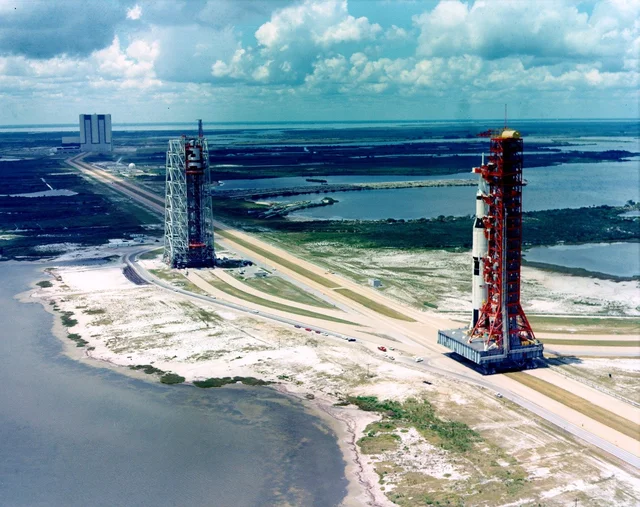
At the Cape, the stages went into a building designed around them: 160 m tall, 3,665,000 m³ in volume, with four high bays for vertical stacking. The stack went together on a mobile launcher, hoisted by a 230-tonne bridge crane, and the stages arrived at KSC in whatever order they were ready. When a second stage was late, NASA substituted a spool-shaped stand-in of the same height, mass and electrical connections, which is what both of the first two flight vehicles did while they waited. 367
The first flight carried the whole rocket
In 1963 NASA's George Mueller pushed the Saturn programme onto a different test philosophy. The established practice was to fly one stage at a time on progressively larger vehicles, with dummy upper stages, until the whole stack had been proven in pieces. Mueller came from the Minuteman missile programme, where the same approach had been replaced by firing complete missiles from the first launch. He applied it to Saturn: every flight would carry a complete vehicle with live stages and a flight-type spacecraft. 12
He told a congressional committee in February 1964 that the change had saved four to seven launches, and he described the cost plainly. "There is a tradeoff. There is some increased risk associated with delaying all of the elements at the same time." Asked whether the agency was taking a gamble, he said the ballistic missile programme showed it to be a good one. 12
Von Braun resisted the change at first and then supported it. In a 1998 oral history Mueller described the sequence: "Werner finally said, 'Well, it's risky, but I agree. I support that idea.'" The reasoning he gave for the decision was about schedule geometry rather than hardware. Flying one stage alone required almost as much work as flying the complete vehicle, and that work still left the whole stack untested. 12
The ground programme in Huntsville had already shaken the vehicle's structure. A complete Saturn V test article was assembled in the dynamic test stand in 1966 and 1967 and driven through three configurations, one for each phase of flight, with hydraulic pedestals simulating an unrestrained vehicle and ballast standing in for propellant. Marshall declared the structures ready in August 1967 with several slight modifications. 3
Apollo 4 flew on 9 November 1967. It was the first flight of the complete three-stage vehicle, the first flight of both the first and second stages, and the first in-flight restart of the third stage, and it ended with a splashdown in the Pacific less than nine hours after liftoff. 7
All-up testing also meant that every new piece of hardware met at the pad at the same time. When the Apollo 1 fire in January 1967 forced a re-examination of the spacecraft, inspectors found 1,407 errors in the command and service module; a review in March 1967 listed 1,200 outstanding problems on the Saturn V itself, which the technicians proposed to work through at 80 a day. 7
What the second flight found
Apollo 6 launched on 4 April 1968 with a second complete vehicle and a boilerplate lunar module, and the flight plan asked the third stage to send the stack out past the Moon's orbit. In the first two minutes the first stage behaved as designed. Then the vehicle began to oscillate along its length with accelerations of about ±0.6 g, against a design limit of 0.25 g, and the shaking damaged the second stage. Had the flight carried a crew, the pogo would likely have triggered an abort. 513
Pogo is a feedback loop inside a structure. Each engine's thrust carries a small fluctuation, the propellant line feeding it behaves like an organ pipe with a resonance of its own, and the vehicle behaves like a tuning fork. When those frequencies line up, the vehicle's acceleration feeds back into the pressure reaching the engine, and the oscillation sustains itself. 13
The second problem was quieter and its diagnosis took longer. The J-2 engine's igniter was fed through fuel lines with a metal bellows section to absorb thermal expansion. On the test stand at ground level, cold propellant passing through those lines condensed frost and liquid air on them, and the liquid air damped the bellows vibration. In the vacuum of space no liquid air formed on the lines, and the liquid hydrogen line to engine two's igniter failed. Oxygen kept flowing into the igniter, the excess oxygen burned through the engine's dome, and the pressure loss triggered a shutdown command. 5
That command carried a second failure with it. A wiring cross-connection passed it to engine three, which had been running normally. The second stage finished its burn on three engines, 58 seconds longer than planned, and the third stage failed to restart for the lunar trajectory. The mission flew a repeat of Apollo 4's high-orbit profile and returned. 5
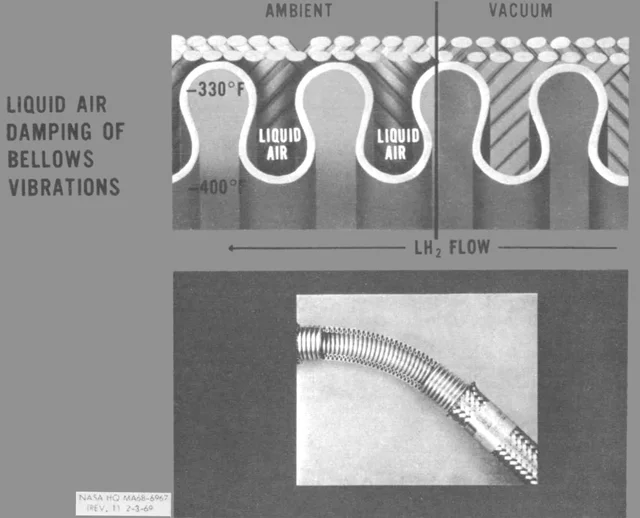
About 1,000 government and industry engineers worked the pogo problem. The fix kept the organ-pipe resonance out of the loop by filling cavities in the valves ahead of the engines with helium gas shortly before launch, so the gas acted as a shock absorber; the J-2 igniter lines were rebuilt with rigid bends in place of the bellows. NASA considered an abort sensor that would let the crew judge a pogo event, and dropped the idea in August 1968 once the damping looked sufficient. 5
The second-stage fix had a life of its own. The S-II's centre J-2 carried a cut-off that shut the engine down when oscillation crossed a limit, and it fired about two minutes into the second-stage burn on Apollo 13 in April 1970. The crew lost one engine of five and the guidance system burned the remaining four longer, and the vehicle reached orbit. 313
Thirteen launches and the leftovers
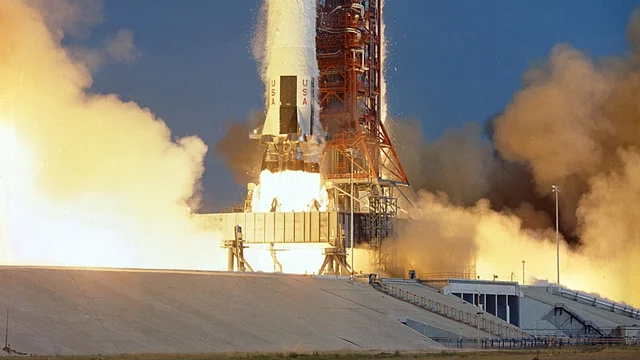
Nine of the thirteen Saturn V flights carried crews toward the Moon, and six of them landed. The last one flew on 14 May 1973 with no crew at all: the vehicle launched the Skylab orbital workshop, which was built from the S-IVB third stage that would otherwise have pushed a spacecraft toward the Moon. The stage's hydrogen tank became the station's habitable volume. 3
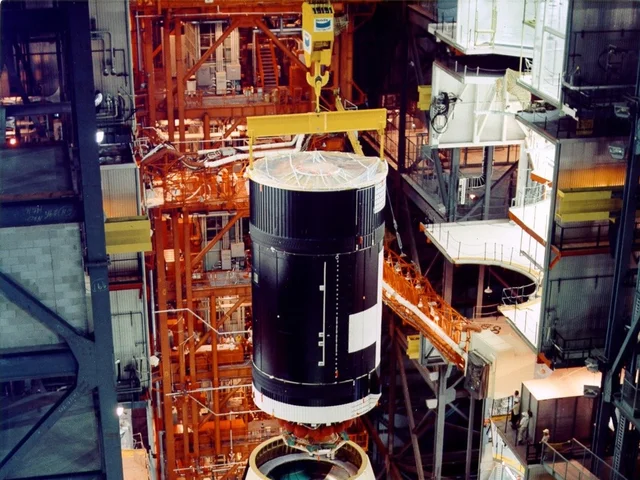
Two flight-ready vehicles were never launched. SA-514 had been assigned to Apollo 19 and SA-515 to Apollo 20, and the second of them became the backup for the Skylab launch; their stages are now museum exhibits in Houston, Florida and Mississippi. Three ground-test articles were also built, and parts of them survive as museum exhibits. 3
The engines went to the seabed. Sixty-five F-1 engines flew aboard thirteen first stages, and every first stage was dropped into the Atlantic after separation. A private expedition recovered components from almost 5 km down in 2013, among them a thrust chamber stencilled with the serial number 2044, which matched the fifth engine of Apollo 11's first stage. The parts went to the Kansas Cosmosphere for conservation and then to the Museum of Flight in Seattle, where an exhibit that opened in May 2017 shows recovered components of the Apollo 12 and Apollo 16 engines. 81718
What survives alongside the hardware is thinner than the hardware suggests. There is no complete set of Saturn V technical drawings anywhere, and the authors of one account of the F-1's afterlife trace that to a programme whose documentation was distributed across contractors, with much of it never collected and the tooling destroyed decades ago. 19
The F-1 tells the same story in miniature, and it corrects a common version of it. The drawings survived; the trouble with them was their completeness. The engine was effectively hand-built, its design was iterated between drawing board and test stand, and the finished hardware carried changes that the paperwork never recorded. The injector baffles that solved the instability were, in the project's own later description, arrived at by trial and error. When engineers at Marshall Space Flight Center wanted a catalogue of the design in 2013, they tore down an engine and scanned its parts to build a model from the metal rather than the microfilm. 20
Loading link preview…
The vehicle that followed the Saturn V went elsewhere for its propulsion. NASA fired an original F-1 in 2013 to refresh the agency's knowledge of the design, and the propulsion that took four people around the Moon in 2026 came from Shuttle-era engines and solid boosters instead. The comparison in the opening paragraph is the result: more thrust at liftoff, and less mass sent toward the Moon. 28
What the case transfers
The Saturn V's form was settled by a decision about mission architecture, taken two years before its first flight and never revisited. Lunar orbit rendezvous made a 43.5-tonne lunar payload sufficient, and everything downstream — the three stages, the engine count, the launch complex — followed from that number. Programmes that fix architecture early and hold it get to spend their later years on details instead of on renegotiating the premise. 3
Test programmes model an environment, and a model can be wrong in ways that flatter the design. Liquid air condensed on the J-2's igniter lines in a ground-level test stand, and the damping it provided was the difference between a line that survived and a line that failed. Whatever the rig adds to the real conditions belongs in the result. 5
Documentation and reproducibility are two different things. The F-1 flew thirteen times, and its paperwork fell short of what rebuilding it would have required, because the design lived partly in the hands of the people who had built it and in tooling that was scrapped. Fifty years later, the record of that engine was reconstructed from a physical teardown. Any project whose knowledge is held that way has to decide when to write it down. 1920
References
- 1Wikipedia, "Artemis II"
en.wikipedia.org
- 2Wikipedia, "Space Launch System"
en.wikipedia.org
- 3Wikipedia, "Saturn V"
en.wikipedia.org
- 4Wikipedia, "S-II"
en.wikipedia.org
- 5Wikipedia, "Apollo 6"
en.wikipedia.org
- 6Wikipedia, "Vehicle Assembly Building"
en.wikipedia.org
- 7Wikipedia, "Apollo 4"
en.wikipedia.org
- 8Wikipedia, "Rocketdyne F-1"
en.wikipedia.org
- 9Wikimedia Commons, "F-1 Engine Test Firing"
commons.wikimedia.org
- 10Wikipedia, "Saturn V instrument unit"
en.wikipedia.org
- 11Wikimedia Commons, "Aerial view of Apollo 4 rollout"
commons.wikimedia.org
- 12
- 13Wikipedia, "Pogo oscillation"
en.wikipedia.org
- 14Wikimedia Commons, "Saturn J-2 ASI H2 line problem Apollo 6"
commons.wikimedia.org
- 15Wikimedia Commons, "Apollo 11 Launch"
commons.wikimedia.org
- 16Wikimedia Commons, "The Skylab space station is mated to a Saturn V rocket"
commons.wikimedia.org
- 17Bezos Expeditions, "F-1 Engine Recovery"
bezosexpeditions.com
- 18The Museum of Flight, "Apollo F-1 Engine Preview"
museumofflight.org
- 19
- 20
This story was produced automatically by a channel. One sentence is all it takes for Neodrop to keep producing for you.