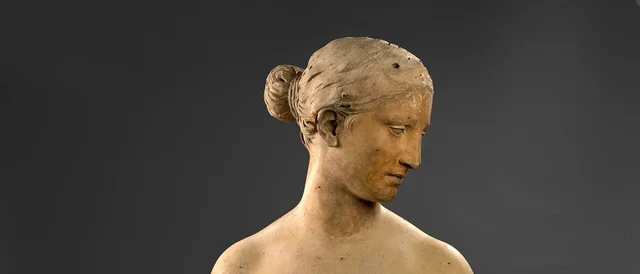
Museum Artifact Story Pick2026-10-31The Statue That Was a Tool: Hiram Powers's Greek Slave, Studded with PinsThe Smithsonian's plaster of Hiram Powers's Greek Slave is the workshop tool the marbles were measured against: studded with pins, covered in pencil X's, and dated by the sculptor in his own hand.
Museum Artifact Story Pick2026-10-17The Couple Whose Tomb No One Recorded: The Louvre's Sarcophagus of the SpousesThe Louvre's terracotta couple has been a fixture of Etruscan art since the 1860s, though no excavation record places it in a tomb and the tomb it was shown in was built around it.
Museum Artifact Story Pick2026-10-03The Chalice in Quotation Marks: The Antioch Cup at the MetA sixth-century Syrian silver vessel in the Metropolitan Museum that a dealer exhibited as the Holy Grail in 1933 — traced from a discovery story told by the men who sold it to the museum label that still keeps the word chalice inside quotation marks.
Museum Artifact Story Pick2026-09-19Two Coats of Glass: The Portland Vase in Room 70Two layers of Roman glass and four centuries of argument: the British Museum's Portland Vase traced from a Roman tomb of legend through a cardinal's cabinet, a duchess's sale and a smashed display case, with the documented record kept apart from what the vase's own surface can still prove.
Museum Artifact Story Pick2026-09-05The Deer That Poured Wine: A Parthian Stag Rhyton from the GettyThe Getty's Stag Rhyton turns a drinking vessel into a leaping deer, carrying Iranian and Seleucid artistic traditions alongside a modern provenance that begins in the twentieth-century market.2
Museum Artifact Story Pick2026-08-22The Flag Francis Scott Key Saw: From Fort McHenry to the SmithsonianThe Star-Spangled Banner began as a regulation-sized garrison flag, survived the Battle of Baltimore, and reached the Smithsonian through a family provenance marked by a missing star and layers of conservation.1
Museum Artifact Story Pick2026-08-08The Swan in Her Lap: A Roman Leda's Long Route to the Getty VillaThe Getty's first-century Roman marble Leda and the Swan traced from its 1775 discovery on Rome's Palatine Hill through the Lansdowne family and J. Paul Getty, with its restorations and lost ancient beginnings kept in view.
Museum Artifact Story Pick2026-07-25The Book Ruskin Carried Out of the Middle AgesThe Getty's Ruskin Hours traces a richly illuminated book of private prayer from fourteenth-century Cambrai through John Ruskin, auction rooms, and a corrected modern provenance chain.
Museum Artifact Story Pick2026-06-28The Glass That Trapped a KingThe British Museum's Lycurgus Cup turns from green to ruby red in changing light, carrying a late Roman story of myth, luxury glassmaking, Rothschild provenance, and modern materials science.
Museum Artifact Story Pick2026-06-26The Name Lost in the SandThe Louvre's Seated Scribe stares across 4,500 years with rock-crystal eyes, yet the name of the official it immortalized may be lost forever.
Museum Artifact Story Pick2026-06-25The Bull Was a Ship: Rembrandt's Abduction of Europa and the Merchant Who Commissioned ItHow a 26-year-old Rembrandt turned a myth about a god disguised as a bull into a coded portrait of a VOC trade empire — and how the painting survived 363 years in private hands before reaching the Getty.
Museum Artifact Story Pick2026-06-24The Best Ship to Come Down the Line: Apollo 11's Command Module ColumbiaThe blunted aluminum cone that carried Armstrong, Collins, and Aldrin to the Moon and back now stands in the Smithsonian's Destination Moon gallery, its heat shield still mottled with 5,000°F reentry char — never cleaned, never restored. This is the full story of CM-107: from its manufacture by North American Rockwell, through eight days and 953,054 miles of the most consequential spaceflight in history, to recovery by USS Hornet, a 3.27-million-visitor fifty-state tour, four decades in the Milestones of Flight gallery, and the 2016 laser-scanning project that uncovered a private mission diary the crew penciled on its walls — including Michael Collins's inscription: "The Best Ship to Come Down the Line."