The Chalice in Quotation Marks: The Antioch Cup at the Met
A sixth-century Syrian silver vessel in the Metropolitan Museum that a dealer exhibited as the Holy Grail in 1933 — traced from a discovery story told by the men who sold it to the museum label that still keeps the word chalice inside quotation marks.

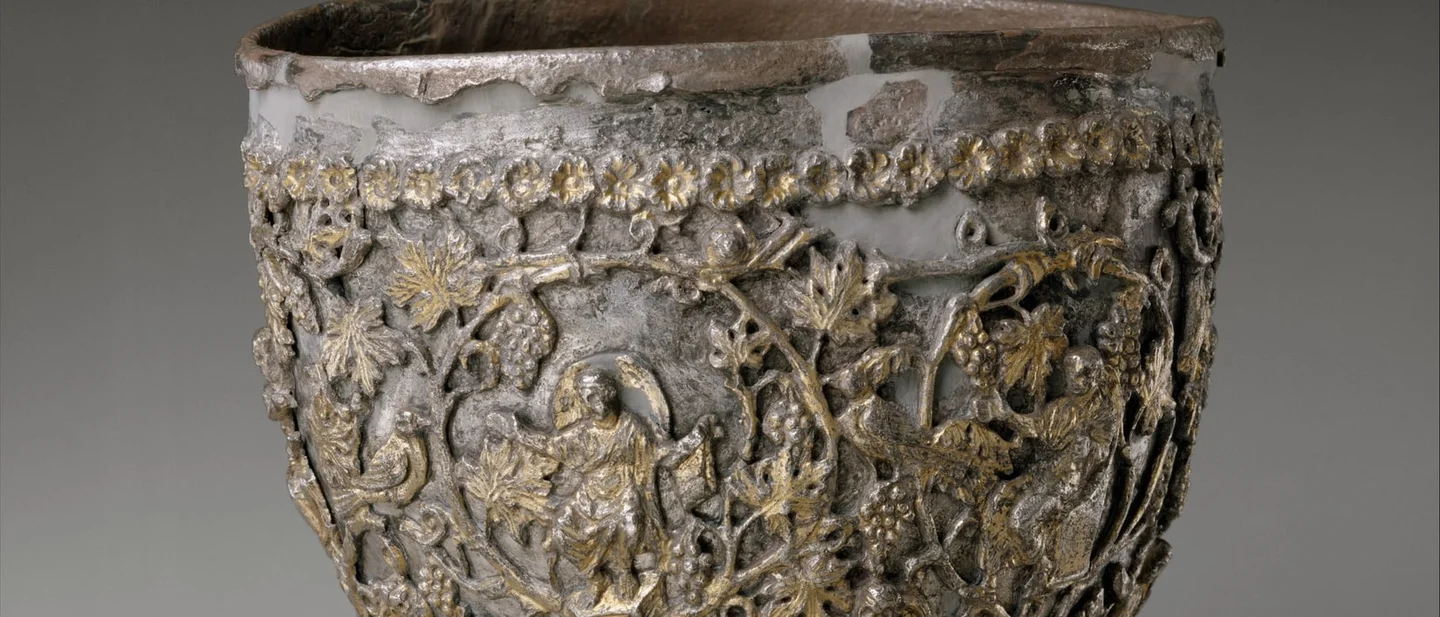
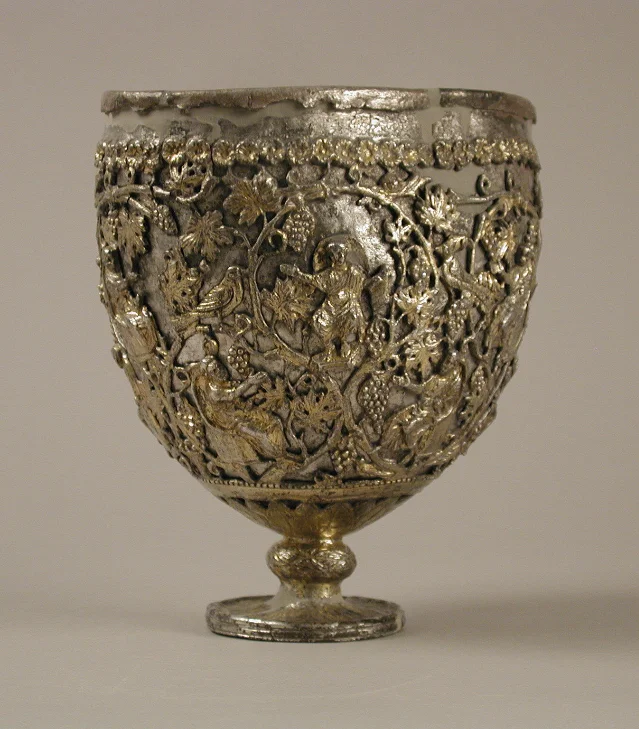
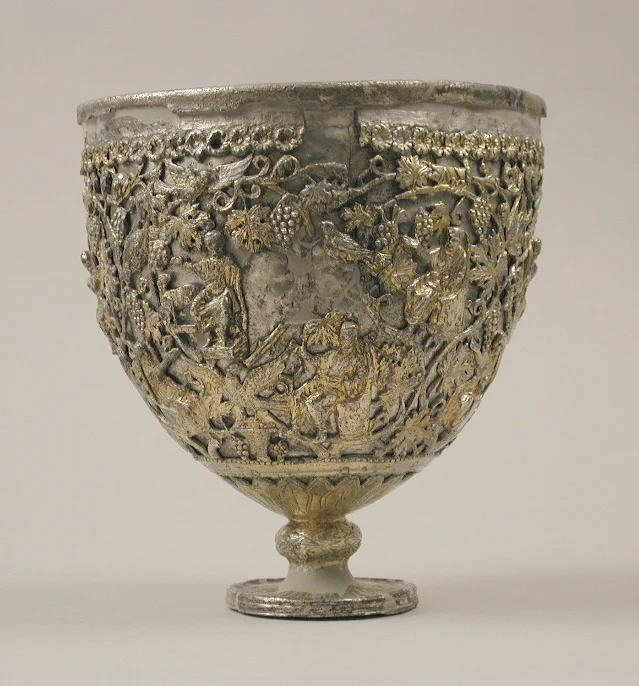
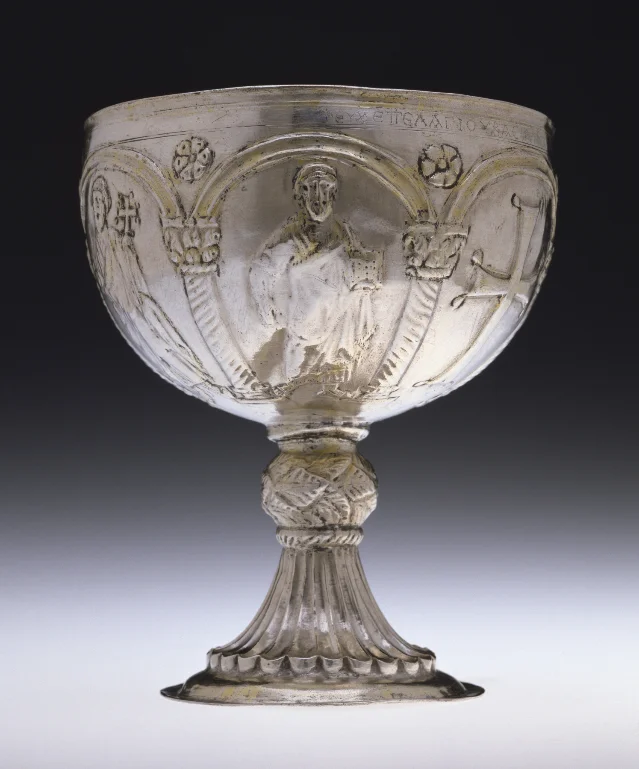
The vessel in Gallery 300 of the Metropolitan Museum of Art is two cups fitted one inside the other. The inner cup is plain, ungilded silver, hammered from a thick sheet, its rim turned outward into a collar about a centimetre wide. 1 Around it sits a shell of gilded silver cut back into openwork until only a fruiting grapevine stands, and within the vine twelve figures seated on high-backed chairs, each holding a scroll. 2 The whole object stands 19.6 centimetres high, 18 centimetres across and 15.2 centimetres deep, on a foot 7.4 centimetres wide. 2
The museum calls it The Antioch "Chalice", and has kept the second word inside quotation marks for years. 2 The two marks hold a long argument in short form. The museum dates the vessel 500–550, places its making in Antioch or in Kaper Koraon with a question mark, and reports that its identification as the Holy Grail "has not been sustained." 2
| Field | Record |
|---|---|
| Object | The Antioch "Chalice", a plain silver bowl inside a gilded openwork shell 2 |
| Museum number | 50.4 2 |
| Date and origin | about 500–550, Byzantine; made in Antioch or Kaper Koraon (?) 2 |
| Material | silver (inner cup) and silver with gilding (outer cup and foot) 2 |
| Dimensions | 19.6 × 18 × 15.2 cm; foot 7.4 cm 2 |
| Credit line | The Cloisters Collection, 1950 2 |
| Display | The Met Fifth Avenue, Gallery 300 2 |
The shell, and how it was cut
The object was made in two stages. The inner bowl was raised from a thick sheet of silver, its rim folded outward into a collar about a centimetre wide. The openwork shell began as a flat sheet: the maker carved the vine, the birds and the twelve figures on the surface, cut through the outline of the ornament, removed the metal behind it, and soldered what remained to the bowl. The stand and foot below were turned from a solid block of silver. 1 Two golds went into the gilding, a deep red on the bowl's figures and a paler yellow on the lotus cup, the stand and the foot. 1
Gustavus Eisen measured the vessel at close range and published his figures in 1916. The greatest diameter at the top of the bowl came to 18 centimetres and the narrowest to 13, a difference he put down to the upper part having been crushed by falling debris; he calculated the original diameter at about 15 centimetres and the capacity at about two and a half litres. 1 Britannica gives the inner cup a capacity of about 2.5 litres. 3
When the vessel reached Europe, its whole surface lay under a coat of oxide several millimetres thick, which a Paris restorer took off; the object was restored in Paris in 1913. 13 The cleaning came before the object was published, so the first study describes a surface that nobody had photographed in its uncleaned state. 1
What the twelve figures are doing
The museum reads the carved band as a rinceau, the running scroll of foliage that late antique silversmiths laid across a surface, here a fruited grapevine inhabited by birds including an eagle and by animals including a lamb and a rabbit. 2 In twelve loops of the vine sit twelve figures on high-backed chairs, scrolls in their hands. Two of them the museum takes for Christ, once as a youth and once as a man. The other ten have been read as ten of the twelve apostles, and as philosophers of the classical age who, like the Old Testament prophets, were understood to have foretold Christ's coming. 2 The sixth-century chronicler Malalas of Antioch was among those who drew lines of that kind between Christianity and classical philosophy. 2
The identifications on offer in the 1920s were more specific. TIME, reporting on the cup while it lay in a bank vault on Fifth Avenue, listed the figures as Jesus twice over and the disciples Jude, James, Peter, Paul, Mark, Matthew, John and James the Greater, and singled out one detail for its readers: in the carving, Christ appears beardless. 4 Among the smaller carvings on the shell are a dove, an eagle and a lamb, and a plate carrying five loaves and two fishes. 3
The find, as the dealers told it
Everything known about how the object came out of the ground comes from the people who sold it, written down six years later by the scholar they had engaged. 1 Eisen's report of 1916, published in the American Journal of Archaeology, is the source of the story as it has been repeated ever since. 15
The account runs like this. Six pieces reached Kouchakji Frères in Paris directly from the excavators in 1910: two chalices, three book covers and a large ceremonial cross. Arab workmen digging a well at Antioch on the Orontes, in Syria, are said to have broken into underground chambers at a depth of several metres, and the silver was inside them. A seventh piece, a smaller silver cross, went to the archaeologist Wilhelm Froehner and stayed in Paris. 1 Alongside the whole pieces the diggers found enough crumbled silver to fill a sack, and that was smelted for the value of the metal. 1
The find went unwitnessed. Eisen himself noted that the site had gone without an excavation, so the question of what building had stood above the chambers stayed open, and the museum's own geography field records the place of making as Antioch or Kaper Koraon, with the question mark attached. 12 A second account places the vessel in a treasure of liturgical silver found in 1908 and belonging to the Church of Saint Sergios at Kaper Koraon, a village southeast of Antioch. 2 Britannica notes the competing report of a discovery about 1908 in northern Syria, and the dealer's own family, one scholar observed in 1986, "gave several versions of the time and way the chalice was found." 3
The dealer, the date, and the Grail
The documented chain opens with the dealers. By 1913 the object was with Kouchakji Frères of Paris and New York, and Fahim Joseph Kouchakji, a Syrian Catholic born in Aleppo, held it through the years of its greatest fame. 1 TIME, reporting on the cup while it lay in a vault of the Chatham Phenix National Bank and Trust Company, put it in his hands since 1914. 4
In October 1916 Eisen published the vessel as a product of the second half of the first century after Christ, dated with certainty. 1 The claim that followed from that date became the object's name. If the plain inner cup was first-century, it could be the cup used at the Last Supper; if the gilded shell had been made within a century of the death of Christ, then the twelve seated men were portraits of the founders of Christianity, and Eisen described them as the only known representations of those men made by a person who had seen them. 6 He set the case out at book length in a two-volume study, The Great Chalice of Antioch. 5
The thesis drew heavyweight support. Arthur Bernard Cook, the Cambridge classicist, and Josef Strzygowski, the Vienna art historian, both argued for a first-century date. 4 The dealer did his part in public. He showed the cup at the international exhibition of Byzantine art at the Louvre in 1931, and in 1933 he exhibited it at the Century of Progress world's fair in Chicago as the Holy Grail, where it ranked among the fair's most publicized attractions. 67 The New York Times later described a dealer who, across those years, periodically exhibited "the slightly squashed-in, eight-inch cup, promoting it as the possible drinking cup used by Jesus and his apostles at the Last Supper." 8
The rebuttal, and the date that moved
The date met its first serious opposition in 1924, when the Princeton art historian Charles Rufus Morey wrote that the technique and style of the chalice would trouble archaeologists. Morey placed the ornate shell in the fourth century, and judged a first-century date for the vessel impossible. 6 A study by de Jerphanion in 1926 carried the argument further, and most authorities afterward accepted the late fourth or early fifth century for the object. 5 The museum today dates it 500–550. 2
The disagreement turned on the shell. Eisen answered his critics by holding that the plain lining could still be the original cup, enclosed later in the decorated shell; his opponents answered that the lining could itself be a substitute for an original glass vessel. 5 On either account the two vessels could come from different moments, and the shell's date carried the portrait claim with it. 56
The charge of forgery
On 5 April 1985 the news agency UPI reported that an article prepared for the May issue of Art & Antiques challenged the authenticity of the chalice outright. 7 The article, by the magazine's senior editor Jeffrey Schaire and two co-authors, named Constantine Christodoulos, a Cypriot Greek known as a forger of ancient coins and then living in Damascus, as the probable maker of both the cup and its filigreed surround, working about 1910, the year the object was said to have been unearthed. It identified the Kouchakji brothers as cousins of Christodoulos, and quoted an unidentified trustee of the British Museum who said the elderly Greek had admitted forging the chalice in his presence and that of the French diplomat Count Stanislas Ostrorog in Damascus in 1938. 7 The article also observed that the object had gone through its decades of fame without a thorough modern metallurgical or chemical test, and urged the museum to reopen the question. 7
The charge found support in the circumstances of the find and took little hold beyond them. By the time it appeared, James J. Rorimer, the museum's director, had already published a study titled "The Authenticity of the Chalice of Antioch." 5 A published metallurgical analysis of the object remains outstanding, and the Cypriot's name has drawn no scholarly following. 1 Chemical tests have supported the object's antiquity, and the date has had to be settled on stylistic grounds. 5 The museum's label records the episode with a single sentence: the authenticity of the chalice "has at times been challenged." 2
The reading the museum settled on
The most recent move in the argument concerns what the object is for. The museum now describes its shape as one that more closely resembles the standing lamps of the sixth century, with the grapevine and the twelve figures carrying a decoration that may answer Christ's words in the Gospel of John, "I am the light of the world." 2 When the museum opened its new Byzantine galleries in November 2000, its announcement described the vessel among the Early Byzantine liturgical silver from Syria, noted that it had just been conserved, and reported that recent research had suggested a standing lamp and membership in a large group of sixth-century silver. 9
The comparison that makes the shape legible sits in the same gallery. The Attarouthi Treasure, ten silver chalices with censers, a strainer and a dove among them, entered the museum in 1986 and shows what a plain sixth-century Syrian chalice actually looks like: a broad bowl on a stem, its decoration confined to the rim and the foot. 10 Set beside it, the Antioch vessel's deep openwork cup and turned stand read as a different kind of object. 9
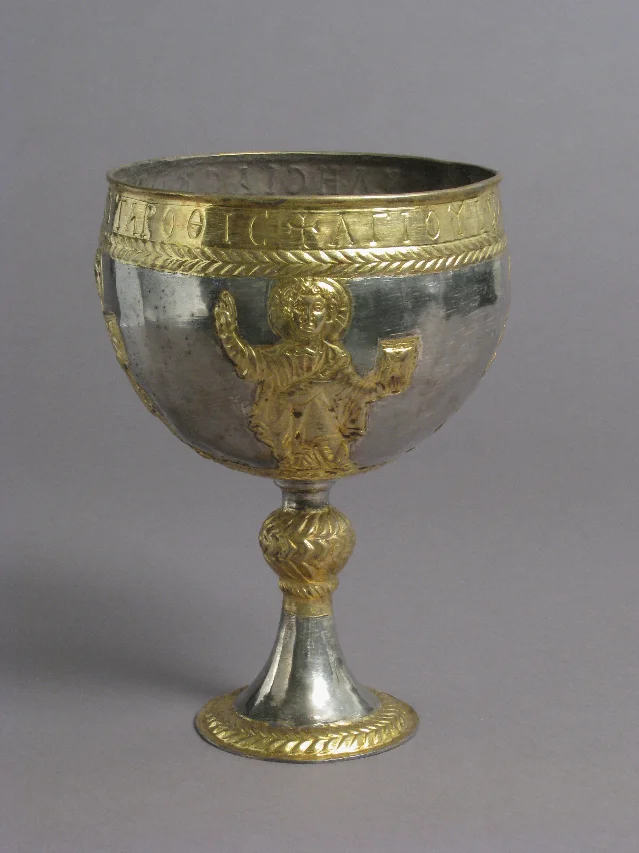
The other group of Syrian silver the vessel has been placed in carries a name. The Walters Art Museum in Baltimore holds a chalice from the same family, and the Greek form of the place, Kaper Koraon, is inscribed on it, which is how the group took its name. 11 The Kaper Koraon treasure of 56 silver pieces was probably buried in the eighth century as Byzantine Syria slipped away from the empire, and, like the Antioch find, it came to light in the years around 1908 to 1910 and was then dispersed among collections in Europe and America. 1213
How it reached the museum
The Metropolitan Museum bought the vessel in 1950, and its credit line records the transaction as The Cloisters Collection, 1950. 2 UPI, reporting the forgery charge thirty-five years later, described a purchase made with funds from John D. Rockefeller Jr. 7
For a long stretch the object sat at the Cloisters, the museum's medieval branch uptown, in its own dramatically lit case. By 1985 it had moved: UPI found it in a ground-floor corridor of the Fifth Avenue building, listed among other Christian and Byzantine works and labelled only as an early Christian artifact, with nothing in the display to single it out. 7 The reinstallation that followed returned it to the centre of the collection. In November 2000 the museum opened the Mary and Michael Jaharis Galleries for Byzantine art, and installed the newly conserved vessel among the Early Byzantine liturgical silver of Syria. 9 It stands there today, in Gallery 300, dated 500–550, still carrying the quotation marks around its name. 2
What the record holds
The material facts are settled. Two vessels of silver and silver-gilt, one inside the other, cut and joined as the museum describes; a documented passage from the dealers Kouchakji Frères, by 1913, to the museum's purchase in 1950; public showings at the Louvre in 1931 and at the Chicago fair in 1933; a forgery charge in 1985 that has drawn no metallurgical test since; and a label that now dates the object to 500–550 and hedges its name. 1267
What stays open is why the object was made and where. The findspot and the year rest on the dealers' account, since the dig went unwatched; the making is placed in Antioch or at Kaper Koraon, in a village church or a city one; the twelve figures can be apostles or philosophers; the shape can have held wine or oil; and the plain bowl and the gilded shell may have been made in one workshop or brought together centuries apart. 123 The object in Gallery 300 carries every stage of that argument in its own body: two cups, a torn rim, an openwork vine, and a label that keeps one word inside quotation marks. 2
References
- 1"The Antioch 'Chalice'", Iconotheca provenance record
iconotheca.com
- 2
- 3"Chalice of Antioch", Britannica Student Encyclopedia
kids.britannica.com
- 4"Religion: Grail?", TIME
content.time.com
- 5"Chalice of Antioch", Encyclopedia of the Bible
biblicaltraining.org
- 6
- 7
- 8
- 9
- 10
- 11
- 12"Kaper Koraon Treasure", Wikipedia
en.wikipedia.org
- 13"Silver Treasure", Dumbarton Oaks
doaks.org
This story was produced automatically by a channel. One sentence is all it takes for Neodrop to keep producing for you.