The Statue That Was a Tool: Hiram Powers's Greek Slave, Studded with Pins
The Smithsonian's plaster of Hiram Powers's Greek Slave is the workshop tool the marbles were measured against: studded with pins, covered in pencil X's, and dated by the sculptor in his own hand.

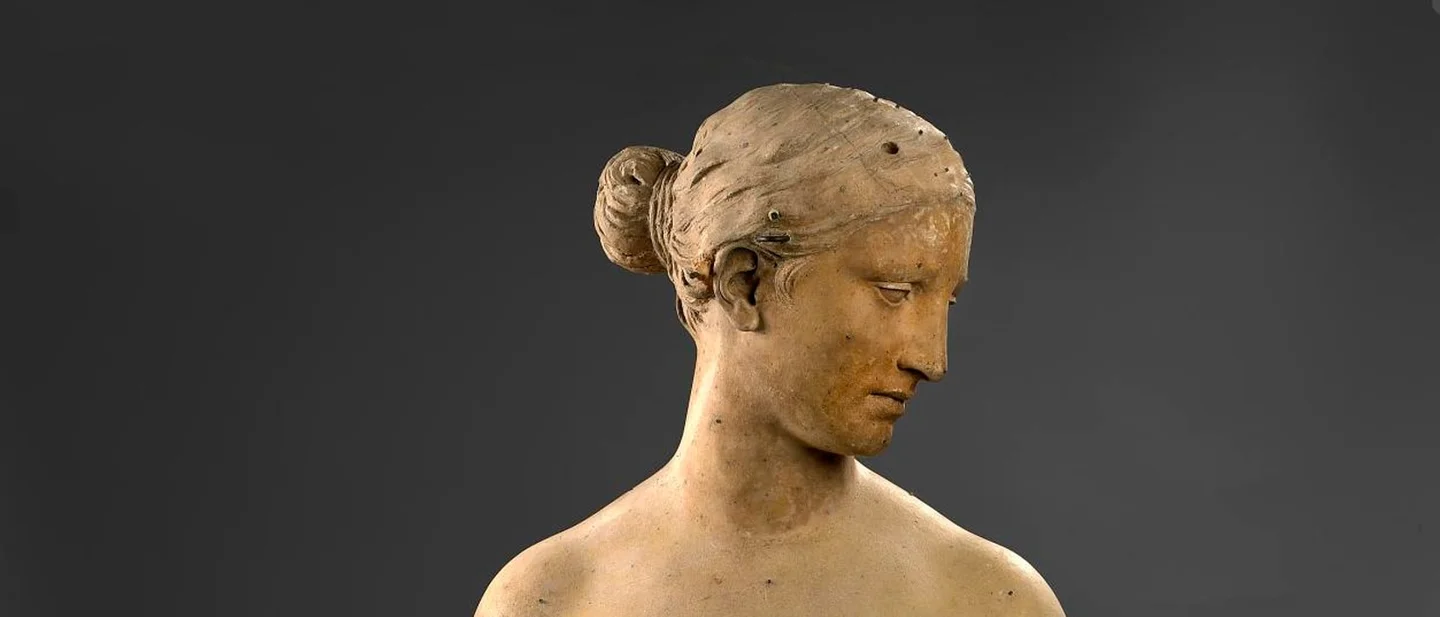
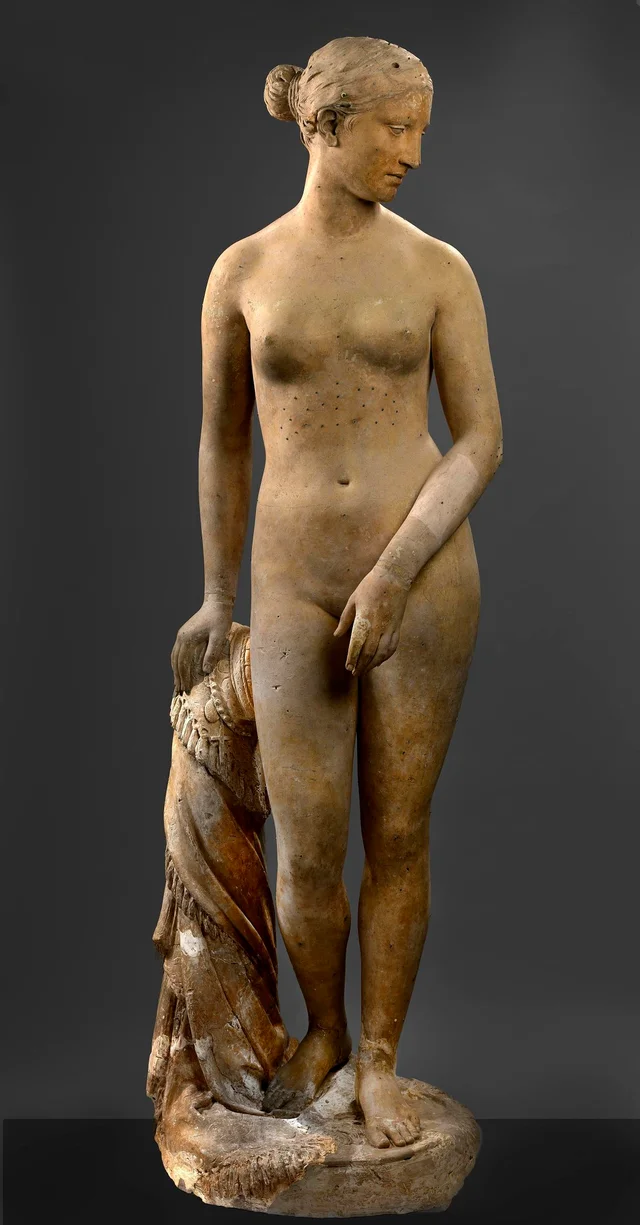
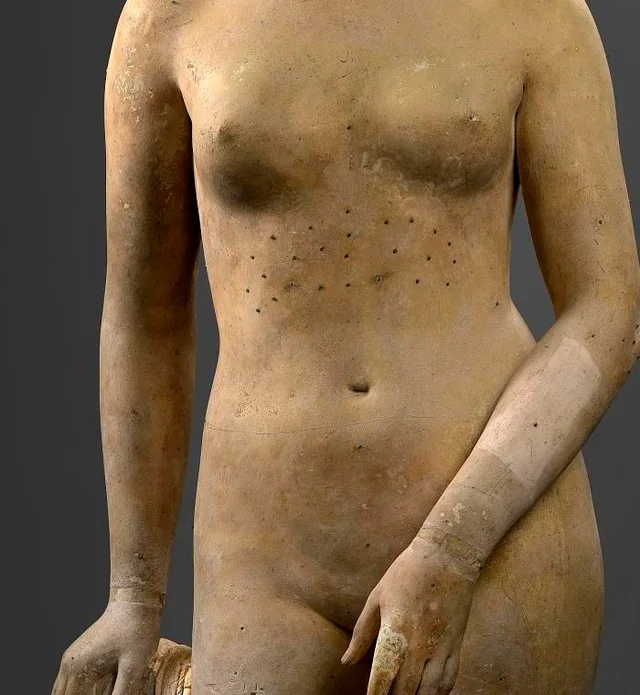
She stands against a flat grey card in the museum's photograph, one hand on a draped column, the other hanging open against her thigh. Her skin is a stained ochre, mottled where dirt and old coatings have been lifted away, and a pale band of later paint crosses her left forearm. Across her chest and belly runs a loose constellation of small dark holes. A metal loop protrudes beside her right temple. 1
The figure is Greek Slave, by Hiram Powers, an American sculptor who worked in Florence: 168.6 centimetres of plaster. The museum calls it the most famous sculpture of the nineteenth century, and this plaster is the cast taken from the clay Powers finished with his own hands on 12 March 1843. Every marble anybody bought came off her. 12
The date pressed into the clay
Most nineteenth-century sculptures carry no day. This one carries "March 12th 1843," written by Powers into the damp clay, and the plaster cast took the writing down with everything else. 2 The date is oddly specific for a workshop object. It is hard to imagine Powers meant anyone to read it, since it sat on a cast that was only ever a step on the way to a marble. 2
Within days the mould makers arrived. Building the mould around the clay destroyed the clay, so the plaster positive that came out of it is the last object made by Powers's hand alone. 2 His patron George Henry Calvert described that plaster in 1847 as "an exact fac-simile of the original clay figure, in hard, smooth plaster of Paris, capable of bearing the usage of the studio, and receiving the many marks that are to guide the marble-cutters." 3
Everything else about the figure, including the pins, belongs to the copying.
| Field | Record |
|---|---|
| Object | Model of the Greek Slave, the pointing plaster 1 |
| Maker | Hiram Powers (1805–1873), American, working in Florence 1 |
| Inventory number | 1968.155.8 1 |
| Date | 1843, inscribed "March 12th 1843" on the clay 12 |
| Material | plaster and metal pins 1 |
| Dimensions | 168.6 × 54.6 × 46.6 cm 1 |
| Credit line | museum purchase in memory of Ralph Cross Johnson 1 |
| Display | gallery location not given; the museum's reduced marble and its daguerreotype of the same subject are both listed as not on view 145 |
Clay dug from the Potomac
Powers was born in Woodstock, Vermont, in 1805 and grew up on a farm in Ohio. He spent 1834 to 1837 in Washington making portrait busts, then moved his family to Florence in 1837 for the marble and the carvers. 12 By 1839 he had taken a studio across the Arno in a former convent, the Annalena, with room for several large figures at once. 2
In January 1841 he wrote to his patron John Preston with two ideas, a Greek slave and a fisher boy. The slave, he said, would be a young girl, nude, "with her hands bound and in such a position as to conceal a portion of the figure thereby rendering the exposure of nakedness less exceptionable to our American fastidiousness." A cross on a chain around her neck would tell viewers she was a Christian. 2
He changed the girl into a grown woman and began modelling in June 1842. The clay came from the banks of the Potomac, shipped to Italy because he liked it, and it went onto an iron armature with tin in the arms so the limbs could be repositioned. He packed five pounds of charcoal inside the figure to draw out the moisture. 2
By October 1842 the model was half done; by January 1843 everything but the hands and feet was finished. Powers called the piece Greek Slave, Greek Captive and Captive Girl in turn, and another sculptor, Henry Kirke Brown, muddled them into "the Captive Slave" after a studio visit. 2 Powers may have settled on that title to bring the figure closer to the American slave trade, a link that became central to how she was shown and read. 2
Nine days in the mould
The men who made the mould were formatori, professional mould makers, and Powers handed the finished clay over to them. They built a piece mould around it, a forma a tasselli of many interlocking sections. Their first coat was milk-thin plaster brushed straight onto the clay, and coarser coats reinforced with horsehair went over that. 2 The arms and head were cut off the clay and moulded separately. 2
Mould and cast together took nine days. 2 When the sections came away, the cast was assembled from its parts, the joins wired and tabbed and then filed smooth. One of those joins runs as a line across the figure's waist in the museum's photograph. 2
Powers's notes from the previous year show him learning the trade: make the first coat thick at sharp corners, or they break coming off; put divisions between thin parts and the mass; expect the expansion of setting plaster to push the inner coats away. 2 What came out of that week was a single positive, and the negative had no clay model inside it any more.
What the cleaning uncovered
By 2013 the surface was filthy. Conservators at the museum's Lunder Conservation Center found two kinds of dirt: soot and fine particulate over the upper two-thirds, and a dense brick or concrete dust over the lower third. 6 Cleaning it carried a risk, because the surface was covered in pencil marks that had to survive the swabs.
Under the dirt were far more of those marks than anyone expected. Hand-drawn graphite X's covered the figure in regular and irregular runs, and numbers appeared on the head, the left arm and the base. 6 The X's sit both under and on top of later coatings, which means the surface was written on, coated and written on again over a long period.
The left forearm carries a pinkish overpaint with a legible "7" written on it; the paint covers some X's and leaves others deliberately exposed. 6 Both wrists show layers of paint and plaster built up in the gaps between shackles and skin. 6 Conservators read that as periodic repair and refreshment, the trace of a tool used for years, probably by more than one carver. 6
The skeleton inside her
Digital X-radiography in 2015 showed a solid plaster body with a four-rod iron armature, a frame built to carry the weight of the pointing apparatus and to survive the vibration of daily use. 26 Ribbons of metal run from one cast section into the next. Above the waist, around a cluster of pins that maps the lower ribcage, several winged metal shapes remain unexplained. 6
The left forearm holds three metal bars wired together and running almost to the elbow. That is more support than a small hand needs, and the conservator who studied it reads the extra weight as the shackle and chains that hung there. 6 The right side needed nothing similar, because one thick bar runs from the base through the column and the arm into the neck and head. 6
The head holds a patch of material with lower porosity and more uniform density than the surrounding plaster. 6 The proposal is a block of wood at the top of the armature, under the metal loop, where the pointing frame hooked on. The X-rays cannot settle that.
The machine that read her
A pointing machine is three slim rods joined by articulated joints, mounted on a wooden crossbar that stands as tall as the model. The crossbar fixes to the plaster at three points, one of them the loop at the figure's right temple. A carver aligns the rod's tip with a pin or an X, then moves the whole apparatus onto the marble block and transfers the reading. 2
Powers noted in February 1842 that a pointing machine made by a London mangle maker cost five pounds, which suggests he bought that one for the studio. 2 Each marble took hundreds of readings, and the readings only reached the large forms. The passages that carried meaning, the locket and the brocaded cloth on the column, were left blunt on the plaster because the machine had no use for them; the carvers finished those from real objects and their own hands. 2
The work went to named men. Leopoldo Fabbri, known as Poldo, began blocking out the first marble in May 1843 and abandoned the block when a flaw appeared. Remigio Peschi, the chief carver, took over the second block and most of what followed. 2 A life cast of a woman's left hand and forearm in the museum's collection holds the same gesture at the same size as the figure, and 3-D deviation analysis found only tiny differences between the two. 2 Powers may have built that cast into his model.
What she was made to say
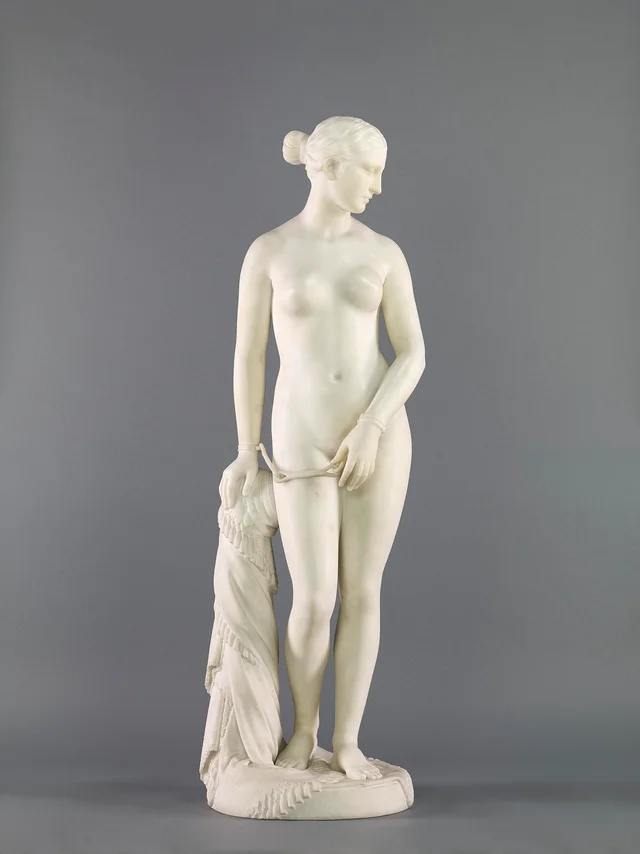
The subject is a Greek woman taken by Ottoman forces during the war of independence, which ended in 1832, and put up for sale in Constantinople. 8 Powers pointed her face down and away, and gave her a cross and a locket, signs of Christian faith and of someone she remembers. 1
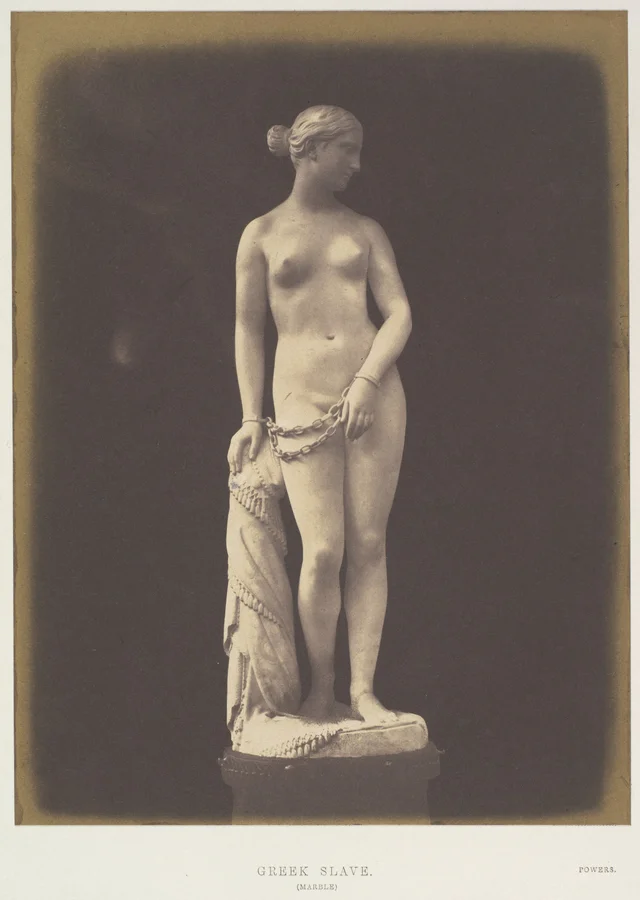
The chains carry the argument. They were carved entirely free of the marble block, even in the narrow gap behind her left hand, so that a viewer who looked closely met the one hard fact in an otherwise soft figure. 8 On the plaster, Powers skipped the carving and tied real chains to cuffs at the wrists; the chains scraped the surface and left abrasions across the thighs. 12
American audiences were allowed to look because the figure was, in the phrase the Reverend Orville Dewey made famous, "clothed all over with sentiment, sheltered, protected by it from every profane eye." 19 Some venues wanted separate hours for men and women. Miner Kellogg, who ran the American tour, refused, on the ground that there was nothing in the statue a modest woman should not study. 9
Abolitionists used her image to argue against slavery in the United States. Slaveholders admired her as well. The museum's label on its reduced marble puts the double life plainly: "Popular among both enslavers and abolitionists, the latter used this image of a captive White woman to elicit sympathy for enslaved African Americans." 5
Six marbles from one matrix
Between 1844 and 1866 Powers's studio cut six full-size marbles from this plaster and its successor. Each was sold as an original, and each patron asked for something nobody else would have. 23
| Version | Date | Present location | What distinguishes it |
|---|---|---|---|
| First | 1844 | Raby Castle, Staindrop, County Durham 8 | The first marble cut; bought by Captain John Grant of London 2 |
| Second | 1846 | Corcoran Collection, National Gallery of Art, Washington 8 | Ordered by William Ward, later 1st Earl of Dudley, who released it so Powers could send it to America 9 |
| Third | 1847 | Newark Museum, New Jersey 8 | Shown in the 2014–15 exhibition Sculpture Victorious 3 |
| Fourth | 1848 | Lost 10 | Lord Ward's second commission, with the Phrygian cap left off the support 10 |
| Fifth | 1850 | Yale University Art Gallery, New Haven 8 | Made for Prince Anatole Demidoff, on an elaborate pedestal of its own 3 |
| Sixth | 1866 | Brooklyn Museum, New York 8 | Cut from a second pointing plaster, with a straight-bar shackle in place of chains 2 |
Grant, who owned the first, wrote to Powers in 1844 in a temper about the second: "I confess I should have been better pleased if he had ordered some other subject and allowed the Slave to stand alone." He asked Powers to leave the chains off his version, or to substitute a cord, and to inscribe it as made to his order. 2 Ward, who wanted his drapery "more careless," got one twist of cloth removed from the support. 210
The variations landed where the pointing machine could not reach: the drapery, the support, the accessories, the chains. The body stayed identical because it was measured, and the individuality was granted in the places measuring did nothing. 2 The sixth marble, made at the end of the Civil War, replaced the draped double chain with a straight iron shackle, and for it Powers built a second pointing plaster with real shackles set into the surface. 2
The gallery and the glass palace
The first marble went to London in 1845, and Grant made sure it went on show. He had the rotating pedestal covered in maroon cloth, the floor carpeted to match, a railing put in front and a circular screen hung from the ceiling so a curtain could be raised and lowered over the statue. 8 By October he could report that "upwards of 40,000 persons" had seen her. 8
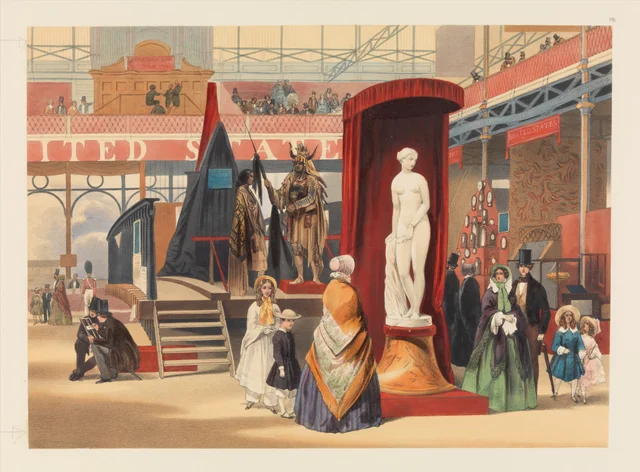
In 1851 the same marble stood in the Great Exhibition at the Crystal Palace, lent by Grant to the American section. It turned on a pedestal under a red canopy, in a hall that six million people visited, and the setting changed what the figure meant. 811 She became an exhibit of American produce in a palace of industry, with George Catlin's Indian Gallery staged behind her and an eagle over the court. 8
Punch took the invitation. On 24 May 1851 the magazine asked why America had sent "the Greek Captive in dead stone" and omitted "the Virginian Slave in living ebony," then printed an eagle with a cat-o'-nine-tails before four chained figures, captioned "Sample of American Manufacture." 8 Antislavery demonstrators worked the fair as well, some of them fugitive slaves, and the British press used the statue to attack American slavery. 11
The tour that made her famous
The fame started earlier than London's glass palace and travelled further. In 1847 Powers sent the second marble to the United States and put it in the hands of Miner Kellogg, a painter friend from Cincinnati who had dug at Nineveh and travelled in Turkey and Greece. 9 Kellogg took 20 per cent of the net profit and paid his own expenses once receipts passed $10,000. 9
The show opened at the National Academy of Design in New York on 26 August 1847, after two days of press previews. Kellogg arranged the platform, the gas lighting, the hangings, the insurance, the tickets and the handbills himself, and stood by the statue turning it and answering questions until he was hoarse. 9 He reprinted Dewey's essay in newspapers across the country and sold a twelve-and-a-half-cent brochure that told visitors how to feel. 9 From New York the statue went to Washington, Baltimore, Philadelphia, Boston and other cities. 9
The fourth, and the only picture of her
Lord Ward had ordered a marble in 1846 and then given it up so that Powers could send it to America. In 1848 Powers made him another, and this time followed his taste: the Phrygian cap, the liberty cap that crowns the support, was left off, and the drapery was rearranged. 10 The marble went to Witley Court in Worcestershire, was lent to the Manchester Art Treasures exhibition of 1857, and drops out of the record after the estate was sold in 1920. 10
The standard catalogue of Powers's work says the sculpture was destroyed when Witley Court burned in 1944. The house burned in September 1937, and the marble may have left earlier; nobody knows which. 10
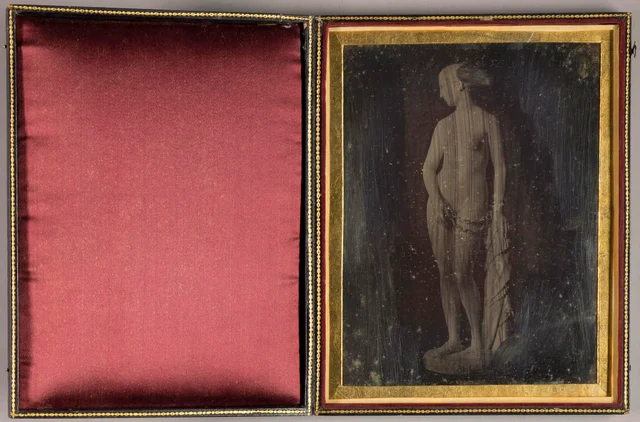
What survives is a daguerreotype. The plate is scratched and faded and was once catalogued by the museum as a mirror. 10 Read closely, it shows a marble with no cap on the support, a different fall of drapery, and a double clasp joining the chains to the manacle that no other version has. 10
Its own chain of ownership runs from Kellogg, who received it from Powers or during a visit to Florence, to his daughter Virginia Somers Snyder, whose estate was bought in 1937 by Martha F. Butler of Alexandria, Virginia. Butler left it to the museum in 1991 with more than four hundred works by Kellogg. 10 Powers had embraced the new medium early, letting visitors take "impressions from the Slave" and sending plates to clients in Philadelphia and England. 10
The patent that never arrived
On 7 July 1849 Powers filed a design patent application for The Greek Slave, sent through the American consulate at Livorno. 13 American design patents had existed since the Patent Act of 1842, and sculpture fell inside them. A sculptor could register a composition and, in principle, stop others from copying it. 13
No patent for the Greek Slave has been found. The application appears to have failed. 13 Plaster and Parian reductions of the figure spread anyway, made by firms that never asked. 13 The museum's exhibition on the plaster was organised with the United States Patent and Trademark Office, and the search for the missing patent behind it grew into a study of nineteenth-century sculptors trying to own their designs. 1314
One of the reductions was good enough to matter. Minton and Company used a mechanical reduction machine to take the proportions off Powers's marble, and their Parian porcelain copies became collected objects in their own right. 11 Frederick Douglass kept a Minton reduction in his house. 11
How she came to Washington
After the fifth marble was finished in 1851 the plaster had no more work to do, and it sat in Powers's last studio, the Villa Powers outside Florence, for the rest of the century and beyond. 2 A photograph by David Lees, taken there about 1952, shows the sculptures in storage, the plasters crowded together under sheets. 2
The museum bought the plaster and about 150 other objects, casts, tools and marbles, from Powers's descendants. The curator who has worked through the studio's papers dates the purchase to 1967, while the accession number 1968.155 carries the following year, and the museum's exhibition text says 1968. 214 The money came from a fund in memory of Ralph Cross Johnson. 1
The cleaning began in 2014 and ran in public view at the conservation centre, which is how a workshop tool became an exhibition. 15 Conservators used a gel that could be held on the surface without soaking the plaster, working around the pencil marks so that the record of use survived the treatment. 15 The sculpture was scanned in three dimensions, printed in glass-infused polymer, X-rayed, and put at the centre of Measured Perfection: Hiram Powers' Greek Slave. The museum's exhibition record gives the run as 2 July 2015 to 8 July 2017; the curator's own article gives the closing date as 19 February 2017. 214
What the record holds
The object's own evidence is unusually complete. A date in Powers's hand, copied from clay to plaster. Several dozen pins and a field of graphite X's that record how the marbles were measured. Abrasions on the thighs where real chains hung. An iron armature with extra bars in the left forearm, sized for that hanging weight. Layers of paint at the wrists from years of repair. 126
The six marbles can be listed with dates and present owners, and five of them are still where the list puts them. The fourth survives as a photograph in a scratched case. 810
What stays open is a shorter list. Whether the head holds a wooden block. Whether the pattern of pin marks could ever tie a particular marble to this particular plaster. Exactly when the museum's purchase was signed. What happened to Lord Ward's marble between the sale of Witley Court and the fire. 2610
The building that holds the plaster is the Old Patent Office, where Powers's application for the design arrived in 1849. The object it described is here too, and no patent ever came of it. 13
References
- 1"Model of the Greek Slave", Smithsonian American Art Museum
americanart.si.edu
- 2
- 3
- 4
- 5"The Greek Slave", Smithsonian American Art Museum
americanart.si.edu
- 6
- 7
- 8
- 9
- 10
- 11
- 12
- 13
- 14
- 15
This story was produced automatically by a channel. One sentence is all it takes for Neodrop to keep producing for you.