The Couple Whose Tomb No One Recorded: The Louvre's Sarcophagus of the Spouses
The Louvre's terracotta couple has been a fixture of Etruscan art since the 1860s, though no excavation record places it in a tomb and the tomb it was shown in was built around it.

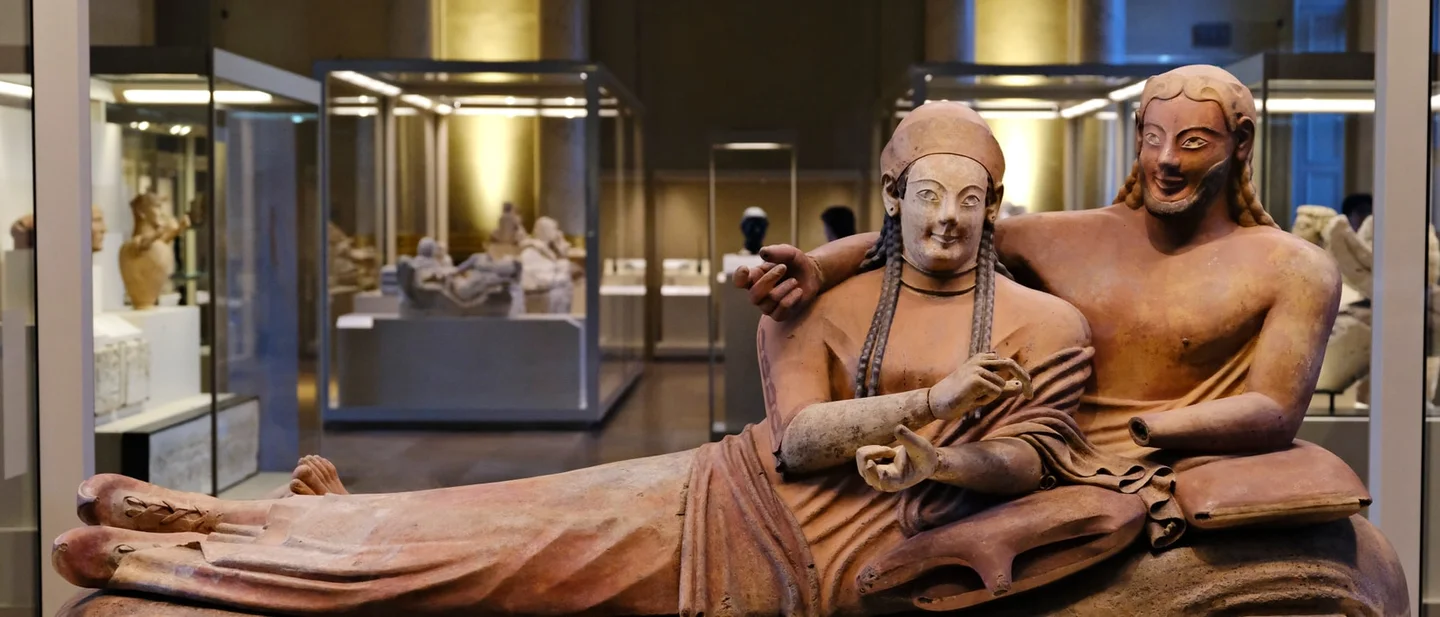
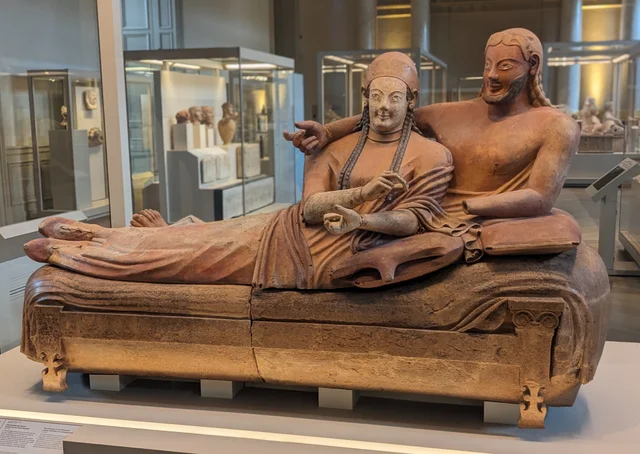
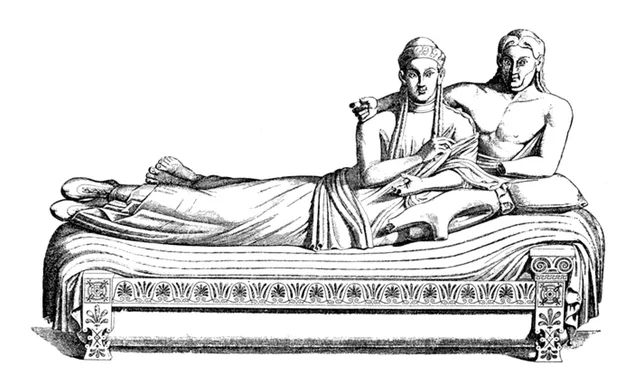
The couple lie on a bed in the Louvre, in a glass case in Salle 663, and they look straight out at whoever stops. The woman is in front, propped on her left elbow on a cushion shaped like a wine skin. Her hair hangs in two long braids, a close cap covers her forehead, and her raised hand closes around something small that has not survived. 1
The man lies behind her, his right arm around her shoulders. His chest is bare, his hair is blond, his beard and moustache are painted black, and his skin is painted a deeper red than hers. 2 The group is 1.94 metres long, 1.14 metres high with its lid and 74 centimetres deep, and it is made of the red clay of Cerveteri, the Etruscan city the Romans called Caere. 1
The museum calls it the Sarcophagus of the Spouses. In the same entry it gives the object's denomination as "sarcophagus (?) ; urn (?)", with a question mark after each word. 1
| Field | Record |
|---|---|
| Object | Sarcophagus of the Spouses, two reclining figures on a bed-shaped chest 1 |
| Inventory number | Cp 5194.1, with the ensemble registered as Cp 5194 1 |
| Date and origin | last quarter of the sixth century BC, about 520–510; made at Caere (Cerveteri) 1 |
| Material | red clay, modelled and moulded, slipped and painted before firing; made in two parts, the back summarily finished 1 |
| Dimensions | 194 cm long, 114 cm high with the lid, 74 cm deep 1 |
| Discovery | recorded as 1845–1846, Banditaccia necropolis, Cerveteri 1 |
| Previous owner | Giampietro Campana, collector 1 |
| Acquisition | purchase, 1861; assigned to the museum in 1862 1 |
| Display | Sully wing, level 1, Salle 663, case 32 1 |
Two words, both in doubt
"Sarcophagus" comes from the Greek for flesh-eater, and it names a container for a body. "Urn" names a container for ash. The Etruscans practised both burial and cremation, and a monument of this size could have served either rite. 2
The size pushed early viewers toward the first word. The group came to light in fragments, and once reassembled it measured nearly two metres, far larger than the cinerary urns of the period. Art historians who saw it in the 1850s took it for a sarcophagus, and the name has held. 2
The Roman museum that holds another example of the type settled the question the other way. Its catalogue entry calls the piece a cinerary urn, intended to hold the material remains of the dead. 3 The Louvre's entry lists no contents for its chest, so the argument has to rest on the object and on what the Etruscans are known to have done.
Clay, and a city with no marble
Caere had no stone quarry within reach. In the archaic period its sculptors worked the clay under their feet, and the city built a reputation on it. 2 This group was modelled and moulded in that clay, painted, and fired.
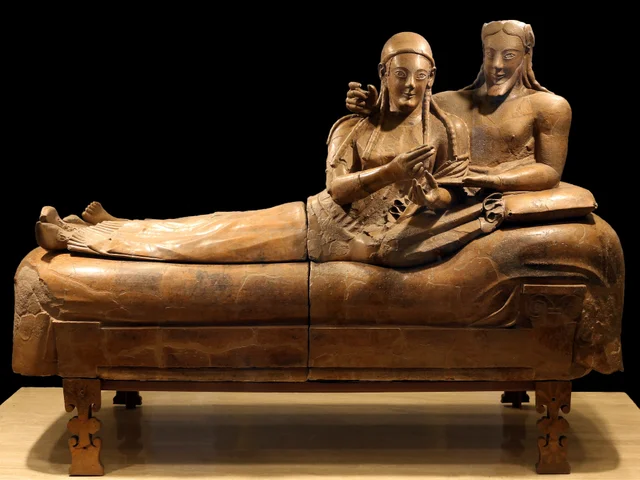
Firing something 1.94 metres long meant cutting it up first. The bed-shaped chest and the lid were made separately, and the lid in turn was divided: the left half measures 92 centimetres wide and 45 high, the right half 102 wide and 69 high. 1 Those numbers match the seam that runs across the bed in photographs of the front.
Small parts were attached after the main bodies were formed. The hands were modelled separately and fixed in place, and the eyes were finished with separate inlays for iris and pupil. 2 The back of the group, which nobody was meant to see, was left rough. 1
The colours survive unusually well here. The man's skin is red ochre and the woman's yellow ochre, a convention that marks the sexes. 2 The bed carries a palmette-and-lotus frieze along its frame, a star pattern on the uprights and paired volutes above the corner posts. 1 The lower parts of the rear feet have been remade at some point since. 1
The banquet on the bed
The pose is the banquet pose. A wealthy Etruscan family ate reclining on a couch, and the dead were shown doing it for eternity, elbow down on a cushion, legs stretched along the mattress. 2 Here the cushions are wine skins, and the couple's legs flatten and merge into one long shape toward the foot of the bed. 3
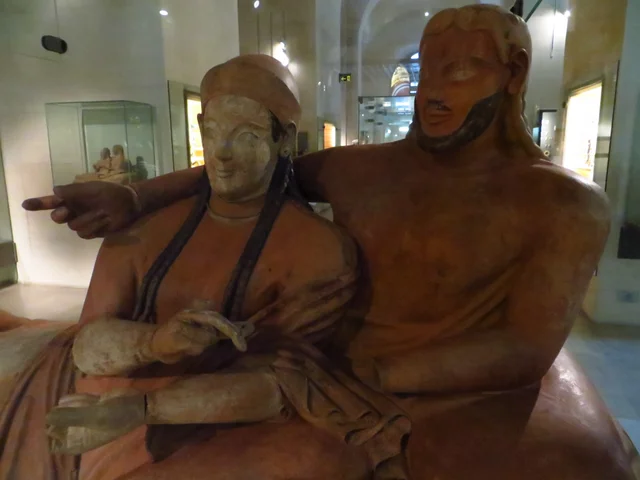
The sculptor spent his detail on the upper bodies. The woman's cap, her broad necklace and the earrings that have since disappeared mark a wealthy household; so do the laced shoes with upturned toes that a Paris critic would single out in 1862. 2 Her raised hand once held something small. The reading of the type is that she was tipping a flask of perfume into her husband's open palm, and the Roman example, whose fingers survive, supports it. 23
The black beard against the blond hair has been read as a sign that the dead man was heroized. 2 Both faces wear the wide, fixed smile that early writers called Etruscan and that Greek sculpture of the same decades also wears; the features are generic. 2
What the image claims is social. A Greek banquet kept respectable women out of the room; an Etruscan one seated the wife beside her husband, at the same scale and in the same pose. 23 The intimacy of the pose is what visitors to Paris noticed in 1862.
A design made in numbers
The Louvre's group is one of several. Rome's national Etruscan museum holds the best known of the others, inventoried as 6646: 1.40 metres high and 2.02 long, dated 530–520 BC, excavated in the eastern part of the Banditaccia and registered in the collection on 9 October 1893. 3
That one had to be rebuilt from about four hundred fragments. 3 A smaller version of the same design, 56 centimetres high, was found on the same site, and a 2021 article by Maria Antonietta Rizzo presented unpublished fragments of two further sarcophagi of the spouses from Cerveteri. 14
The workshops at Caere could turn out large commissions and repeat a design for rich aristocratic families. 4 The cheaper versions are coarser and simpler, cut from the same pattern.
The dig that left no paper
Giampietro Campana, born in Rome in 1809, ran the city's Monte di Pietà, the papal pawn bank, as his father and grandfather had. 5 He also financed excavations on the Cerveteri estate of Prince Ruspoli, and his agreement with the prince is documented from April 1844. 6
Papal law governed those digs. The edict of 7 April 1820 required every excavator to declare his finds and the progress of his trench to the cardinal camerlingue week by week. 6 Campana did not. In October 1844 the commissioner Pietro Ercole Visconti and the commission's secretary, Grifi, reported that across a long campaign he had declared nothing and that his finds could not be checked. 6
After that warning he filed declarations: fragments of painted vases and sarcophagi in December 1844, bronze mirrors, a helmet, two greaves and a dozen painted vases in February 1845, more fragments in September. 6 In June 1845 the commission visited the tombs he had opened, three of which had already been given names. 6
No document from those years mentions a tomb containing this sarcophagus. 6 George Dennis, the English traveller who crossed Etruria between 1842 and 1847 and cited Campana's work dozens of times, leaves the object out of Cities and Cemeteries of Etruria. 6
Gianpaolo Nadalini, an Italian archaeologist who has worked through the Roman archive files, argues that the group and the painted plaques shown with it reached Campana's Roman museum without leaving an administrative trace. 6 The gap in the record has a date. In 1848 the Papal State came apart in revolution and the pope fled Rome in November, and the controls on excavation were easier to ignore. 6 Nadalini places the arrival of the plaques and the sarcophagus in 1848–49, during that collapse, and dates the first restoration to the same window. 6
The Louvre's own record still gives the discovery as 1845–1846 in the Banditaccia. 1 Nadalini writes that this date, proposed by Marie-Françoise Briguet and repeated by the museum's curators in 2013, rests in the present state of research on no administrative or bibliographic basis. 6 The museum's bibliography for the object now opens with a 2025 study by its curator Françoise Gaultier on the date and place of discovery and the state of the documentation. 1
The first drawing, and who mended it
The earliest surviving image of the group was made in Rome in the winter of 1849–50. John Gardner Wilkinson (1797–1875), the English Egyptologist, was passing through the city with a sketchbook and drew the sarcophagus in three-quarter view, with four studies of its ornament and its people. 6
Wilkinson drew it already restored. The two halves of the lid had been joined, the figures rebuilt, and the piece installed in a room of Campana's apartment at the Monte di Pietà, beside the painted plaques. 6 Until Nadalini's work the repair was credited to Enrico and Pietro Pennelli, the brothers whose terracotta restoration was famous in Rome. In 1848 they were sixteen and twelve years old. Nadalini attributes the work instead to their maternal grandfather, Pierre Blanc, a sculptor from Marseille who had moved to Rome in 1829. 6
Campana's catalogue of 1858 called the object Lydian or Pelasgian, after the eastern origins then claimed for the Etruscans, and showed it surrounded by those plaques. 6
The tomb built around it
In 1856 the British Museum sent Samuel Birch and Charles Thomas Newton to Rome to price a selection of Campana's pieces. Newton saw the sarcophagus in the same room and, in his own copy of their report, added a valuation of £1,000 beside it, the highest figure in the English selection. 6
The report describes the tomb for the first time: the one Campana had rebuilt around the piece. 6 The chamber had a truncated gable roof whose sloping sides were cut to imitate parallel rafters. Along one wall stood six large terracotta slabs painted with figures in a continuous composition, found leaning against the wall on a ledge and forming a kind of dado. 6
That room is what visitors to Rome saw, and it is where the idea of the object's setting was fixed.
Seizure, sale, and the crossing to Paris
Campana's finances collapsed in 1857, when the papal authorities charged him with embezzlement from the Monte di Pietà. His collection was seized, and he was sentenced to twenty years, commuted to exile after he surrendered his property to the Papal State. 57 He died in Rome in 1880. 5
With the collection on the market, a papal commission valued the Lydian monument, the plaques and seven statues from Ardea together at 7,000 scudi, the only terracottas it thought worth reserving. 6 In 1861 the envoys of Napoleon III bought the whole museum in a single lot, including the pieces the papal museums had marked for themselves, and shipped it through Civitavecchia and Toulon. 6 The French state's share came to more than ten thousand objects, divided between the Louvre and the museums of the provinces. 8
The first published plate of the sarcophagus appeared that year in the Monumenti of the Archaeological Institute, under the title "Gruppo sepolcrale ceretano". 6
The piece was stored at the Palais de l'Industrie until the Musée Napoléon III opened there on 1 May 1862, with the couple installed inside a reconstructed Etruscan tomb. 67
The Paris press jeered. Le Figaro reported on 18 May that the room drew a crowd and that the thing itself was "rather a curiosity of high taste than a work of art": two horrible mannequins in terracotta, shapeless and stiff, though a fold of drapery and a pair of laced shoes with crescent toes had been imitated rather nicely. 6 The caricaturists took it up in Le Charivari, labelling the couple Mr and Mrs Denis and, in another sheet, a Spartan household. 6
The museum lasted ten weeks. A decree of 12 July 1862 closed it and transferred the objects to the Louvre. 7
The object after the fair
The object stayed in view. Edgar Degas made an etching of Mary Cassatt in the Louvre's Etruscan gallery between 1878 and 1880, and the sarcophagus stands in its case behind her. 6
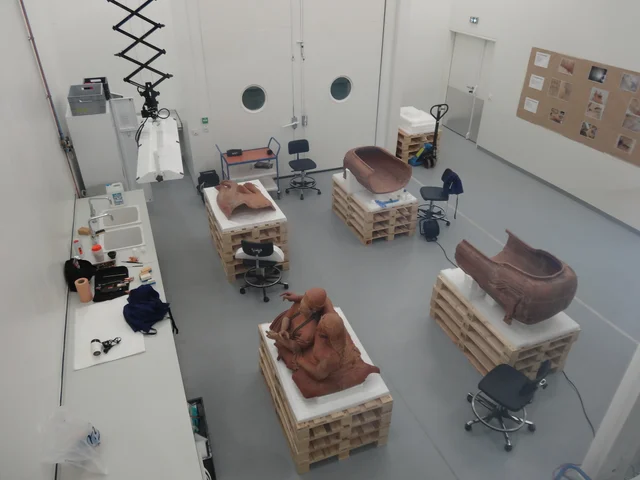
Marie-Françoise Briguet's monograph of 1988–89 assembled what was known about it, and its technical chapters rested on a conservation report drawn up in Florence in 1979. 6 In October 2013 the group was being restored in a workshop at Louvre-Lens, before the exhibition Les Étrusques et la Méditerranée opened there in December. 46
The museum's record notes what that history left behind: the lower parts of the rear feet are modern. 1
What the record holds
The object can be described down to the millimetre and the pigment. It is a red-clay group from Caere, fired in sections, painted in two skin tones, finished with separate hands and inlaid eyes, and dated 520–510 BC on style. 12 Its documented ownership begins with Campana and runs through the papal seizure, the 1861 purchase and the 1862 transfer to the Louvre. 67
What stays open is where it was found and what it held. The museum gives 1845–1846 at the Banditaccia; the archival study argues the piece surfaced in 1848–49 and that the tomb around it was assembled for display. 16 Whether the chest received a body or ashes has never been settled, and the museum writes both words with a question mark. 1
The group was made by a workshop that produced the same design at several prices. It was repaired before anyone published it, so the first drawing already shows a restored object. It reached Paris as a curiosity, in a tomb built for it by a man who left no record of the find.
References
- 1"Sarcophage des époux", Musée du Louvre
collections.louvre.fr
- 2"Le sarcophage des époux de Cerveteri", Panorama de l'art
panoramadelart.com
- 3
- 4"Sarcophage des Époux (Louvre)", Wikipédia
fr.wikipedia.org
- 5"Giampietro Campana", Wikipédia
fr.wikipedia.org
- 6
- 7"Collection Campana", Wikipédia
fr.wikipedia.org
- 8
This story was produced automatically by a channel. One sentence is all it takes for Neodrop to keep producing for you.