Two Coats of Glass: The Portland Vase in Room 70
Two layers of Roman glass and four centuries of argument: the British Museum's Portland Vase traced from a Roman tomb of legend through a cardinal's cabinet, a duchess's sale and a smashed display case, with the documented record kept apart from what the vase's own surface can still prove.

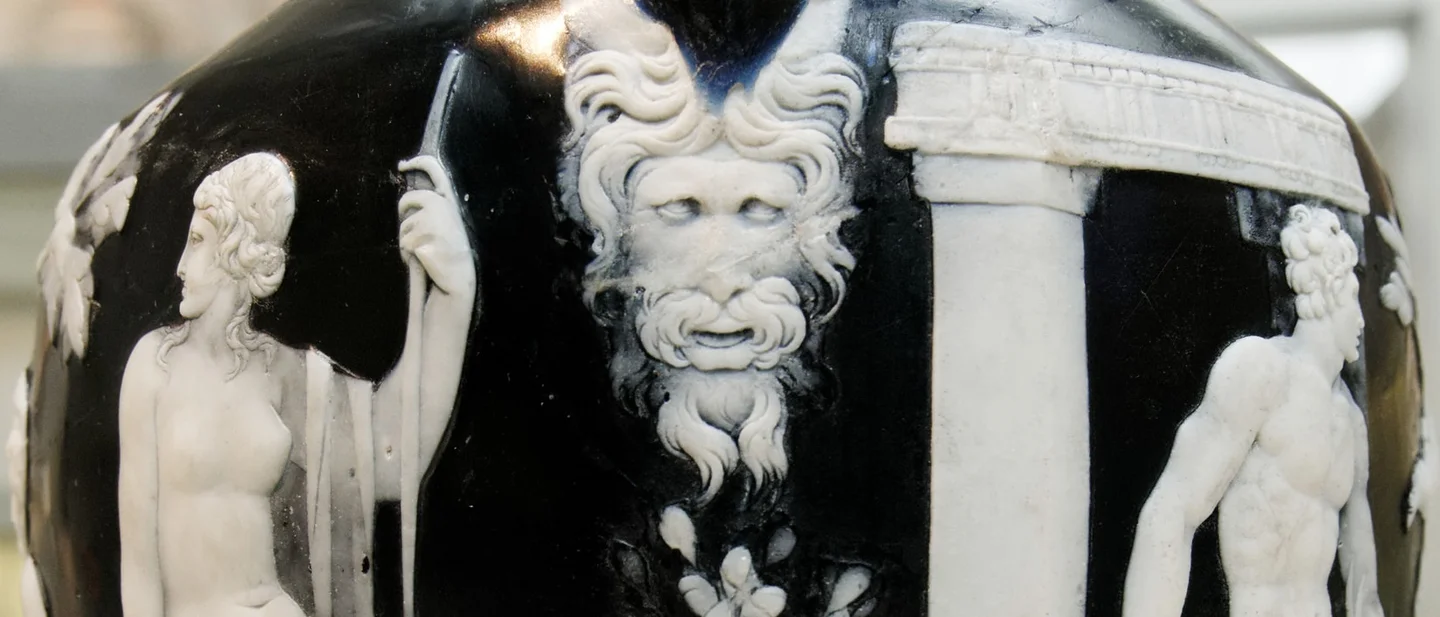
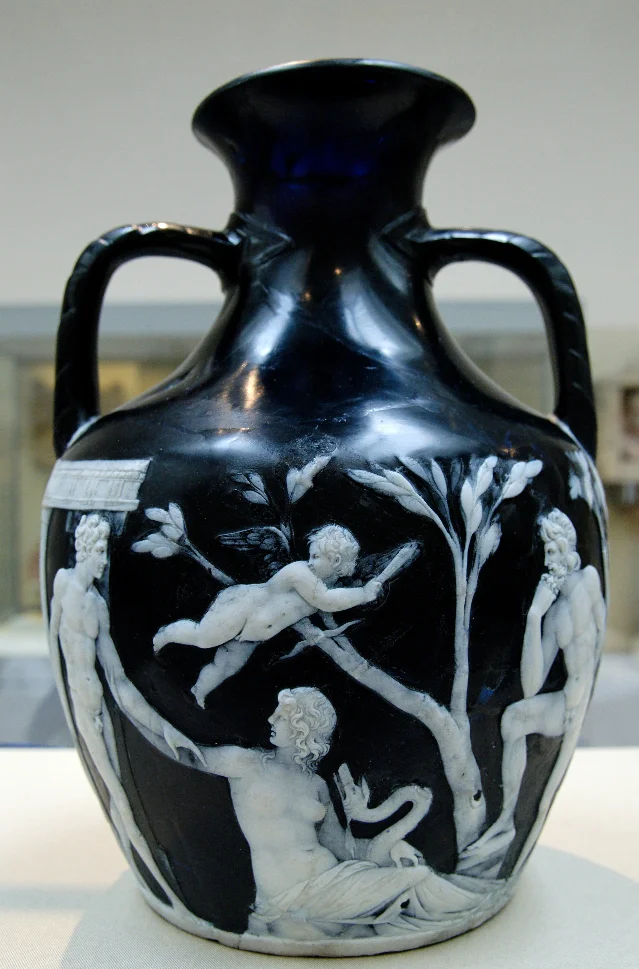
The Portland Vase is built of two layers of glass. The inner body is deep blue, and over it lies a thin skin of opaque white that a cutter has carved back into figures: a young man stepping from a rustic shrine, a half-draped woman seated on the ground with a serpent rising toward her face, a winged boy above her holding a bow and a torch, and a bearded man watching with his chin on his hand. 1 The vessel stands 24 centimetres high and 17.7 centimetres across, with two ribbed handles and a body that has lost its base. 2
Four centuries of examination have made this the most famous surviving piece of Roman cameo glass, and left the argument over what its carved figures are doing still unsettled. 2
| Field | Record |
|---|---|
| Object | Portland Vase, a two-handled amphora carved in two layers of glass 1 |
| Museum number | GR 1945.9-27.1 (Gems 4036) 2 |
| Date and origin | about AD 5–25, perhaps from Rome 2 |
| Material | translucent dark cobalt blue glass under an opaque white layer 1 |
| Height and width | 24 cm high, 17.7 cm in diameter 2 |
| Base | missing; the vessel probably ended in a point, like a cameo-glass vessel found at Pompeii. A cameo-glass disc showing a pensive Priam sat on the underside from at least 1826 and is displayed separately 2 |
| Display | Room 70, Roman Empire 2 |
Two layers, and a dispute over how they met
Cameo glass belongs to a narrow window in the history of the material. Glassblowing arrived around 50 BC, and the museum's account places the making of cameo vessels within about two generations of that invention, when makers were still experimenting. 2
The method the museum records is dip-overlay: a bubble of blue glass was partly dipped into a crucible of white glass, the two were blown together, and the white layer was then cut back to leave the design in relief. The cutting is attributed to a skilled gem-cutter, since the fineness of the work matches the best Roman engraved gems. 2
That account has a rival. In 2017 a team at the Australian National University in Canberra scanned a fragment of Roman cameo glass in a computed tomography machine and examined the air bubbles trapped between the blue and the white. The bubbles were large and flat, and the surface carried cold-working marks. Richard Whiteley, an associate professor of glass at the ANU School of Art and Design, read both features as the signature of pressing and turning: crushed white glass packed into a mould, molten blue glass introduced and pressed against it, the shape formed without blowing — a process now called pâte de verre. 3 Whiteley credited the same conclusion to the German glass artist Rosemarie Lierke, whose writings on the subject in the 1990s had never won acceptance. 3
| Account | What it claims | Evidence offered | Proposed by |
|---|---|---|---|
| Dip-overlay | A blue bubble dipped in white glass and blown, with the white then cut back to leave the relief 2 | The vessel's layered structure, read against the Roman practice recorded in the museum's catalogue 4 | The British Museum, following Susan Walker, its deputy keeper of Greek and Roman antiquities in 2003 4 |
| Pâte de verre | Crushed white glass packed into a mould, molten blue pressed against it, the form built by pressing and turning 3 | CT scans of a Roman cameo-glass fragment showing large flat bubbles and cold-working marks that the ANU team found incompatible with blowing 3 | Richard Whiteley, ANU (2017), and Rosemarie Lierke (1990s) 3 |
Whichever account holds, one stage of the work is agreed: the white layer was cut by hand, figure by figure, and the task called for a cutter of exceptional skill. 2
What the figures are doing
The museum's own summary of the subject keeps to what the carving can support: the theme is love and marriage, the sea-snake places the scene in a marine setting, and the vessel may have been made as a wedding gift. 2 The other side of the vase shows three figures seated on rocks beneath a tree: a young man beside a column or pillar, a half-draped girl reclining on the same rock with her arm raised to her head and a burning torch hanging from her left hand, and a second half-draped girl holding a sceptre. 1
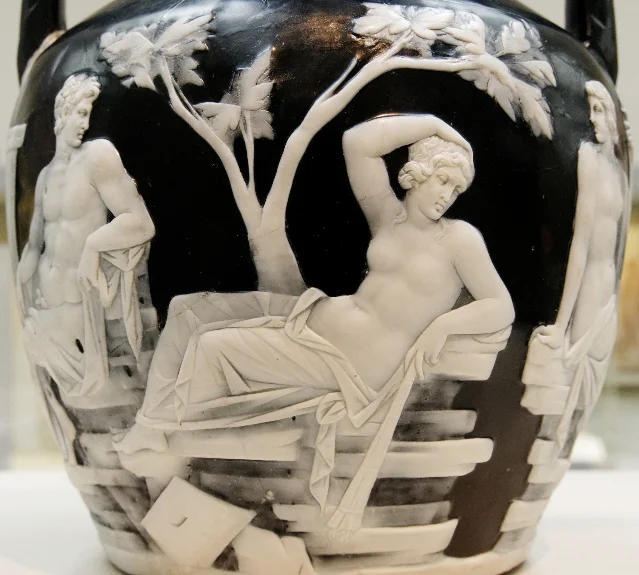
The readings put on the figures have multiplied. The earliest recorded explanation, printed in 1633, took the reclining woman for Olympias, the mother of Alexander the Great, and the serpent for the god Apollo. 5 The reading repeated most often since makes the scene the wedding of the sea goddess Thetis to the mortal Peleus. 6 Others have seen Dionysus greeting Ariadne, or a Roman story: Mark Antony drawn on by Cleopatra on one side, and Augustus consoling his sister Octavia on the other. 6 The carving gives no names, and a torch, a bow and a serpent each answer to several of these stories at once. That is why four centuries of examination have produced a shelf of readings and no agreed one. 6
From a Roman hill to a cardinal's cabinet
The vase's discovery went unrecorded. By the eighteenth century the account ran that it had come out of a tomb under the Monte del Grano outside Rome, from a marble sarcophagus believed to hold the emperor Severus Alexander and his mother Julia Mamaea. That imperial identification was later given up, and the legend stayed with the vase. 6 The museum's published account leaves both the findspot and the year open, so the documented life of the object begins with the vase already in Rome. 2
The first firm sighting is a winter visit. In 1600–01 the French scholar Nicolas-Claude Fabri de Peiresc saw the vase in the collection of Cardinal Francesco Maria del Monte, and wrote to the painter Peter Paul Rubens about it. 7 In 1626 the vase passed into the Barberini collection, the family that had given the church Pope Urban VIII three years earlier. It stayed with the Barberini for a century and a half, and the family's palazzo, designed by Bernini, became a regular stop for British visitors on the Grand Tour. 8
The Barberini years ended in debt. Around 1780 Donna Cordelia Barberini-Colonna sold the vase to James Byres, a Scottish dealer in antiquities, to clear gambling debts. 8 Sir William Hamilton, the British envoy at the court of Naples and one of the great collectors of the period, bought it in 1782, most likely on a bond of £1,000 at five per cent interest — the sign of a man who meant to sell it on. 8
Hamilton found his buyer in England. In 1784 he sold the vase privately to Margaret Cavendish-Harley, the dowager Duchess of Portland, for 1,800 guineas, and she died the following year. 8 Her collection went to auction, and her son, William Cavendish-Bentinck, the 3rd Duke of Portland, bought the vase back into the family. 8 In 1810, after the vase took slight damage, the 4th Duke deposited it with the British Museum for safekeeping. 9 It remained on loan for the next century and a third, apart from three years between 1929 and 1932, when it was offered at Christie's and failed to reach its reserve. 2 The museum bought the vase outright from the seventh Duke of Portland in 1945, with the aid of a bequest from James Rose Vallentin. 2
The copies that spread its fame
Three days after the 1786 auction, the 3rd Duke agreed to lend the vase, together with a cameo from the same lot, so that Josiah Wedgwood could copy it. 8 Wedgwood had spent years developing jasperware, a fine-grained stoneware that holds a crisp relief and can be coloured through its body, and the Roman vase became the test of it. 8
Wedgwood thought about the market from the start. Writing to Hamilton in June 1786, he counted the ways the vase could be copied to suit different purses, from plain white biscuit for artists to polished jasperware for the richest buyers, and warned that the best version might cost £5,000 to produce. 8 The first-edition copies appeared in 1790, modelled by William Hackwood and Henry Webber. 10
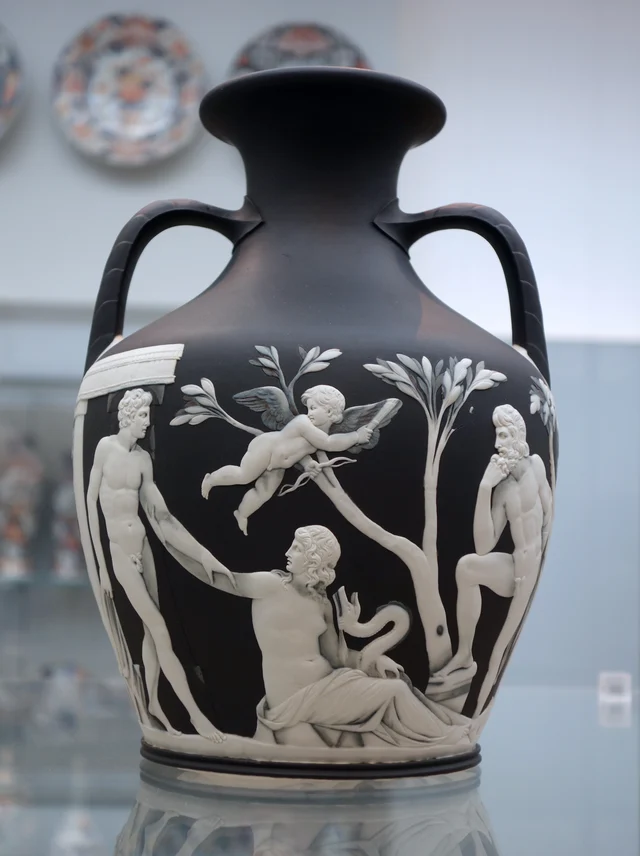
For a while the copies carried more cultural weight than the original. The year after Wedgwood's first copies went on show, Erasmus Darwin put the vase into his poem The Botanic Garden, and the painter Benjamin West made a study for a picture celebrating English manufacture. Both tributes went to the English ceramic copy. 8
The next generation of copies was made in glass. Benjamin Richardson of the Red House Glassworks at Wordsley offered £1,000 to anyone who could reproduce the vase in cameo glass, and two of his employees took up the challenge: Philip Pargeter supervised a cased blank of the right form in 1873, and John Northwood carved it between 1873 and 1876. 11 The exhibition of Northwood's vase set off a vogue for cameo glass in England that lasted to the end of the century. 11
The afternoon it was smashed
On 7 February 1845 a visitor to the museum threw a carved stone from a nearby exhibit at the case holding the vase. The vase broke into more than 80 pieces. 12
The man gave his name as William Lloyd and said he was a student at Trinity College, Dublin; he had been drinking for several days. 12 Charged with wilful damage, he left court with a conviction for destroying the glass case and a fine of £3, because the lawyers arguing the case read the wording of the act as covering only objects worth £5 or less. 12 The museum's own inquiries concluded that the man was William Mulcahy, a student who had gone missing from Trinity College, and the owner dropped any civil claim against him, saying he had no wish to make an impoverished family suffer for "an act of folly or madness which they could not control". 12
The museum's restorer, John Doubleday, rebuilt the vessel, and 37 small fragments stayed out of the repair. 9
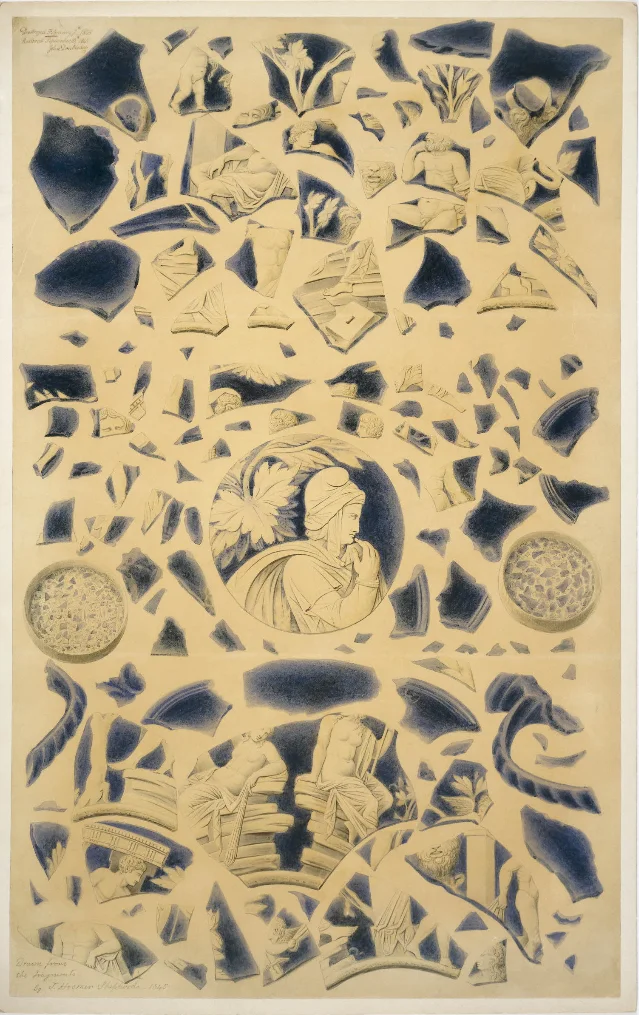
The vase in the case is a later assembly
The 1845 repair aged. By 1948 the museum decided to restore the vase again, and only three of the pieces that Doubleday had left out went back in. 9
The decisive work came forty years later. In 1987 the vase was the centrepiece of an international exhibition of Roman glass, and by then the joins had weakened so far that a gentle tap made the vase rattle. 9 After the exhibition closed, the museum took the vase apart. Conservators photographed and drew every fragment to record its position first, the BBC filmed the dismantling, and conservation scientists tested a range of adhesives for long-term stability before settling on an epoxy resin. 9
Reassembly ran into an obstacle left by earlier repairs: the edges of some fragments had been filed down, so the pieces no longer met cleanly. 9 Every fragment went back except a few small splinters, and the gaps that remained were filled with blue epoxy resin, or with white resin where a loss fell inside one of the figures. 9
The museum's catalogue holds a further qualification about what the visitor is looking at. The white design may have been reworked after the vase was rediscovered in the sixteenth century. 1 A separate registration number covers approximately forty small fragments that are held apart from the vase, most of which went back in during the 1980s work. 1
How the date is fixed, and how far it holds
The vase's date rests on comparison with other objects, because no absolute test reaches it. Carbon dating works on material that was once alive, and glass falls outside it; luminescence dating needs a sample heated above 350°C together with the soil it lay in; the remaining techniques would consume part of the vessel. Comparison keeps the age of the vase open to interpretation. 4
The openness has been tested in public. In 2003 Jerome Eisenberg, the editor of the art and archaeology magazine Minerva, announced that the vase was probably made in the sixteenth century, reading the style of its figures as closer to the Renaissance than to Rome. 4 Susan Walker, then the museum's deputy keeper of Greek and Roman antiquities, answered that disagreement over the iconography gave no reason to think the object modern, and that the case for the vase's date deserved to move a few decades forward, from the late first century BC into the early first century AD. 4 The museum now catalogues the vase as "perhaps from Rome, about AD 5–25". 2
What the record holds
The vase's material and its route to London are documented. Two layers of blue and white glass, cut by hand into figures, and a chain of owners that runs from Cardinal del Monte's cabinet in 1601 through the Barberini, Hamilton, the Duchess of Portland and the Dukes who lent it and finally sold it, to the museum's purchase in 1945. 2
Its making and its meaning rest on inference. The workshop and the cutter are unnamed, the ground the vase came out of is a story, the date is fixed by style, and the figures carry no labels. 2 The disc that once closed the base sits in a separate display, kept with the vase as a related object rather than as part of it. 1
The vase itself stands in Room 70, 24 centimetres tall, white figures on blue, held together by joins made in the 1980s around a break of 1845, and dated by comparison with everything else like it. 2
References
- 1British Museum collection record
britishmuseum.org
- 2British Museum highlights: The Portland Vase
web.archive.org
- 3ANU: CT Lab scans challenge theories of ancient glass making
physics.anu.edu.au
- 4The Guardian: Why can't scientists date the Portland Vase?
theguardian.com
- 5Wikipedia: Portland Vase
en.wikipedia.org
- 6World History Encyclopedia: The Portland Vase
worldhistory.org
- 7
- 8Romantic Circles: Antiquity by Design, Re-Mediating the Portland Vase
romantic-circles.org
- 9
- 10Wikimedia Commons: Wedgwood first-edition Portland Vase, about 1790, V&A
commons.wikimedia.org
- 11Corning Museum of Glass: Replica of the Portland Vase
glasscollection.cmog.org
- 12
This story was produced automatically by a channel. One sentence is all it takes for Neodrop to keep producing for you.