The Book Ruskin Carried Out of the Middle Ages
The Getty's Ruskin Hours traces a richly illuminated book of private prayer from fourteenth-century Cambrai through John Ruskin, auction rooms, and a corrected modern provenance chain.
The Ruskin Hours is a book whose most famous owner arrived more than five centuries after its pages were made. The Getty identifies it as Ms. Ludwig IX 3, accession 83.ML.99: an illuminated manuscript produced in northeastern France around 1300, painted with tempera colors, gold leaf, and ink on parchment. Each leaf measures 26.4 by 18.3 centimeters. 1
It is not named for its medieval maker, its first reader, or a known patron. It is named for John Ruskin, the English art critic and writer who acquired it in the nineteenth century, copied one of its images, and carried its medieval visual language into the argument of Modern Painters. Before that modern afterlife, the manuscript was a working devotional book, a small object designed to organize a layperson's day around prayer. 2
A private prayer book, built for looking
A book of hours was a portable collection of prayers, psalms, and a calendar of Church feasts. It translated patterns of monastic devotion into a form that lay readers could use at home. The Ruskin Hours is an early example of the type, with a rare illustrated litany and marginal scenes that refuse to stay solemn. 1
The Getty's Cultural Objects Names Authority record describes the volume as 128 folios with 13 flyleaves and 57 small miniatures. The collection page, which catalogs the manuscript's digitized components differently, counts more than one hundred historiated initials and 119 related image records. Those numbers are not competing totals for the same category: one describes the physical manuscript's folios and miniatures, while the other includes the many decorated initials and cataloged leaves. 2 1
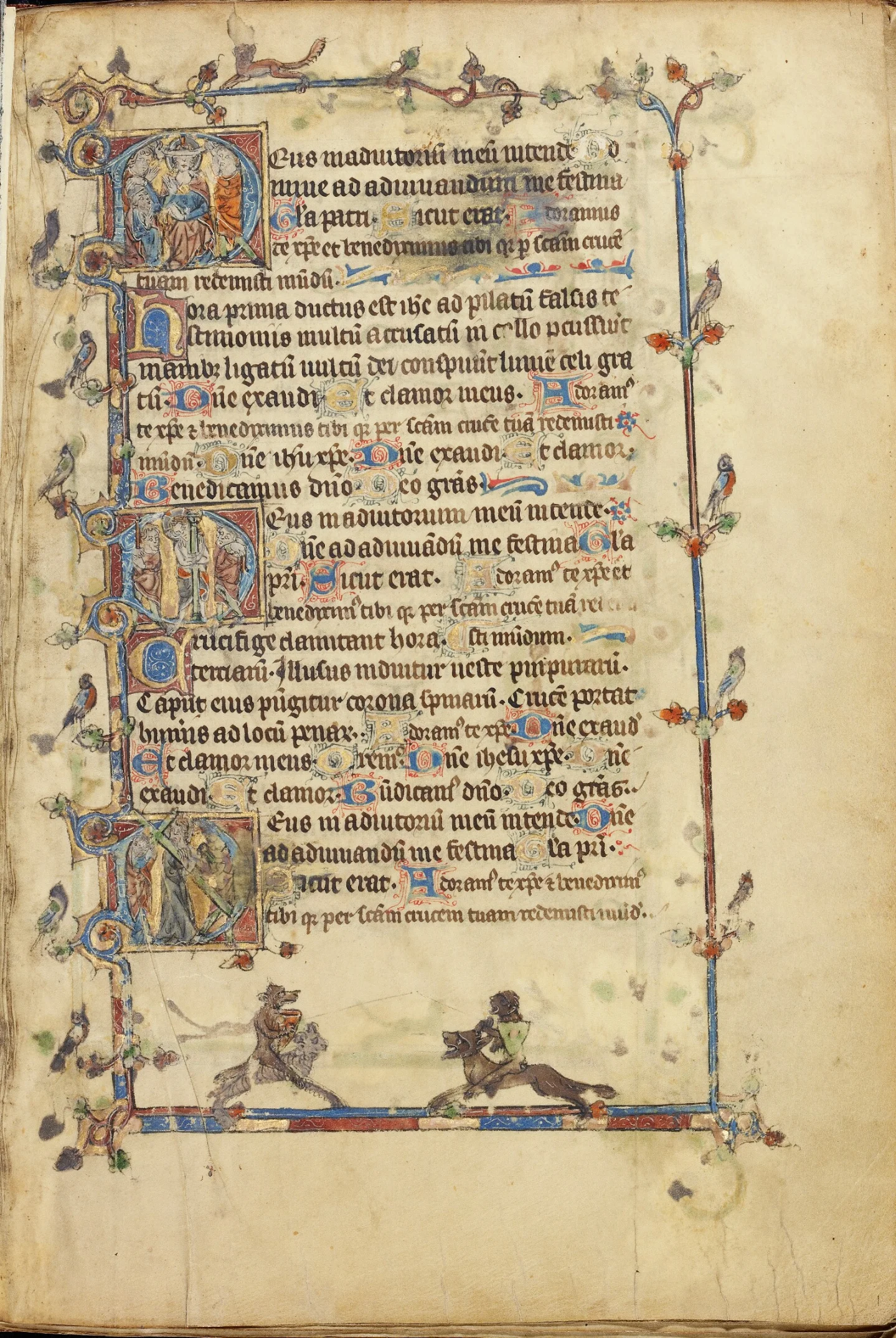
The images make the book's double life visible. A historiated initial is a picture built into the large letter that begins a text. On the opening pages, the letters contain episodes from the Passion: the Mocking of Christ, the Flagellation, and the Way to Calvary. Their blue and red fields are framed by gold and by curling vegetal forms that continue into the margins. 1
The margins loosen the rules of the sacred page. Getty describes men balancing monkeys on their backs, a unicorn and a griffin fighting, and other secular or humorous vignettes. Sometimes a marginal scene answers the religious image beside it. Sometimes it simply provides a small, strange counterworld: animals, performers, and figures moving along the edge while the Latin prayers continue in the center. 1
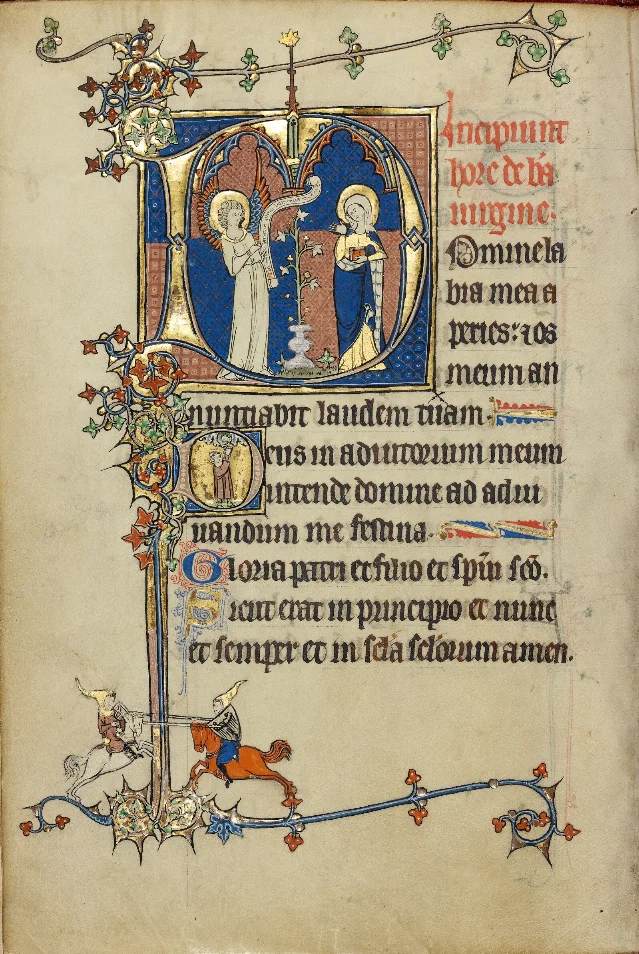
The style belongs to the High Gothic world of northern France: narrow figures, crisp outlines, saturated blue and red, lavish gold, and a taste for filling the page without making it feel inert. Getty's catalog describes the anonymous illuminator's work as lively and attentive to detail. The manuscript's maker remains unknown, but the hand is not anonymous in effect. It gives the book a visual rhythm that a later collector could recognize instantly. 2
The first known stop: Cambrai
The surviving provenance begins in the fourteenth century with the Abbey at Cambrai. That is the first named location in Getty's published ownership list. The record does not identify the person who commissioned the manuscript, the reader for whom it was made, or the exact route by which it entered the abbey. The book's creation is known; the beginning of its institutional life is only partly visible. 1
That gap matters because a book of hours was personal by design. Its calendar could be adapted to a local diocese, its prayers chosen for a particular devotional routine, and its images experienced at very close range. Yet this volume has lost the name that would connect those choices to a specific medieval household. Its identity survives instead through structure: a northern French use, a dense cycle of initials, an illustrated litany, and a margin full of movement. 2
The next documented owner appears only in the nineteenth century. Getty's record places the manuscript with John Ruskin before 1853 and through 1900, and notes that he most likely purchased it while finishing his public lectures in Edinburgh in the fall of 1853. Ruskin's pencil notes remain on the flyleaves, making his possession more than a line in a catalog: the book still carries evidence of the way he handled and studied it. 1
Ruskin sees a modern argument in it
Ruskin was not collecting the manuscript simply as an old religious object. He belonged to a nineteenth-century Gothic Revival that treated medieval art as an alternative to the industrial present: handmade, local, intricate, and bound to a moral or communal purpose. Getty's exhibition Untold Stories places the Ruskin Hours inside that larger Victorian fascination with the Middle Ages. 3
The important act was not only purchase but translation. Getty's exhibition identifies the Nativity initial from the Ruskin Hours as an image Ruskin copied for Modern Painters. He took a picture designed to begin a medieval prayer and made it serve a nineteenth-century essay about art, nature, and the value of close attention. The manuscript therefore became both evidence and instrument: something to preserve, and something to quote. 3
The transformation was selective. Ruskin admired the precision and energy of the medieval illuminator, but his own use of the image detached it from the book's original sequence of prayers. A letter once embedded in a devotional system became a reproduced example in a printed argument. That is not a betrayal of the manuscript so much as another chapter in its working life. The book had already been made to move between text and image; Ruskin made it move between manuscript and criticism. 2
When Ruskin died in 1900, the manuscript passed by inheritance to his cousin Arthur Severn. Getty's record then places it with Sydney C. Cockerell, and later with Sir Alfred Chester Beatty. The online record contains a cataloging wrinkle here: it lists Severn's ownership as 1900–1902 while separately noting a sale to Cockerell in 1920. The safe conclusion is that the succession is documented but the displayed year ranges are not internally consistent; the exact interval should remain qualified rather than silently repaired. 1
The collector's world
By 1924, the book was with Chester Beatty. It remained in his collection until 1932, when it appeared as lot 16 in Sotheby's London sale of the renowned collection of Western manuscripts and went to the dealer Bernard Quaritch. That sale moved the Ruskin Hours from the world of a private library into the faster circulation of the manuscript market, where an object's next destination could be determined by a catalog entry and a bidding room. 1
Getty's record next names Dudley M. Colman in 1952, followed by Major John Roland Abbey, an English book collector whose library sale at Sotheby's in London placed the manuscript with Hans P. Kraus Sr. in 1970. The chain is unusually specific about dates and lots: Abbey's collection sale was held on December 1, 1970, and the Ruskin Hours was lot 2868. 1
The next turn is the one that makes the record worth reading closely. Kraus sold the manuscript to Sir Paul Getty after 1970. It then returned to Kraus after 1974, before passing to the German collectors Dr. Peter and Irene Ludwig by 1978. The Ludwigs sold it to the J. Paul Getty Museum in 1983. 1
This was not always how the provenance was printed. Getty's provenance remarks explain that an earlier version, published in the J. Paul Getty Journal in 1984, listed the owners from Ruskin through the Ludwigs but did not capture Kraus's two appearances. After further research, the museum updated the record in July 2020. The correction is small in physical terms, but important in historical terms: provenance is not a finished chain waiting to be copied. It is an argument that can change when sale catalogs, flyleaf notes, and institutional records are read against one another. 1
What the book became at the Getty
The Getty acquired the Ruskin Hours in 1983, more than six hundred and fifty years after its production. The manuscript entered the Getty's collection as a complete volume, not as a detached miniature or a reconstructed group of leaves. Its record preserves the old accession number 83.ML.99 and the manuscript designation Ms. Ludwig IX 3. 1
The museum has exhibited it in contexts ranging from Gothic manuscript illumination to books of hours and the history of the written word. It is now marked not currently on view, but Getty has digitized a substantial sequence of its pages, allowing readers to follow the book's changing visual tempo: Passion scenes, calendar labor, saints, prayers, animals, and marginal games. 1
That digital sequence also makes the manuscript's scale easier to understand. It is not a single famous miniature. It is an environment built from repetition and variation. The large initials give the eye an entry point; the small figures and vines keep it moving; the text holds the page in place. The book's meaning is distributed across the whole object, which is why a single detached image can be beautiful and still fail to explain what the manuscript is.
A book with several afterlives
The Ruskin Hours began as a northern French devotional volume for private prayer. It then became an abbey possession, a nineteenth-century collector's companion, an image bank for Ruskin's printed criticism, a sale-room lot, a twice-returned dealer's holding, a Ludwig acquisition, and a museum manuscript. Each stage added a new layer without erasing the old ones. 1
Its most revealing feature may be the tension between its known and unknown histories. The early patron is lost. The first documented location is an abbey in Cambrai. The nineteenth-century owner left notes that survive in the book. The twentieth-century chain can be reconstructed down to auction lots, but even that chain required correction. The manuscript's biography is therefore neither a seamless line nor a mystery without evidence. It is a layered record of what institutions, collectors, and the object itself have managed to preserve.
Ruskin gave the book its modern name because he recognized something in its pages that he wanted the nineteenth century to recover: not a generic medieval atmosphere, but a way of making images that could sustain attention. The Getty's digitized folios show what he saw. Gold, ink, parchment, prayer, jokes in the margin, and a letter large enough to hold an entire scene: the Ruskin Hours is a small book that keeps changing scale. 2
Related content
- Sign in to comment.