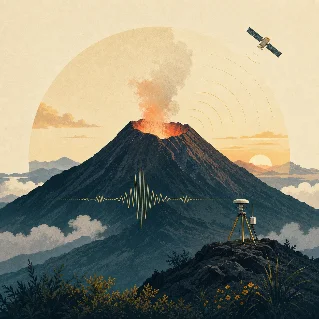
Listening practice: The volcano clues scientists watchPart one: English listening1×2:48Part two: Chinese coaching and vocabulary5:11Part three: English replay0:007:570:00English narratorA volcano can look silent for years, but silence is not the same as sleep. Under the surface, hot rock can move, pressure can rise, and water inside cracks can heat and change. Scientists cannot simply look at a mountain and know the exact hour of an eruption. Instead, according to the United States Geological Survey, they watch a set of vital signs. Those signs include earthquakes, changes in the shape of the ground, volcanic gases, water chemistry, and sometimes fast-moving mudflows called lahars. The goal is not magic prediction. The goal is to notice when a volcano is behaving differently from its normal background pattern.0:40English narratorThe first clue is often shaking. The United States Geological Survey says earthquake activity is the most consistent sign of volcanic unrest. When magma pushes through rock, it can crack the rock around it, and those cracks make small earthquakes. A single earthquake may not mean much. A swarm of earthquakes, changing depth, or a new pattern near the volcano can matter more. Instruments called seismometers record the shaking and help scientists locate where the movement is happening. In this way, a volcano is a little like a locked door: you may not see the person on the other side, but you may hear the handle begin to move.1:15English narratorA second clue is the ground itself. As magma collects below a volcano, the land above it may lift, sink, or shift sideways. According to the United States Geological Survey, scientists use G P S stations to track a monitoring point in three dimensions, sometimes within a very small fraction of an inch. They also use a satellite method called InSAR, which compares radar images taken at different times to map tiny surface changes from space. NASA Earthdata describes how satellite radar can help researchers study many volcanoes and look for deformation, thermal changes, and gas signals. This matters because some volcanoes are remote, snowy, or dangerous to visit.1:58English narratorA third clue rises into the air. Volcanic gases can reveal what is happening underground. The United States Geological Survey explains that gas emission rates and chemical composition can offer clues about magma below. Water vapor, carbon dioxide, sulfur compounds, and other gases may escape through vents and hot ground. Scientists also watch ash clouds, because ash can threaten communities and aircraft far from the crater. The Smithsonian and United States Geological Survey weekly report shows that volcano monitoring is global and continuous, with many observatories reporting activity, alert levels, ash plumes, and satellite observations. A volcano does not speak in one voice. It speaks through shaking ground, swelling slopes, hot gases, and changing skies.2:48Chinese coach这一遍英文的主线很清楚:火山监测不是准确预言某一天几点会喷发,而是观察火山有没有偏离平时的「背景状态」。请抓住三个线索:shaking,地震活动;ground deformation,地表形变;volcanic gases,火山气体。听的时候不要被每个细节绊住,先判断每一段在讲哪一种线索。3:16Chinese coach几个高频词先记住。unrest,是「不稳定、活动增强」,在火山语境里通常指火山开始表现出异常信号。magma,是地下的岩浆;到达地表之后才常说 lava,熔岩。seismometer,是地震仪,用来记录 shaking。swarm,是一群、一连串,earthquake swarm 就是密集的小地震群。background pattern,可以理解为平时的正常波动。3:52Chinese coach第二组词和空间变化有关。deformation,是形变;lift, sink, shift sideways,分别是抬升、下沉、横向移动。G P S stations 在这里不是给手机导航,而是固定在山体附近,长期记录某个点的位置。InSAR 是一种卫星雷达方法,它比较不同时间的雷达图像,帮助科学家从太空看见很小的地表变化。remote 表示偏远,snowy 表示被雪覆盖,dangerous to visit 表示不适合人员直接靠近。4:35Chinese coach最后听一个长句结构:The goal is not magic prediction. The goal is to notice when a volcano is behaving differently from its normal background pattern. 这里有一个对比,不是神奇预测,而是发现「什么时候」火山行为不同于平时。第二遍重听时,请特别留意 according to the United States Geological Survey 这类来源归属表达,以及 clue, sign, signal 这些表示「线索、信号」的词。5:11English narratorA volcano can look silent for years, but silence is not the same as sleep. Under the surface, hot rock can move, pressure can rise, and water inside cracks can heat and change. Scientists cannot simply look at a mountain and know the exact hour of an eruption. Instead, according to the United States Geological Survey, they watch a set of vital signs. Those signs include earthquakes, changes in the shape of the ground, volcanic gases, water chemistry, and sometimes fast-moving mudflows called lahars. The goal is not magic prediction. The goal is to notice when a volcano is behaving differently from its normal background pattern.5:50English narratorThe first clue is often shaking. The United States Geological Survey says earthquake activity is the most consistent sign of volcanic unrest. When magma pushes through rock, it can crack the rock around it, and those cracks make small earthquakes. A single earthquake may not mean much. A swarm of earthquakes, changing depth, or a new pattern near the volcano can matter more. Instruments called seismometers record the shaking and help scientists locate where the movement is happening. In this way, a volcano is a little like a locked door: you may not see the person on the other side, but you may hear the handle begin to move.6:28English narratorA second clue is the ground itself. As magma collects below a volcano, the land above it may lift, sink, or shift sideways. According to the United States Geological Survey, scientists use G P S stations to track a monitoring point in three dimensions, sometimes within a very small fraction of an inch. They also use a satellite method called InSAR, which compares radar images taken at different times to map tiny surface changes from space. NASA Earthdata describes how satellite radar can help researchers study many volcanoes and look for deformation, thermal changes, and gas signals. This matters because some volcanoes are remote, snowy, or dangerous to visit.7:10English narratorA third clue rises into the air. Volcanic gases can reveal what is happening underground. The United States Geological Survey explains that gas emission rates and chemical composition can offer clues about magma below. Water vapor, carbon dioxide, sulfur compounds, and other gases may escape through vents and hot ground. Scientists also watch ash clouds, because ash can threaten communities and aircraft far from the crater. The Smithsonian and United States Geological Survey weekly report shows that volcano monitoring is global and continuous, with many observatories reporting activity, alert levels, ash plumes, and satellite observations. A volcano does not speak in one voice. It speaks through shaking ground, swelling slopes, hot gases, and changing skies.