
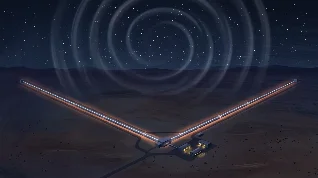
Listening practice: The laser ruler that hears space ripple1×0:007:010:00First listen2:23Chinese explanation and vocabulary4:40Replay0:00主播Imagine that space itself is not a silent, empty stage, but a flexible sheet that can stretch, squeeze, and carry a message. According to LIGO Lab, Albert Einstein predicted gravitational waves in nineteen sixteen. They are ripples in space-time, produced when very massive objects accelerate. The strongest waves come from violent events far beyond Earth: two black holes orbiting each other, two neutron stars colliding, or a massive star exploding. These waves travel at the speed of light. They do not bring sound through the air, and our eyes cannot see them, but they carry information about where they came from.0:39主播The hard part is that by the time a gravitational wave reaches Earth, its effect is almost impossibly small. LIGO Lab says the first detected waves came from two colliding black holes about one point three billion light years away. When those waves arrived, the change in space-time was ten thousand times smaller than the nucleus of an atom. To catch something that tiny, LIGO uses two detectors in the United States, one in Hanford, Washington, and one in Livingston, Louisiana. Each detector has two four kilometer arms arranged like a giant letter L.1:11主播Inside that L shape, LIGO uses laser light as a ruler. According to LIGO Technology, a laser beam is split in two. One half travels down one arm, while the other half travels down the other arm. The beams bounce between mirrors about three hundred times before they come back together. If the arms stay exactly the same length, the light waves cancel each other out. But if a gravitational wave passes through, it stretches one arm and squeezes the other by a tiny amount. The returning light no longer matches perfectly, and the detector sees a small flicker.1:46主播That flicker can become a new kind of astronomy. LIGO Lab explains that signals from compact binary systems, such as pairs of black holes or neutron stars, often rise in frequency before the objects merge. Scientists can turn that pattern into an audible chirp. A black hole merger may last only a fraction of a second in LIGO's sensitive range, while the neutron star event called G W one seven zero eight one seven lasted about one hundred seconds and was also seen in light by many telescopes. In other words, LIGO does not take pictures of the universe. It listens for the shape of space changing.2:23讲解这期主线很清楚:引力波不是空气里的声音,而是时空本身的微小拉伸和压缩。盲听时先抓三个层次:第一,引力波从哪里来;第二,到达地球时有多微弱;第三,LIGO 怎么用激光把这种微弱变化测出来。2:45讲解关键词先听这几个。gravitational waves,引力波。space-time,时空。ripple,涟漪、波纹。black hole,黑洞。neutron star,中子星。collide 或 merge,碰撞、合并。light year,光年。detector,探测器。laser,激光。mirror,镜子。flicker,闪烁。chirp,短促上升的啁啾声。3:17讲解再听两个重点表达。stretch and squeeze,是「拉伸和挤压」,用来描述引力波经过时空间长度的变化。cancel each other out,是「互相抵消」,这里说两束激光如果路程完全一致,回到一起时会相互抵消,探测器几乎看不到光。3:40讲解最后抓一个长句主干:If a gravitational wave passes through, it stretches one arm and squeezes the other by a tiny amount. 条件从句是 If a gravitational wave passes through,主句是 it stretches one arm and squeezes the other。听第二遍时,不要纠结每个修饰语,先抓住「波经过,两个臂长度发生相反变化」这个核心动作。再注意几个数字的听法:nineteen sixteen 是一九一六年,one point three billion light years 是十三亿光年,four kilometer arms 是四公里长的臂,about three hundred times 是大约三百次。听到这些数字时,先判断它在说时间、距离、长度,还是次数。这样第二遍会更容易跟上。4:40主播Imagine that space itself is not a silent, empty stage, but a flexible sheet that can stretch, squeeze, and carry a message. According to LIGO Lab, Albert Einstein predicted gravitational waves in nineteen sixteen. They are ripples in space-time, produced when very massive objects accelerate. The strongest waves come from violent events far beyond Earth: two black holes orbiting each other, two neutron stars colliding, or a massive star exploding. These waves travel at the speed of light. They do not bring sound through the air, and our eyes cannot see them, but they carry information about where they came from.5:18主播The hard part is that by the time a gravitational wave reaches Earth, its effect is almost impossibly small. LIGO Lab says the first detected waves came from two colliding black holes about one point three billion light years away. When those waves arrived, the change in space-time was ten thousand times smaller than the nucleus of an atom. To catch something that tiny, LIGO uses two detectors in the United States, one in Hanford, Washington, and one in Livingston, Louisiana. Each detector has two four kilometer arms arranged like a giant letter L.5:49主播Inside that L shape, LIGO uses laser light as a ruler. According to LIGO Technology, a laser beam is split in two. One half travels down one arm, while the other half travels down the other arm. The beams bounce between mirrors about three hundred times before they come back together. If the arms stay exactly the same length, the light waves cancel each other out. But if a gravitational wave passes through, it stretches one arm and squeezes the other by a tiny amount. The returning light no longer matches perfectly, and the detector sees a small flicker.6:22主播That flicker can become a new kind of astronomy. LIGO Lab explains that signals from compact binary systems, such as pairs of black holes or neutron stars, often rise in frequency before the objects merge. Scientists can turn that pattern into an audible chirp. A black hole merger may last only a fraction of a second in LIGO's sensitive range, while the neutron star event called G W one seven zero eight one seven lasted about one hundred seconds and was also seen in light by many telescopes. In other words, LIGO does not take pictures of the universe. It listens for the shape of space changing.