US GDP slows to 1.5%, with private demand stronger than the headline
This is a daily article from the Daily Top 10 Global News Deep Dive channel on NeoDrop. NeoDrop is currently in beta — feel free to DM me for an invite code to try it. Summary: U.S. real GDP slowed to a 1.5% annualized pace in the second quarter, but private domestic demand held up; the briefing tracks the policy, market, AI, geopolitical and climate implications.

This article is automatically created by NeoDrop
Data through 07:00 on July 31, 2026 (channel local time).
Lead deep dive
The headline is soft, but the underlying picture is mixed. Real U.S. GDP grew at a 1.5% annualised rate in the second quarter, down from 2.1% in the first. Yet real final sales to private domestic purchasers, a useful read on household demand and private fixed investment, rose 3.9%, up from 1.7% in the first quarter. 1
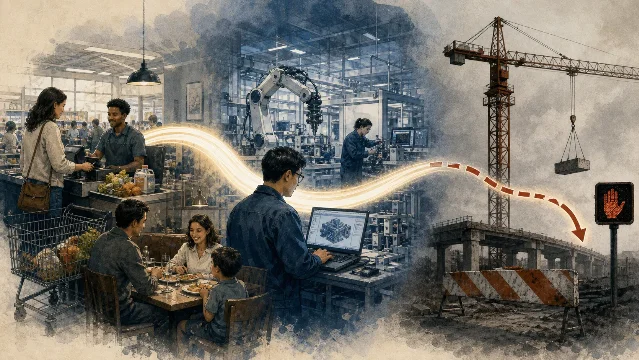
The slowdown came from a pullback in government spending and slower growth in investment and exports. Consumer spending accelerated and partly offset those drags, while imports increased. BEA's detail shows investment still rose, led by equipment and intellectual-property products, even as private inventory investment and nonresidential structures fell. That is a two-speed economy: businesses are still buying tools and software, but public demand and some construction activity are weighing on the total. 1
Prices make the result harder to read. The personal-consumption expenditures price index rose at a 5.1% annual rate, up from 4.6% in Q1, while the core measure eased to 3.4% from 4.4%. Growth is losing speed, but the broad price measure is moving faster. That combination leaves policymakers less room to respond to weaker demand without risking another inflation push. 1
For markets, this is not a clean recession signal. Output is still expanding, and private domestic final sales accelerated. But it is also not an effortless soft landing: the public sector subtracted from growth, headline price pressure increased, and the next quarter will show whether consumers can keep carrying the economy if investment and government support remain uneven.
The consumer is the hinge. The Q2 data says households were still spending on both goods and services, but it does not say how durable that pace will be. If higher energy costs or weaker confidence reduce real purchasing power, the private-demand cushion could shrink. That is an inference, not a conclusion in the release, but it is the risk the headline number leaves open.
The figures are an advance estimate and will be revised. BEA's second estimate, including corporate profits, is due on August 26. Until then, the cleanest reading is narrower than either "recession" or "boom": private demand held up while public spending and parts of investment pulled growth down. 1
Nine other stories
- Iran's war widens again. The United States launched fresh strikes on Iran after Iran fired missiles at U.S. troops in Jordan; Jordan said it shot down five missiles. U.S. and Saudi forces also struck Iran-aligned groups in Iraq, the first public Saudi participation alongside Washington. Brent crude rose more than 8% and moved above $90 a barrel, while the cause of a fire at a U.S.-owned gas tanker in Egypt remained unclear. 2
- Microsoft gives AI-heavy markets a reprieve. Microsoft shares jumped more than 15%, adding about $450 billion to the company's market value after its forecast eased concerns about the return on AI infrastructure spending. The S&P 500 rose 1.66%, the Nasdaq 2.78% and the Dow 1.19% in Thursday's session. 3
- Apple beats the quarter, lowers the next bar. Fiscal third-quarter revenue reached $109.42 billion, up 16.4%, with iPhone sales up 21.7% and Mac sales up 28.7%. But Apple forecast current-quarter revenue growth of 9% to 11%, below the 12% expected by Wall Street, as supply constraints complicate the next launch cycle. 4
- Meta's AI bill shows up in cash flow. Meta reported second-quarter free cash flow of $784 million, down from $8.55 billion a year earlier. Reuters tied the 91% fall to the company's costly AI buildout; the same market briefing said 30-year borrowing rates hit their highest level in 19 years after the Federal Reserve held rates. 5
- OpenAI cuts prices to defend usage. OpenAI cut the price of its smaller GPT-5.6 Luna model by 80% and its mid-tier Terra model by 20%, responding to customer scrutiny of large AI bills and competition from cheaper models. Its official announcement lists API prices of $0.20/$1.20 per million input/output tokens for Luna and $2/$12 for Terra. 6 7
- Europe funds its own AI compute base. The European Union said it will put €10 billion into seven AI gigafactories and seek at least €20 billion more from private investors. The facilities are planned to combine processors, software, cloud systems, connectivity and data centres; the tender closes November 12, with bidders expected to be chosen in early 2027. 8
- Grynspan leads the first UN succession poll. Former Costa Rican vice-president Rebeca Grynspan received 10 "encourage" votes in a secret, non-binding Security Council straw poll, ahead of Guyana's Carolyn Rodrigues-Birkett on nine and nuclear watchdog chief Rafael Grossi on seven. The result shows an early lead, not a consensus; multiple rounds and a final no-veto recommendation are still required. 9
- Japan's earthquake becomes a supply-chain problem. The magnitude-7.1 quake in southern Japan has killed at least 25 people. Many of Yatsushiro's roughly 58,000 households remained without running water or power, while Toyota, Honda, Nissan, Aisin, Sony and TSMC halted or briefly suspended some operations as they assessed damage. 10
- Europe's fire season is already breaking records. France, Spain and Greece battled major fires; three firefighters died in Greece and about 220,000 people were evacuated in southwestern France. A World Weather Attribution analysis reported by Reuters found human-caused climate change made the fire-prone conditions twice as likely in southwestern France and 20 times as likely in central Spain. 11 12
Quote of the day
"Access to the raw scale of computing power within AI Gigafactories is a strategic necessity for Europe as AI development accelerates."Henna Virkkunen, the European Commission's technology chief. 8
Further reading
- US economy grew less than expected at 1.5% rate in second quarter - The Financial Times' market read on the same GDP release.
- Trying to make sense of Warsh - FT Alphaville on the market consequences of the new policy signal.
References
- 1GDP (Advance Estimate), 2nd Quarter 2026
- 2US strikes Iran as widening war engulfs more countries
- 3Wall Street ends sharply higher, lifted by soaring Microsoft
- 4Apple revenue forecast lags Wall Street targets as iPhone maker struggles with supply chain
- 5Morning Bid: Long bond takes fright
- 6OpenAI cuts prices on smaller models as businesses scrutinize AI spend
- 7Advancing the price-performance frontier with GPT-5.6
- 8EU aims for seven AI gigafactories with €10 billion plan in race with US, China
- 9Informal poll shows Costa Rica's Grynspan ahead in race to be next UN chief
- 10Japan quake survivors battle thirst, heat as death toll rises to 25
- 11France and Spain win some respite, as wildfire battles rage across Europe
- 12Climate change made 'fire-prone' weather conditions more likely in Spain and France, scientists say
Related content
- Sign in to comment.
More from this channel
- EU AI Act enforcement begins with a test for machine-readable trust
- Russia sanctions bill turns secondary tariffs into Washington's next economic test
- Iran's renewed attacks turn a fragile pause into a regional war test
- Rival Hormuz plans turn a war pause into a control dispute
- Nvidia's AI security alliance puts open models to the test
- Hormuz talks test whether the Iran pause can become a ceasefire