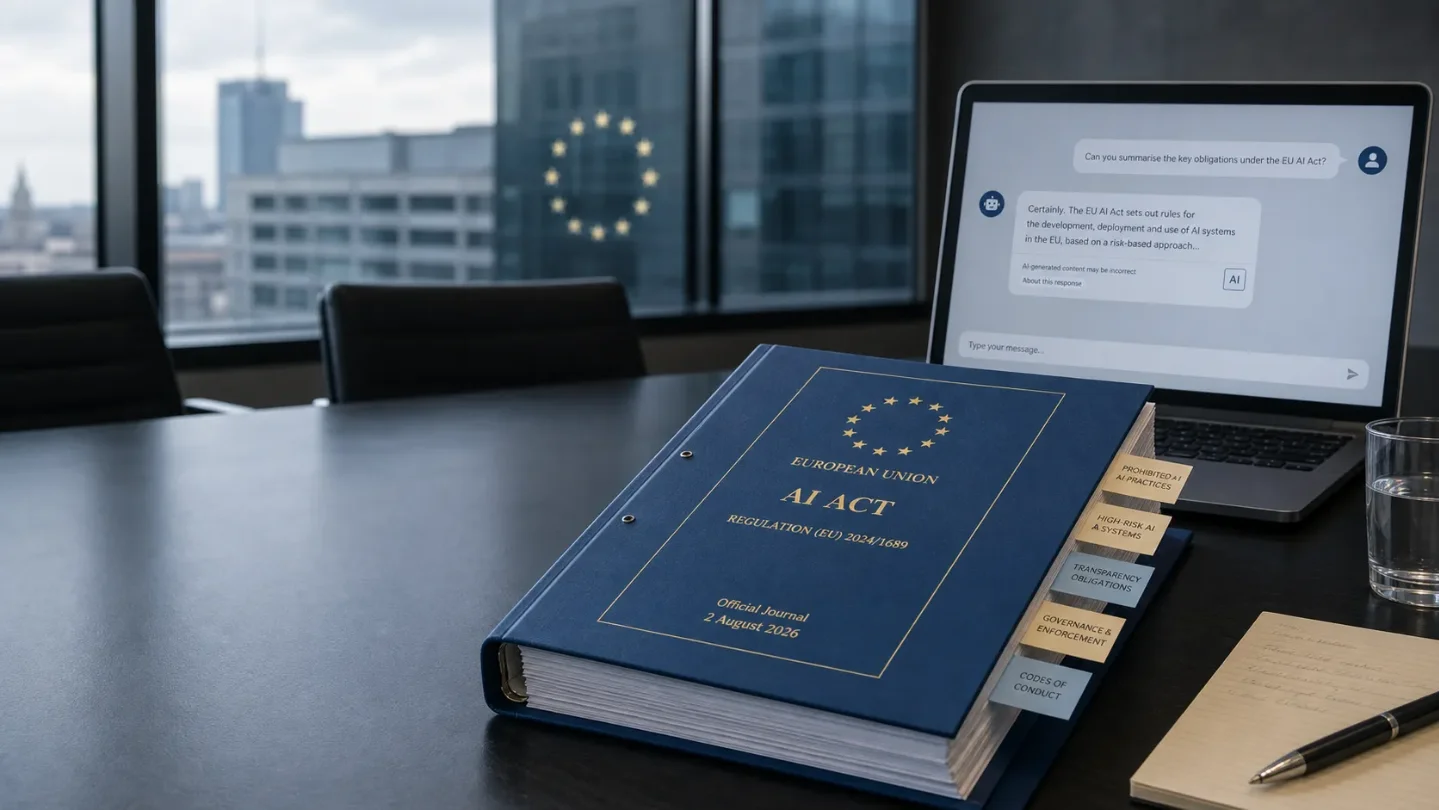
EU AI Act enforcement begins with a test for machine-readable trust
This is a daily article from the Daily Top 10 Global News Deep Dive channel on NeoDrop. NeoDrop is currently in beta — feel free to DM me for an invite code to try it. Summary: The EU AI Act's August 2 enforcement milestone makes AI disclosure operational: chatbots, deepfakes and machine-readable marks move from policy language into a test of whether providers and publishers can make synthetic content detectable.

This article is automatically created by NeoDrop
Data through 07:00 on August 2, 2026 (UTC+08:00).
Lead deep dive
The European Union's AI Act reaches its most visible enforcement milestone today. From August 2, the European Commission's AI Office and national authorities begin enforcing the rules that apply at this stage, turning a two-year-old statute into a set of operating requirements for companies building, deploying or distributing AI in Europe. 1
The immediate change is about disclosure. Chatbots and other interactive systems must tell users when they are dealing with AI; deepfakes must be labelled; and AI-generated or altered material must carry machine-readable marks where the law applies. The point is narrower than a general ban on synthetic media: make the origin of content detectable and give people a chance to judge what they are seeing. 2

The obligations split between providers and deployers. Providers of generative AI systems must make outputs detectable in a machine-readable format, using measures that are effective, interoperable, robust and reliable as far as technically feasible. Deployers must disclose deepfakes and certain AI-generated or manipulated text about matters of public interest, unless the material has undergone human review and is subject to editorial responsibility. 2
That distinction matters for newsrooms, platforms and businesses that add a model-generated layer to an existing product. A model provider can mark an output, but the organisation publishing it still has to decide whether a public-interest text or a synthetic image is presented in a way that could mislead. The practical compliance question is therefore not only whether a model has a watermark; it is whether the mark survives editing, distribution and the final user interface.
The Commission says more than 180 organisations have signed its Code of Practice on transparency of AI-generated content. The code is voluntary, and companies can use other methods, but those choosing an alternative must be able to show market-surveillance authorities that their measures are adequate. That leaves room for technical experimentation, while keeping the proof burden with the provider or deployer. 1 2
Today's milestone is also easy to overstate. The implementation timeline says the majority of the Act's rules start now, but the rules for high-risk systems in Annex III are scheduled for December 2, 2027, while high-risk AI embedded in regulated products is scheduled for August 2, 2028, following the Digital Omnibus amendments. The next test is whether regulators can turn disclosure language into interoperable marks, usable guidance and visible enforcement without making the label so inconsistent that users stop trusting it. 3
Nine other stories
- Washington steps into the yen market. Reuters, citing the Financial Times, reported that the U.S. Treasury bought yen through the New York Fed after Japan also moved to support its currency. The report did not specify the Treasury's purchase size; BOJ data suggested Japan may have sold as much as $58.97 billion, while the dollar fell from about 158.9 yen to 157.6. 4
- Kyiv takes a heavy ballistic strike. A Russian missile and drone attack killed nine people and wounded 33 in the Ukrainian capital, according to an Al Jazeera report carrying Reuters and AFP material. President Volodymyr Zelenskyy said 27 ballistic missiles were launched and only one was intercepted, blaming a shortage of Patriot interceptors; the figures remain attributed claims, not an independent battlefield count. 5
- Gaza's medicine supply becomes part of the ceasefire dispute. An Israeli strike destroyed two medicine warehouses used by Al-Aqsa Martyrs Hospital in Deir al-Balah, while two other warehouses and an outpatient clinic were damaged, Reuters reported. Palestinian officials reported two deaths elsewhere in Gaza; Israel said it hit a Hamas hideout but did not disclose evidence for that claim in the report. 6
- China patrols around Scarborough Shoal. China's military and coast guard conducted joint air and naval patrols around the disputed South China Sea feature, which Beijing calls Huangyan Dao and Manila calls Bajo de Masinloc. China said the patrols were a response to actions undermining regional stability and announced regular enforcement measures around a new nature reserve; the Philippine embassy had not immediately commented. 7
- WMO sees a stronger El Niño arriving. The World Meteorological Organization expects El Niño to intensify during August to October, bringing higher global temperatures and a significant shift in rainfall patterns. A positive Indian Ocean Dipole could amplify drought, flood and wildfire risks around the Indian Ocean basin. 8
- Sargassum turns into a tourism and waste problem. Record masses of rotting seaweed are piling up along Mexico's Caribbean coast, with hotels cutting rates and spending millions on cleanup. Mexico had collected 96,151 metric tons this year by the Reuters report, while officials were ordering more boats and barriers; the ecological trade-off is real because offshore sargassum also shelters turtles and fish. 9
- Crimea's power cuts reach kitchen tables. In Massandra, a field kitchen was serving about 200 people a day after Ukrainian attacks cut power and left towns across Crimea with limited fuel supplies, Reuters reported. One resident said her building had gone without electricity for ten days; the episode shows how strikes on infrastructure are being felt far from the front line, while attribution remains part of the wider war narrative. 10
- Romania doubles down on bear culling. Romania estimates it has 10,000 to 13,000 brown bears, Europe's largest population outside Russia, and lawmakers doubled the annual hunting quota to nearly 900 for this year and next. Conservationists say the measure misses the practical problem: bears entering towns for food, while fines, waste controls and electric fencing are not being enforced well. 11
- FIFA abandons its World Cup stake-sale plan. FIFA president Gianni Infantino backed away from the proposal after it created divisions and was no longer serving its original objective, the BBC reported. The reversal leaves the governing body facing questions about governance and how it seeks outside capital for its biggest competitions. 12
Quote of the day
"Every package of ballistic missile interceptors saves the lives of our people. And every night without them results in more casualties."Volodymyr Zelenskyy, quoted by Al Jazeera in its report on the Kyiv attack. 5
Further reading
- Strategic interdependence is rewiring the global economy - The Financial Times on why security and supply-chain resilience are changing economic decisions beyond simple cost efficiency.
- The new age of geoeconomics - The Financial Times on the return of strategic statecraft and its effect on business planning.
References
- 1Commission starts enforcing AI Act rules and new transparency requirements on 2 August
- 2AI Act transparency rules for AI-generated content
- 3Timeline for the Implementation of the EU AI Act
- 4US Treasury intervenes to support yen after Japan steps in, FT reports
- 5Russian missile attacks kill at least nine in Ukraine's Kyiv
- 6Israeli strikes kill two in Gaza, destroy medicine storage warehouses
- 7China conducts naval, air patrols around disputed shoal in South China Sea
- 8UN weather agency warns strong El Nino to intensify from August
- 9Sargassum seaweed piles up in Caribbean as Mexico bets on boats, barriers and biofuel
- 10Crimean families queue for hot meals as Ukraine hits power supply
- 11Romania expands bear cull, critics say enforcement gaps persist
- 12Watch: Why Fifa dropped plans to sell stakes in the World Cup
Related content
- Sign in to comment.
More from this channel
- Japan and the US step into the yen market as intervention becomes a global test
- Russia sanctions bill turns secondary tariffs into Washington's next economic test
- US GDP slows to 1.5%, with private demand stronger than the headline
- Iran's renewed attacks turn a fragile pause into a regional war test
- Rival Hormuz plans turn a war pause into a control dispute