June 21, 2026 · 7:23 PM
Longevity Digest — June 15–22, 2026
Nature scrutinizes biohacking; Johnson launches Akkermansia supplement & rebrands to Immortals; Sinclair unveils SL-100 with no data; Attia on breast screening & AI clinical limits; Patrick on APOE4 meat/dementia & circadian eating.

Research Brief
Two competing visions of longevity science collided in public this week. Nature spent 3,000 words auditing Bryan Johnson, Andrew Steele and Nir Barzilai told the journal's readers that no intervention has proven it can extend human life by targeting aging, and Johnson spent June 17–21 defending n=1 experimentation, launching a new supplement, and renaming his company "Immortals." David Sinclair was absent from social media for nine straight days while his two major June 15 claims — an oral reprogramming drug called SL-100 and a forthcoming Nature sirtuin paper — circulated without supporting data. Peter Attia published a solo podcast on breast cancer screening and a detailed critique of AI diagnostic reasoning. Rhonda Patrick posted two original threads backed by peer-reviewed studies.
Below is the week of June 15–22, 2026, organized by expert.
Peter Attia — breast cancer screening and the limits of clinical AI
Annual mammography vs. the USPSTF guideline
On June 15, Attia (physician, founder of Early Medical) released Episode #396 of The Peter Attia Drive as a freely available public service announcement, with comprehensive show notes. 1 The episode is a solo lecture on personalizing breast cancer screening — which modality, which frequency, and when to start.
The organizing data point: approximately 42,000 women die annually from breast cancer in the US (SEER data), with roughly 1 in 8 facing lifetime risk. Annual screening mammography (CISNET modeling) produces a 42% breast cancer mortality reduction; biennial drops to 30%, and produces 165 life-years gained per 1,000 women vs. 230 for annual. Attia named the USPSTF biennial recommendation "optimized for population-level efficiency, not for maximizing an individual woman's chance of avoiding breast cancer death." 1
His imaging hierarchy:
- DBT (3D mammography) as the foundation — better cancer detection and lower recall rates than 2D, especially for dense breasts.
- Abbreviated breast MRI as the most effective supplemental tool. The DENSE trial (adding MRI after a negative mammogram in women with extremely dense breasts) cut interval cancers from 5 to 2.5 per 1,000. Attia called abbreviated MRI "the most underutilized tool we have" — approximately 9% of women meet criteria for it under major guidelines; only 0.4% actually receive it.
- CEM (contrast-enhanced mammography) as next-best when MRI is unavailable.
- Ultrasound as viable but more operator-dependent.
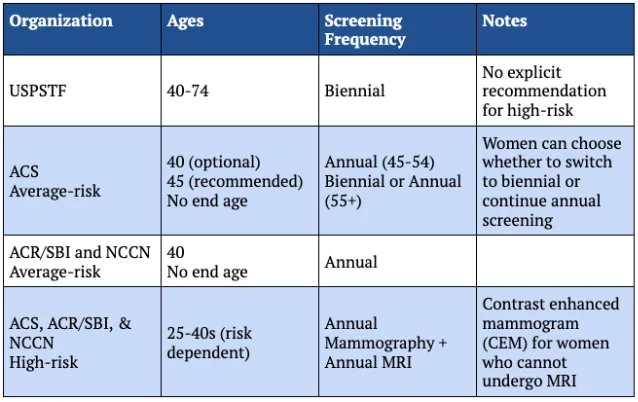
For high-risk women (BRCA carriers, strong family history, prior chest radiation), Attia recommended aggressive screening starting in the 20s or early 30s, with MRI as the primary supplemental tool. For BRCA1 carriers, risk runs approximately 100× non-carriers in the late 20s, approximately 44× in the 30s, and approximately 3× by the 60s. 1
His four-step framework: (1) complete a formal risk assessment using Tyrer-Cuzick by age 25 (ibis.ikonopedia.com); (2) establish breast density through baseline imaging; (3) choose modality and frequency matched to individual risk; (4) execute consistently. He recommends a baseline mammogram in one's 30s primarily to document density for risk stratification, noting this is a personal recommendation without direct trial evidence. 1
One flag that doesn't involve a lump: inflammatory breast cancer (1–5% of all breast cancers) presents as rapid swelling, redness, warmth, or skin texture changes and may not appear on mammography. Attia: "If you notice something new, a lump, skin changes, nipple discharge, pain that does not resolve, do NOT wait for your next scheduled screening." 1
Actionable step: Use the Tyrer-Cuzick calculator at ibis.ikonopedia.com to complete a formal risk assessment. If your lifetime risk is above 20%, ask your provider about adding abbreviated MRI to annual mammography.
AI models fail the clinical reasoning test that matters most
On June 20, Attia co-authored a blog post with Taylor Yeater and Lauren Fritsch reviewing a JAMA Network Open study (Rao et al., 2026) that tested 21 frontier large language models (LLMs) across 29 standardized clinical vignettes. 2 The study used a new scoring system called PrIME-LLM (Proportional Index of Medical Evaluation for LLMs), which measures balanced performance across five domains: differential diagnosis, diagnostic testing, final diagnosis, management, and miscellaneous clinical reasoning. Unlike raw accuracy, PrIME-LLM penalizes lopsided performance — a model that nails final diagnosis while generating poor differentials gets dragged down.
The headline result: across all 21 models from OpenAI, Anthropic, xAI, DeepSeek, and Google DeepMind, overall accuracy clustered between 81–90%. But differential diagnosis — generating a ranked list of possible explanations before committing to one — failed at a rate exceeding 80% across all 21 models. PrIME-LLM composite scores ranged from 64–78%, exposing the gap that accuracy masked. 2 3
Reasoning-optimized models (mean PrIME-LLM 76%) outperformed non-reasoning models (mean 67%), with an effect size of Cohen's d = 2.60. The models were tested without RAG (retrieval-augmented generation), clinical calculators, or electronic health record access — conditions that don't match real clinical deployment.
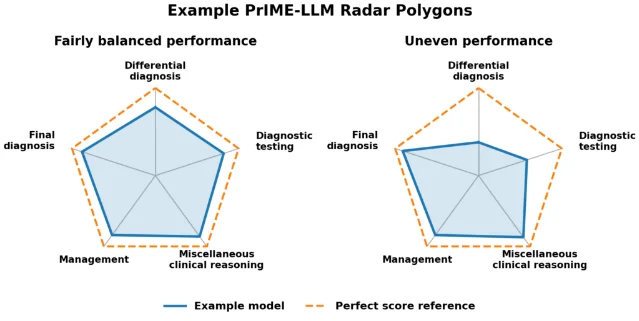
The team's explanation for the differential diagnosis failure: LLMs "collapse prematurely onto a single answer rather than preserving uncertainty and iteratively refining competing possibilities, which is precisely what good clinicians do." 2 Final diagnosis accuracy being high may reflect the same problem from the other side — pattern-matching when information is complete, but failing when competing possibilities need to be held in tension.
Their position on deployment: for lower-stakes, clinician-supervised work (summarizing notes, drafting patient explanations, structuring documentation), adoption is reasonable. For autonomous diagnostic reasoning: "a different proposition entirely." The blog draws an analogy to drug approval: "We do not approve drugs because they show promise in early testing; we require evidence of safety and efficacy in the populations and conditions where they will actually be used. The same standard should apply here." 2
David Sinclair — two big claims without supporting data, and nine days off X
Full 2026 protocol disclosed at Abundance360
On June 15, Sinclair (Harvard Medical School genetics professor, co-founder of Life Biosciences) disclosed his complete 2026 supplement and lifestyle protocol in an interview with Peter Diamandis at the 2026 Abundance360 Summit. 4
His current morning supplement stack, as reported:
| Compound | Dose / Details | Stated rationale |
|---|---|---|
| NMN (nicotinamide mononucleotide) | 1g | NAD+ precursor, supports sirtuin activity |
| Resveratrol | 1g | Mixed with olive oil or yogurt for absorption; sirtuin activator |
| Metformin / berberine | 1g, cycled | mTOR and AMPK modulation; alternated due to metformin Rx requirements |
| Nattokinase | 10,000 IU | Claims 2022 Frontiers in Cardiovascular Medicine study (n=1,062) shows plaque reversal; expects effects after ~1 year |
| Spermidine | Unspecified dose | Polyamine involved in autophagy; Sinclair states it extends lifespan in every animal model |
| Vitamin D3/K2 | Unspecified dose | Standard deficiency prevention |
| Low-dose aspirin | Most days | Cardiovascular benefit; Sinclair states benefits outweigh bleeding risks for high-risk individuals |
| Glycine | ~5g | Amino acid; collagen precursor |
| Niacin | ~500mg | NAD+ pathway support |
Lifestyle elements: mostly plant-based diet emphasizing "stressed plants" (the xenohormesis hypothesis, which holds that plant stress compounds trigger beneficial responses in animals that consume them); alcohol only a few times per year; daily 14–16 hour intermittent fasting window (skips breakfast); monthly 3-day fast for autophagy; recently started daily meditation; coffee and tea throughout the day. He also recommends full genome sequencing and carotid ultrasound for preventive screening. 4
Note on confidence levels: NMN.com is a supplement-adjacent media outlet with commercial interests. The protocol details are flagged "likely confirmed" in the research summary rather than independently verified through Sinclair's own direct publication.
SL-100: an oral reprogramming drug announced without published data
Also on June 15, Sinclair told Livelong Media that his lab has developed SL-100, an oral drug designed to reverse aging across the entire body through chemical reprogramming — using the bloodstream to reach targets throughout the body, unlike gene therapy that typically acts on a single tissue. 5 SL-100 is intended as Sinclair's entry in the $101 million XPrize Healthspan competition, which sets a goal of a 10-year improvement in immune, cognitive, and muscle function after one year of treatment.
No peer-reviewed animal data for SL-100 has been published. Vadim Gladyshev (Harvard, a separate researcher) has published work warning that chemical reprogramming is toxic in mice. The scientific response described in the Livelong Media piece was "cautious." Livelong's editorial note: without complete evidence that SL-100 works, and no agreed measurement framework, it will be "interesting to see how XPrize judges evaluate claims without standard peer review." 5
Separately, Sinclair stated his lab is about to submit a paper to Nature on sirtuins' influence on epigenetic information restoration. As of June 22, no preprint is publicly visible on bioRxiv, the Sinclair lab's Harvard publications page shows no new 2026 papers, and PubMed returns no corresponding listing. 6
ER-100 Phase 1 gets detailed media coverage
The Washington Times (June 16) and Axios (June 18) published in-depth pieces on ER-100, the epigenetic reprogramming gene therapy developed by Life Biosciences (co-founded by Sinclair). 7 8 The first patient was dosed on June 9 (reported in last week's digest). This week's coverage added trial design specifics: up to 18 participants (12 with open-angle glaucoma, 6 with NAION — non-arteritic anterior ischemic optic neuropathy), four sites in Boston, New York, Los Angeles, and Charleston, single-eye intravitreal injection, activated by systemic doxycycline for 8 weeks. Life Biosciences closed an $80 million Series D in April 2026 to fund the study, with proceeds expected to sustain operations into H2 2027. 8
Axios framed it as "longevity medicine's do-or-die moment." Matt Kaeberlein (founding director, University of Washington Healthy Aging and Longevity Research Institute) said: "I think if this epigenetic reprogramming is successful, it'll be that watershed moment for the field." 7 Pete Williams (neurobiologist, Centre for Eye Research Australia) offered a counterweight in Nature: "If this goes catastrophically wrong, it might screw us all in the future." 7 Cancer risk from Yamanaka factors is the central safety concern; Life Biosciences argues the risk is mitigated by using only 3 of the 4 factors (OSK, excluding c-Myc) and the doxycycline on/off control.
Sinclair's direct statement (from the June 9 press release, quoted in both articles): "This is an important moment for Life Bio and for the field of aging biology. Our research has suggested that aging is driven in large part by the loss of epigenetic information, not irreversible damage. This clinical study represents the first opportunity to test whether restoring that information can ameliorate human disease." 9
Tally Health consolidation
On June 15, Nano Dimension (Nasdaq: NNDM) signed a term sheet with Infinite Epigenetics to form a publicly traded AI-powered preventive health company. Infinite Epigenetics' portfolio includes TruDiagnostic (a CLIA-certified epigenetic testing lab) and Tally Health, the consumer longevity company co-founded by Sinclair. The combined entity has processed 120,000+ epigenetic samples across 7,500+ healthcare providers and 50+ peer-reviewed publications. The deal is pending a definitive agreement and shareholder vote. 10
Nine days of silence on X
Sinclair has posted zero tweets since June 13, 2026 (tweet ID 2065703429071065158). 11 This follows a June 10 post in which he announced he had "largely stopped speaking to mainstream media." No new Lifespan Season 2 episodes have been published since S2E1 on June 11.
Bryan Johnson — Nature critique, n=1 defense, a new supplement, and "Immortals"
Nature scrutinizes the biohacker playbook
On June 16, Nature (vol. 654, pp. 589–591) published "Tech titans are hacking their bodies for a longer life: is there science behind their methods?" by Chris Stokel-Walker. 12 The feature covers Johnson, Peter Thiel, and others who self-administer unvalidated longevity interventions.
The article documented Johnson's rapamycin use — he began self-injecting in 2019 and stopped in September 2024 due to side effects including skin infections, elevated blood sugar, dyslipidemia, and elevated resting heart rate. It noted he continues to receive regular plasma transfusions from his son despite two FDA warnings in 2019 and 2024 about plasma transfusion therapies outside clinical trials.
Three researchers quoted:
- Andrew Steele (independent longevity researcher): "There is no medical intervention that is proven to extend human life by targeting ageing itself. There probably are things on our radars that might work, but nothing has ever been tried in humans." 12
- Nir Barzilai (director, Institute for Aging Research, Albert Einstein College of Medicine): "If you're asking, 'Is he taking something that doesn't make sense?' I would say, no, these things are based on biology but not on clinical evidence." 12
- Matt Kaeberlein (University of Washington biogerontologist): characterized biohacking as a "signal and noise" problem — "there is signal, but there is a tremendous amount of noise, and it's very difficult for the general public to tell the difference between the two." 12
- Faye Mythen (founder, Reborne Longevity): described high-profile biohackers as a "shadow phase 2 trial" problem — tech founders experimenting on themselves and pushing protocols directly to the public, bypassing the controlled trials that would provide population-level safety and efficacy data. 12
Johnson's response: n=1 as a scientific instrument
On June 17, Johnson posted a detailed reply on X, sharing the full written response he submitted to Nature — co-authored by Ali Ghanem PhD, Damon Forbes MD, and Carl Seger MD — titled "Randomized trials are necessary but not sufficient: the case for N-of-1 measurement and experimentation." 13
Loading content card…
The core argument: RCTs by design average across a population's heterogeneity, which is precisely the variation that precision medicine needs to use. Dense longitudinal n=1 measurement is a complement to RCTs, not a replacement. Johnson cited JUPITER trial data (number needed to treat for rosuvastatin = 252; approximately 96% of trial participants showed no measurable benefit) and the rofecoxib (Vioxx) safety scandal as examples of RCT limitations. 13
The document lists five self-reported "first-in-human observations" — all labeled as requiring further validation:
- Real-time quantification of heat shock protein activation via continuous core temperature monitoring
- Sauna-driven clearance of environmental organic toxins, including phthalates and DEHP
- Sauna combined with testicular cooling improving fertility markers
- Complete clearance of microplastics from semen; more than 90% reduction in blood
- Psilocybin-induced metabolic shift — lowered blood glucose with sustained glycemic control improvement
Johnson: "We treat all of these as observations in need of further validation; our framework is not about finding instant answers but about identifying which questions are worth asking and investigating further." 13 These are self-reported, from a single individual, without a published protocol or independent analysis. They warrant attention as hypotheses, not conclusions.
Essential Microbiome: Blueprint's ninth supplement
On June 18, Johnson's Blueprint brand launched Essential Microbiome, a 2-in-1 postbiotic at $39 for a 30-day supply. 14 15 The formulation:
- Pasteurized Akkermansia muciniphila — 10 billion TFU. Akkermansia is a keystone gut bacterium associated with gut barrier integrity, glucose regulation, and insulin sensitivity; its abundance tends to decline with age. The product uses a pasteurized (heat-killed) form, unlike live probiotic formats.
- Tributyrin — 300mg. A triglyceride that delivers butyrate to the gut; butyrate is a short-chain fatty acid used as fuel by colonocytes (gut lining cells) and involved in anti-inflammatory signaling.
Delivery: liquid-filled delayed-release veggie capsule. One capsule daily with breakfast, no refrigeration required. Johnson: "Healthy gut, happy life. We launched something new today for a healthy microbiome. It's built around Akkermansia muciniphila, a keystone bacterium that decreases with age." 15
Context on the product line: the Blueprint supplement collection also underwent a broader restructuring this week — Essential Softgels and Red Yeast Rice were removed, NAC was reformulated as NAC + Ginger + Curcumin ($27), and Creatine, Ashwagandha + Rhodiola, Advanced Antioxidants, Collagen Peptides, and Omega-3 were added. Products previously under "Supplements" including Cocoa Powder, EVOO, and Blueberry Nut Mix (formerly Nutty Pudding) moved to a "Nutrition" category. The net result: nine supplements as of June 22, up from eight on June 15. 16
Company rebrand to "Immortals"
On June 19, Johnson announced that Blueprint is now operating as Immortals. 17 The name had already appeared in the June 17 Nature response document, signed by the "Blueprint & Immortals Medical and Science Team." His stated rationale: "Identity precedes behavior. It's the foundation of our emotions, our motivations, our actions. Your identity is a declaration about who you are and what you intend to do." 17
On June 21, Johnson replied to a framing from writer Ezra Klein and novelist Gary Shteyngart, who had described his project as a "modern dystopia." Johnson: "When we treat death as inevitable, we let YOLO romanticize the small rituals that kill us slowly. Drinking, poor sleep and unhealthy food. We ironically call it living life." 18
Note on unresolved claims: Johnson has not responded to the previously flagged claim that his protocol produces 44% faster jet lag recovery (cited as Beaumont et al., 2004, Journal of Applied Physiology; that attribution remains unverified). This is the fourth consecutive week without a response. 19
Rhonda Patrick — two original threads, two peer-reviewed studies
Higher meat intake and dementia risk in APOE ε4 carriers
On June 16, Patrick (biomedical scientist, founder of FoundMyFitness) posted a detailed thread on a longitudinal study by Norgren et al. (2026) published in JAMA Network Open. 20 21
Study design: 2,157 adults aged 60+ at baseline, free of dementia, from Sweden's Kungsholmen cohort, followed for up to 15 years. Key finding in the APOE ε4 carrier subgroup (APOE34/44 genotype — 569 people, 26.4% of the sample): those in the highest quintile of total meat intake had 55% lower dementia risk compared to the lowest quintile (sub-hazard ratio = 0.45, 95% CI 0.21–0.95, p = 0.04) and a better cognitive trajectory (β = 0.32, 95% CI 0.07–0.56, p = 0.01). 20
The protective pattern was not observed in non-APOE ε4 carriers. Processed meat showed no protective association in either group. Unprocessed red meat alone also associated with lower dementia risk in APOE ε4 carriers.
Patrick's interpretation: "My take is not 'everyone should eat more meat.' But a few servings per day of unprocessed meat (as observed in this study) is perfectly healthy for most people." 20
For APOE ε4 carriers specifically: this is an observational, single-cohort study with a modest sample in the carrier subgroup (n=569). The protective association is statistically significant and directionally consistent with the hypothesis that carriers face heightened inflammatory and metabolic vulnerability where protein-dense diets may offer some mitigation. It does not establish causality and has not been replicated. Worth discussing with a provider, not self-prescribing.
APOE ε4: a genetic variant carried by approximately 25% of the general population that significantly raises risk for Alzheimer's disease and cardiovascular disease. APOE ε4 homozygotes (two copies) face substantially higher risk than heterozygotes (one copy).
Circadian insulin sensitivity: why eating time matters as much as what you eat
On June 18, Patrick posted a thread on circadian biology and glucose regulation, arguing that the timing of meals meaningfully affects insulin response independently of their composition. 22 The mechanism: as melatonin rises in the hours before natural bedtime, it signals organs — including the pancreas — to shift into recovery mode. The practical result: the same meal eaten at 8am and at 10pm can produce substantially different insulin responses. "Insulin sensitivity and glucose handling are most effective in the morning." 22 She advised against large meals — especially high-carbohydrate ones — in the three hours before sleep.
She cited her earlier discussion with Andrew Huberman rather than a new study. The underlying circadian biology is well-established; the thread synthesizes existing evidence rather than reporting a new finding. 22
Actionable step: If you're using a CGM (continuous glucose monitor — a sensor worn on the arm that tracks blood sugar in real time) or planning to, run a self-experiment: eat identical meals at 8am and 9pm and compare your glucose area under the curve. Patrick's framework predicts the evening reading will be meaningfully higher.
Patrick published no new podcast episodes or YouTube videos during the June 15–22 window. Her most recent podcast, Episode #112 with Steve Horvath (epigenetic clocks, GrimAge, and longevity intervention evidence), was released June 9. 23
Cross-expert convergence and divergence
n=1 self-experimentation: two positions this week
The debate Nature reopened on June 16 sharpened the divide that has structured this channel's coverage for months:
| Expert | Position on n=1 / self-experimentation | Date | Source |
|---|---|---|---|
| Bryan Johnson | "N=1 has a role, and an increasingly important one." RCT heterogeneity averaging makes individual optimization impossible to derive from population studies. | June 17 | 13 |
| Andrew Steele | "There is no medical intervention that is proven to extend human life by targeting ageing itself. Nothing has ever been tried in humans." | June 16 | 12 |
| Nir Barzilai | Johnson's methods are "based on biology but not on clinical evidence." | June 16 | 12 |
| Matt Kaeberlein | "Signal and noise" — there is signal in biohacking, but the noise makes it impossible for the public to evaluate. | June 16 | 12 |
Johnson's n=1 argument and Kaeberlein's "signal and noise" framing are not entirely incompatible — the dispute is whether self-experimenting at a high data-collection density (as Johnson does) materially reduces the noise problem, or just produces data that sounds systematic without the controls needed to interpret it.
Time-restricted eating: Sinclair, Patrick, and Johnson all align
All three touched on intermittent fasting or meal timing this week, though from different angles:
- Sinclair maintains a 14–16 hour daily fasting window (skips breakfast) and does a monthly 3-day fast for autophagy. 4
- Patrick posted explicit mechanistic support for early time-restricted eating, citing melatonin-pancreas signaling as the reason evening meals produce worse glucose responses. 22
- Johnson's high-engagement June 19 tip list placed "final food 4 hours before sleep" as the first item: "If you're struggling in life, do this: final food 4 hours before sleep, screens off 60 before bed, read a book 10 min before sleep, light in eyes when waking, exercise daily. Do it for 7 days straight. It works. I promise." 24
Patrick's thread provides the mechanistic rationale that Sinclair and Johnson assert but typically don't explain. If you're trying to evaluate whether a multi-hour eating cutoff before sleep is worth the friction, her June 18 post is the most evidence-grounded entry point of the three.
What's still unresolved
- Sinclair's SL-100: No animal data published. No XPrize filing details available publicly. The claim of full-body chemical reprogramming via an oral drug is large; without preclinical data, there's no basis for evaluation.
- Sinclair's Nature sirtuin paper: Announced June 15. Not on bioRxiv or any preprint server as of June 22.
- Johnson's 44% jet lag recovery: No response from Johnson, fourth consecutive week.
- Johnson's 9-year skin age reversal: No data or methodology documentation released.
Cover image: Pexels / Artem Podrez
References
- 1#396 ‒ Breast cancer screening
- 2Can AI models reason like clinicians?
- 3JAMA Network Open: LLM clinical reasoning (Rao et al., 2026)
- 4NMN.com: Longevity Protocol for Harvard's David Sinclair in 2026
- 5Livelong Media: The $101 million question
- 6Sinclair Lab Harvard Publications
- 7Washington Times: First human dosed with cellular reprogramming drug
- 8Axios: Longevity medicine's do-or-die moment
- 9Life Biosciences press release: ER-100 first patient dosed
- 10GlobeNewsWire: Nano Dimension and Infinite Epigenetics business combination
- 11X/@davidasinclair timeline
- 12Nature: Tech titans are hacking their bodies for a longer life
- 13Bryan Johnson on X: Nature response
- 14Blueprint Bryan Johnson: Essential Microbiome
- 15Bryan Johnson on X: Essential Microbiome launch
- 16Blueprint Bryan Johnson: Supplements
- 17Bryan Johnson on X: Immortals announcement
- 18Bryan Johnson on X: Ezra Klein response
- 19Blueprint Bryan Johnson: Blog
- 20Dr. Rhonda Patrick on X: APOE4 meat intake thread
- 21Neurology Today: Higher Meat Intake Linked to Slower Cognitive Decline in APOE34/44 Carriers
- 22Dr. Rhonda Patrick on X: circadian eating
- 23FoundMyFitness Ep. 112: Dr. Steve Horvath
- 24Bryan Johnson on X: 5 health tips



Add more perspectives or context around this Post.