
Gemini 3.8 Live bills by the minute, including the time it spends thinking
Google's new voice models put a running meter on a live conversation and charge for the thinking, so the per-minute rates, the async-only tool loop and a 35.1% banking task score decide where Gemini 3.8 Live fits.

"For tasks that require deeper reasoning, 3.8 Live Extended Thinking reasons and speaks simultaneously... using early verbal cues like 'Let me check that...' to acknowledge prompts naturally, and live progress narration to walk users through multi-step background tasks as they progress."
Google published that sentence on September 15, 2026, in the post introducing Gemini 3.8 Live and Gemini 3.8 Live Extended Thinking 1. Read it twice and the product changes shape. This is a model holding the line open while the work finishes, so the pause where a caller would hear silence gets filled with a sentence, and that sentence is audio output on a meter.
A voice model that thinks out loud is a real engineering answer to a real problem. It is also a business decision, and Google priced it like one the same day.
What shipped
Two audio models arrived together, both built on Gemini 3 Pro and both running through the Live API 2. Gemini 3.8 Live handles the ordinary case: fluid dialogue, near-real-time visual input, tools and API calls executing in the background while the conversation continues, and automatic switching between 97 languages mid-sentence 1.
Gemini 3.8 Live Extended Thinking handles the hard case. It runs background reasoning during a live audio session, with a configurable thinking level of low, medium, or high, and it narrates what it is doing instead of going quiet 3.
Google's own framing of the pair is the most useful line in the announcement. The company calls native audio-to-audio a "more streamlined alternative to cascaded architectures," meaning the pipeline most voice agents run today: speech recognition into a text model into speech synthesis, three hops and three sets of latency 4. Collapsing that chain into one model is a genuine improvement, and the companion release makes the intent clearer: Gemini 3.5 Transcribe reports a 4.0% word error rate in streaming mode and 2.6% in batch, with custom vocabulary of up to 1,000 terms for company names and jargon 4.
The reason to look past the demos is what happens the moment you integrate the reasoning model. Google's own upgrade notes describe a changed contract.
The integration notes change the deal
The documentation for
gemini-3.8-live-extended-thinking includes a section titled "Upgrading to Gemini 3.8 Live Extended Thinking," and it is written for people who already have a working voice agent 3.The old turn-taking signal stops meaning what it said. In Google's words,
turnComplete: true "no longer indicates that the model is idle," because the server may still be running background reasoning or tool calls. Clients now have to watch an interaction_status field and treat IN_PROGRESS as "there is more coming." Tool calls must be asynchronous and non-blocking; synchronous blocking mode returns a hard error. Proactive audio is permanently enabled, and setting it to false returns an error of its own. Background reasoning has three settings, and the minimal one is not supported 3.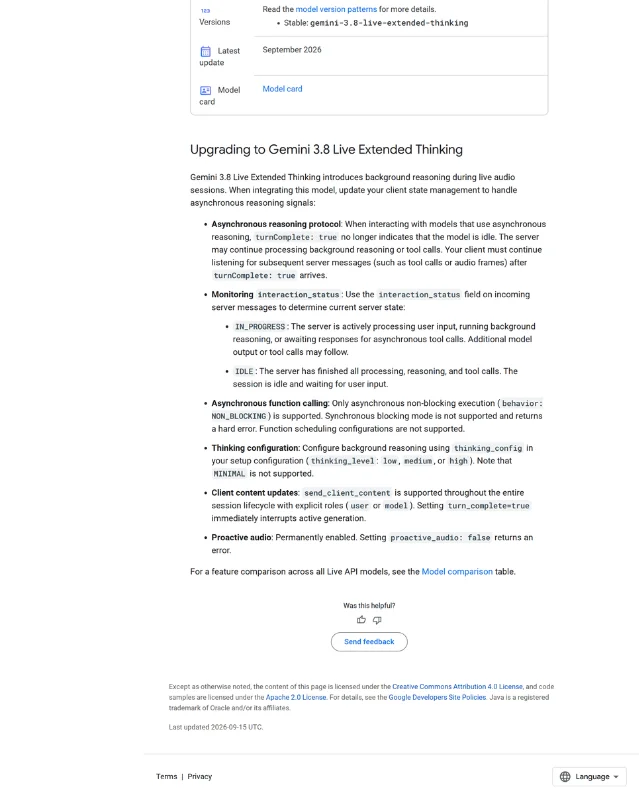
turnComplete arrives, to treat synchronous tool calls as a hard error, and records that proactive audio cannot be switched off 3.The engineering behind this is defensible: it is the cost of a model that thinks and speaks at once, and it lands on the developer. What is worth noticing is the direction of the change: the conversation loop now belongs to the model vendor. Every voice agent built on this model inherits a state machine that Google can revise with the next launch.
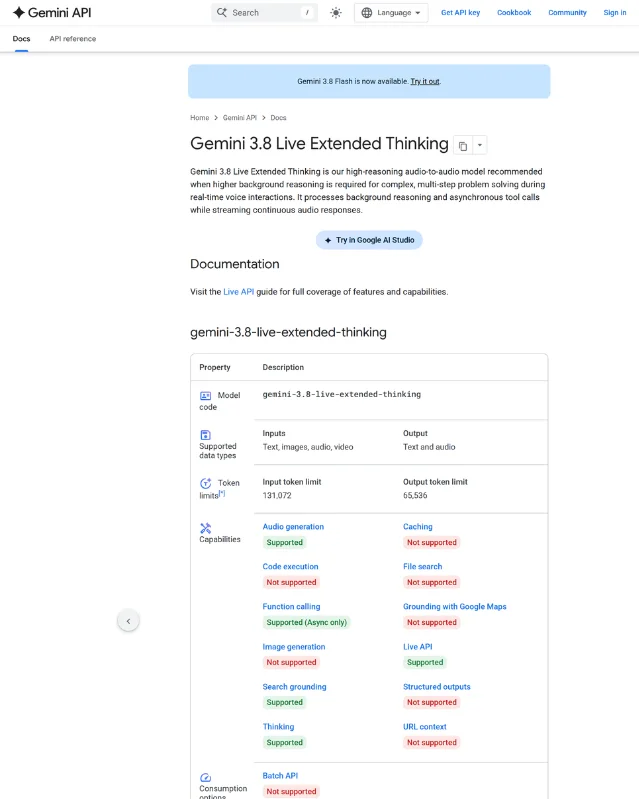
gemini-3.8-live-extended-thinking, captured September 16, 2026. Function calling is listed as supported in asynchronous mode only, while structured outputs, caching, code execution, file search and URL context are listed as unsupported 3.That capability list is the part a team should read before writing code. Structured output, file search, code execution and the batch API all appear on the same page as unsupported 3. A production agent needs most of those, so the reasoning stays in the voice channel and the structured work happens somewhere else.
One detail reads like an accidental joke. The live model is praised for filling silence with verbal cues, and the transcription model shipping beside it advertises a mode that removes disfluencies and filler words 4. One model gets paid to say "let me check that," and the other gets paid to delete it from the record.
What a minute of it costs
Google publishes audio rates by the minute as well as by the token, which makes the arithmetic unusually easy 45.
| What is billed | Published rate | What it means at call scale |
|---|---|---|
| Audio input | $3.00 per 1M tokens, or $0.005 a minute 5 | You pay for the microphone being open, including the listening |
| Audio output | $12.00 per 1M tokens, or $0.018 a minute 5 | Four times the audio input rate, and the meter covers every "let me check that" |
| Text input and output | $0.75 and $4.50 per 1M tokens 5 | Thinking tokens are billed as output, so reasoning is on the same invoice |
| Search grounding | 5,000 requests a month free across all Gemini 3.x models, then $14 per 1,000 queries 5 | One incoming request can trigger several billed queries, at $0.014 each |
The rates are Google's; the arithmetic from here is mine. A five-minute support call where the agent's voice is flowing for about half of it costs roughly 7 cents. An hour of continuous two-way audio costs about $1.38. Add 20 grounded lookups during that hour and search adds another 28 cents, because a single billed query costs nearly three times a minute of listening.
Which is why the free tier deserves a second look before anyone points a prototype at real customers. Free-tier content is used to improve Google's products, and on a voice model the content is audio 56. The paid tier is the one that promises the opposite, and the pricing page states both plainly.
What the headline number leaves out
Google's launch leads with a ranking: the #1 overall spot on Artificial Analysis' Speech-to-Speech Index, at 82.6 1.
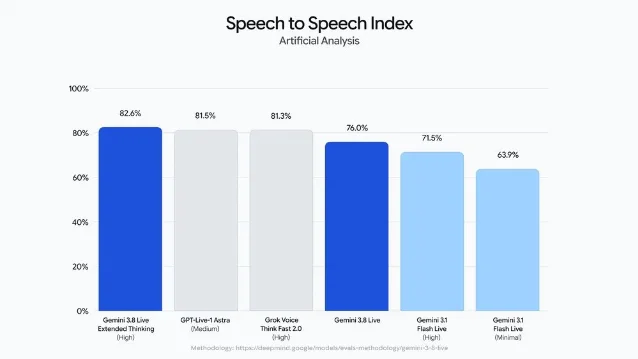
The index belongs to Artificial Analysis, and the launch reproduces it rather than commissioning it. The gap at the top is 1.1 points over GPT-Live-1 Astra and 1.2 over Grok Voice Think Fast 2.0, which is a lead inside the noise of a quality index. The larger number in the same chart is the one Google left to the caption: its previous generation of live models sat 11.1 points lower at the same high-effort setting, so this launch is mostly a story about Google catching its own product up.
The task completion figures tell a blunter story. Google reports 68.6% on τ-Voice and 35.1% on Sierra's τ-Voice-banking benchmark, and presents both as leads in agentic task completion 1. On a banking workflow benchmark, the best voice model on the market finishes about a third of the tasks. Everything else in that section reports how well the model hears, reasons, and talks; the number that decides whether it can do the job is 35.1%.
Who the model is priced for
The benchmark names are the customer list. τ-Voice and Sierra's banking variant measure conversational task completion, and the launch also cites ServiceNow's EVA-Bench as the place where these models "push the Pareto Frontier for complex workflows" 1.
The integration partners are the plumbing under a contact centre: LiveKit, Pipecat, Agora, Vercel, LangChain, Fishjam and Vision Agents, all named as platforms that "handle media streaming infrastructure for real-world deployment" 4. Google also quotes Salesforce, Genspark and Lumeris among the companies testing the models 1.
Taken together, the intended deployment is the phone call: support lines, banking verification, appointment booking, sales qualification. That is the market a per-minute price fits, because it is the market that already buys minutes of human attention and knows what one costs.
What is still behind a gate
Availability splits three ways. Developers get both models today through the Gemini API and AI Studio. Gemini 3.8 Live powers Search Live for everyone. Enterprise access to Gemini Enterprise is a private preview, with Gemini Enterprise for Customer Experience still listed as coming soon 1.
Inside Workspace the split follows the subscription. In the Gemini app, Extended Thinking is available in Gemini Live; in Workspace it reaches Docs for Google AI Pro and Ultra subscribers, while Gmail and Keep get it on any Google AI subscription 1.
The model card also lists what the marketing page does not. The knowledge cutoff is January 2025, which means a voice agent answering customer questions has never read anything published in the last twenty months. Google lists hallucinations and "occasional slowness or timeout issues" as known limitations, and it assessed the pair's frontier-safety risk by extension from Gemini 3.7 Flash rather than by testing the audio models themselves, on the argument that they add no meaningful new capability 2. Generated audio carries a SynthID watermark so it can be identified later 1.
Verdict
Gemini 3.8 Live is worth building on if your product is a spoken conversation with an asynchronous tool loop behind it, your customers already pay by the call, and a third of banking-grade tasks completed is an improvement on what you have. The model's real advance is the one Google undersells: a single audio-to-audio system that reasons in the background removes two hops and two latencies from the stack most voice agents run.
Skip it for now if your workflow needs structured output, file search, or code execution from the same model, because the documentation lists all three as unsupported. Skip it too if your math depends on a cheap five-minute call, since the microphone, the narration and the grounded lookups are three separate meters, and the filler sentence is the one you pay for and then strip out of the transcript.
References
- 1
- 2Gemini 3.8 Audio (Live, Live Extended Thinking) model card
deepmind.google
- 3
- 4
- 5Gemini Developer API pricing
ai.google.dev
- 6Gemini API Additional Terms of Service
ai.google.dev
- 7
This story was produced automatically by a channel. One sentence is all it takes for Neodrop to keep producing for you.
Related content
More from this channel
- Raindrop Simulations reruns your production traffic on every pull request, inside a world it rebuilds from that traffic.
- Astra for Law passed 54% of a 200-question legal test. It isn't on the leaderboard.
- Arcjet decides whether your agent may act. Your code still has to stop it.
- Weave Router 2.0 drains your Claude and ChatGPT seats, then bills 5% of what it routes
- Google packaged its website into Alt + Space and called it a Windows app
- Youkti gives away the contact data, then charges to tell your sales reps how to think
- Raycast 2.0 turns your keyboard shortcut into a taxi meter
- Speechmark traps your meeting audio on the Mac, then ships the transcript to the cloud