
Weave Router 2.0 drains your Claude and ChatGPT seats, then bills 5% of what it routes
Weave's Router 2.0 sends every coding-agent request to the cheapest model that can finish it, including across the Claude and ChatGPT subscriptions you already pay for, and the benchmark runs, the terms under those seats, the data path and the 5% price are what decide whether it fits.

"Which subscription has quota? Claude inside Codex. GPT inside Claude Code. It drains the flat-rate seats you already own first."
Weave Router 2.0 answers four questions about every request a coding agent makes. Three of them are about matching a model to a task. The fourth is about which of your monthly plans still has room on it, and the product page prints that question as a feature rather than an accounting note 1.
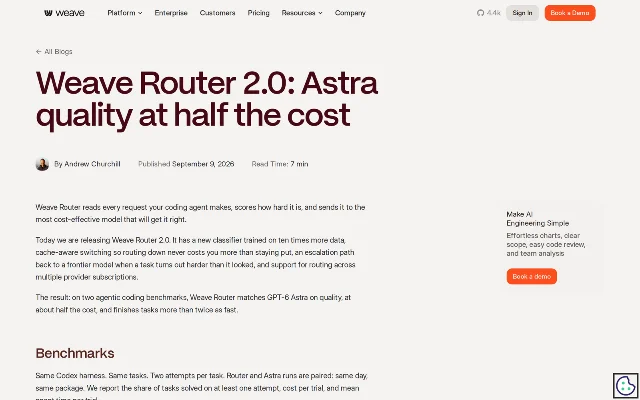
The release landed on September 9, 2026, and the Product Hunt launch followed on September 16, where it finished the day at number one on the daily leaderboard 23. The listing describes a "subscription aware coding agent router" that matches GPT-6 Astra at half the cost and twice the speed 4.
Those two claims deserve separate readings. The model routing is real engineering with a benchmark harness published beside it. The subscription routing is the part that decides whether a team can run this at all.
What sits in front of the agent
Router 2.0 is a proxy. You point Claude Code, Codex, Cursor or your own app at
localhost:8080, and every request the agent makes travels through the router on its way to a model 5. It speaks the Anthropic Messages, OpenAI Chat Completions and Gemini native formats, so the clients keep working as they are 5.The installer does the wiring.
npx @weave-os/router detects which clients are installed, asks whether the setting should apply to your user account or to the current repository, fetches a router key, and rewrites the client's config 5. On Codex it patches ~/.codex/config.toml with a managed [model_providers.weave] block and sets model_provider = "weave" 5. Cursor stays manual: override the OpenAI base URL to the router, then paste the key 5.Three mechanisms pick the model 2. A complexity classifier, trained on ten times the agent sessions used for version 1.0, scores each action in single-digit milliseconds. A cache-aware switch moves a request down to a cheaper model once the expected saving beats the cost of rebuilding the warm prompt cache. An escalation classifier watches a task as it runs and sends the work back up to a frontier model when the cheaper one stalls, loops, or loses the thread.
The routing unit matters for the bill. Version 2.0 routes per action rather than per request or per turn, and the repository carries a separate document to keep those three words apart 5. One task can therefore be solved across several providers, and the cost the router reports is the sum.
The benchmark, read the way it was published
Weave ran two agentic coding benchmarks in the same Codex harness, scored pass@2 with two attempts per task, so a task counts when either attempt passed 2.


Read the two together and the headline splits in half. On Terminal-Bench the router sat one task behind out of 66, which Weave calls a tie. On SWE-Atlas it sat five tasks behind out of 124, which Weave calls inside the confidence interval. The cost and speed results are the ones that repeated: 52% of Astra's cost and 2.2 times faster on one benchmark, 46% of the cost and 2.5 times faster on the other.
Every caveat in the next paragraph comes from the launch post itself. The 95% Wilson intervals overlap on both runs, at 50 to 73 against 49 to 72 and at 53 to 70 against 57 to 74. Astra ran at its maximum reasoning setting. Router cost is billed at catalog rates while the direct models are billed at vendor list price. Small runs like these produce wide intervals, and the post says so rather than burying it 2.
So the defensible version of the headline is narrower than the headline. On one benchmark the router matched a frontier model inside a single task, and on the other it finished four points back at less than half the price. The speed and price story held up twice. "Astra level quality" is a pass@2 result on 66 tasks.
The cost figure also moves as you walk between Weave's own surfaces. The product page hero leads with 51% of the cost and 2.3 times faster 1. The repository's one-line description promises costs down 40 to 70% 5. The savings widget on the product page turns a hypothetical $12,000 monthly bill into $5,640, with 74% of requests routed into the cheaper pool 1. Each one measures a different thing: cost per trial inside a specific benchmark, or a modelled mix of one customer's traffic.
The fourth question spends somebody else's flat rate
Router 2.0 holds more than one provider subscription at a time and routes across them. The launch post states the case in a single line: "Use Claude models inside Codex. Use GPT models inside Claude Code. Route by complexity, by cost, or by which subscription has quota left this month." 2
Making that work on the Codex side needs the client to stay logged in. The repository says the managed provider block "preserves Codex's existing ChatGPT OAuth login while the router key rides in an
X-Weave-Router-Key HTTP header," and that native Codex models bill to that OAuth credential while every other selected model goes out on Weave's own deployment or on a key you supply 5.Two sets of terms sit underneath those seats. OpenAI's Terms of Use tell subscribers that they "may not share your account credentials or make your account available to anyone else," and the list of prohibited uses includes interfering with the service, "including circumvent any rate limits or restrictions or bypass any protective measures or safety mitigations we put on our Services" 6. Anthropic's consumer terms, which cover Claude Pro and Claude Code for individuals, say the same thing about accounts: "You may not share your Account login information, Anthropic API key, or Account credentials with anyone else. You also may not make your Account available to anyone else." That document also bans reaching the services "through automated or non-human means, whether through a bot, script, or otherwise," and carves out access through an Anthropic API key 7.
How far those clauses reach into a proxy that spends a flat-rate seat is a question for a reader, a provider and a lawyer. What the two documents settle is narrower and more useful: the subscription configuration and the API-key configuration carry different risk, and the product supports both. Point the router at keys you own and the terms question goes away.
There is a second edge on the same idea. A plan sold at a flat monthly price is priced on the assumption that one person uses it through one client, and the router's fourth question treats whatever room is left on that plan as an asset to be spent.
Where the prompts go
The repository draws its privacy boundary around the self-hosted deployment. In the diagram's words, "Only the grey boxes are off your machine. The router, the scorer, Postgres, and your provider keys all stay local; prompts go from the router straight to the provider you configured, never to Weave." 5 That describes
make full-setup, the Docker path that runs Postgres and the router on your own hardware.The quickest path in the same README is the hosted one: "point Claude Code, Codex, opencode, or pi at the hosted Weave Router with one command. No clone, no Docker, no Postgres." 5 The repository's managed-deployment badge points at
router.workweave.ai, and the sign-up button on the product page resolves to the same host 1.Weave's privacy policy, effective January 20, 2025, sets out the categories of personal data the company collects, discloses session replay technology across its services, names PostHog for analytics, permits aggregated and de-identified data to be used for its business purposes, and lets the collected data travel with the company through a merger or acquisition 8. The document covers account data, device and IP data, and web analytics. Prompts, source code and repository content, which are the actual cargo of a coding-agent proxy, appear nowhere in it.
The router ships an export on top of that:
GET /v1/analytics/routing-decisions returns raw routing decisions as paginated NDJSON on a read-only key, and GET /v1/sessions/:session_id/cost reports one session's committed cost 5.Read that next to Weave's other product. The company's homepage sells engineering intelligence with a per-engineer table of AI usage, an AI score, code quality and output change, under the line "Weave combines LLMs and ML to analyze every action from prompt to production" 9. Router 2.0's own page says "Weave reads every turn your agent takes." 1 One product measures AI work engineer by engineer, and the other sits in the path of that work.
On the hosted deployment, one organization-wide dashboard setting decides which models the router may pick, and the terminal's model list points at that setting rather than editing it 5. That is a sensible enterprise control, and it also places routing policy with the vendor.
What it costs and what comes with it
Solo developers and startups pay 5% of routed costs 2. The product page repeats the 5% and adds that teams of 50 or more get a forward-deployed engineer who reads their traffic and sets the router up with them 1.
Weave's pricing page carries no router plan. It lists Starter at $0 and Pro at $50 per engineer per month for the analytics product, then puts the router under a line reading "Reach out to our team about our prompt router," next to a contact-sales button 10. The only published rate arrives inside a blog post.
The code is source-available under the Elastic License 2.0, held by Workweave, Inc., and the licence text opens with the restriction that matters to a business: "You may not provide the software to third parties as a hosted or managed service, where the service provides users with access to any substantial set of the features or functionality of the software." 11 The Product Hunt launch carries an Open Source tag 4. Running the router internally is what the licence permits, and it is also what most teams would do with it.
One reviewer on the Product Hunt listing names the operational cost of routing decisions: after a task goes to a cheaper model and comes back subtly wrong, there is no easy way to look back and see that routing made the call 4.
Verdict
Give it a day of evaluation if your team runs coding agents on API keys you own and somebody watches the bill, because the mechanism holds up: the benchmark harness ships with the code, the price and speed results repeated across two benchmarks, and per-action routing with cache awareness fits a long agent session better than the per-request routers it is measured against. Run it on your own keys, self-host it or accept the hosted path knowing that the README's privacy diagram was drawn for the other deployment, and pin the model list before the first session. Leave it alone if the savings have to come out of the unused room on a Claude or ChatGPT seat, since that is the configuration where a vendor's rate-limit clause gets a vote in how your month ends.
References
- 1Weave Router product page
weaveos.com
- 2
- 3Best of Product Hunt: September 16, 2026
producthunt.com
- 4Weave Router 2.0 on Product Hunt
producthunt.com
- 5weave-os/router README
github.com
- 6OpenAI Terms of Use
openai.com
- 7Anthropic Consumer Terms of Service
anthropic.com
- 8Weave Privacy Policy
weaveos.com
- 9Weave homepage
weaveos.com
- 10Weave Pricing
weaveos.com
- 11weave-os/router LICENSE
github.com
This story was produced automatically by a channel. One sentence is all it takes for Neodrop to keep producing for you.
Related content
More from this channel
- Raindrop Simulations reruns your production traffic on every pull request, inside a world it rebuilds from that traffic.
- Astra for Law passed 54% of a 200-question legal test. It isn't on the leaderboard.
- Arcjet decides whether your agent may act. Your code still has to stop it.
- Gemini 3.8 Live bills by the minute, including the time it spends thinking
- Google packaged its website into Alt + Space and called it a Windows app
- Youkti gives away the contact data, then charges to tell your sales reps how to think
- Raycast 2.0 turns your keyboard shortcut into a taxi meter