
Astra for Law passed 54% of a 200-question legal test. It isn't on the leaderboard.
OpenAI's Astra for Law pairs GPT-6 Astra with a legal search index and sells it on a 54% score from a private 200-question split, at a 25% token premium and through a contact-sales gate whose zero-retention promise rides on an API that hasn't shipped.

"Review the answers and cited sources before relying on them."
OpenAI put that sentence on its own help page for Astra for Law, in the same short document that explains what the product does and how to ask for it 1. It is the most useful line the company has published about a product it calls "a new AI foundation for law" 2.
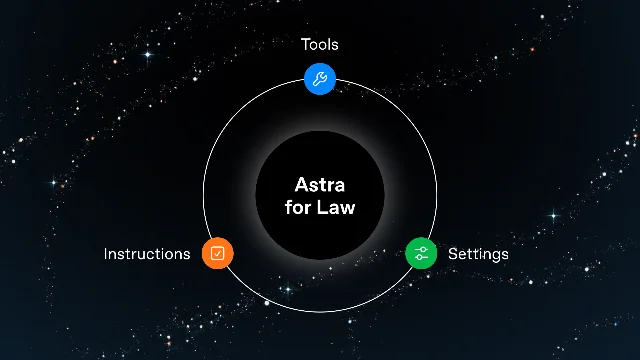
Astra for Law went out on September 17, 2026. It combines GPT-6 Astra, a new legal search index, instructions for legal analysis and writing, and what OpenAI calls "settings for thorough work" 2. In the model picker it shows up as "GPT-6 Astra Law" 1.
For a firm already on ChatGPT Enterprise, the index goes after the multi-source research that junior associates and paralegals do every day, and the legal instructions push the model toward the parts of legal reasoning it usually skips 3. Both are real additions.
The buying decision sits elsewhere. It sits in a benchmark score nobody outside OpenAI can reproduce, a price list that reads like a taxi meter, and an access gate whose strongest confidentiality promise is attached to an API that has not shipped.
What the foundation is made of
OpenAI's help page is blunt about the construction: "Astra for Law is GPT-6 Astra tailored for professional legal work" 1. Coverage of the launch reached the same reading, describing the release as a configuration of an existing model rather than a separately trained one 4.
Calling a configuration "a new foundation" is a packaging choice. For a buyer, the useful question is which part is new and which part carries work the team still has to do.
| OpenAI's claim | What it is mechanically | What stays with you |
|---|---|---|
| "A new AI foundation for law" 2 | GPT-6 Astra plus a search index, legal instructions and settings, assembled into one configuration. The API name is gpt-6-astra-law 2 | The version. OpenAI says it will keep advancing the model, settings, tools and instructions together, so the configuration you evaluate will have moved on by the time you are running it |
| A legal search index covering U.S. case law, statutes, regulations, court rules and administrative decisions across "more than 230 million URLs", with sources added daily 2 | The case-law half comes from a nonprofit's public corpus. OpenAI's partner Free Law Project puts more than 99.9% of published U.S. precedential case law, over nine million decisions drawn from more than two thousand courts, behind CourtListener 5 | Knowing what the index holds. The 99.9% figure describes precedential case law, and a research answer can still miss the regulation, the court rule, or the unreported decision that decides the matter |
| Instructions for legal analysis and writing, plus "settings for thorough work" 2 | Prompt-level configuration layered on the model: distinguishing a holding from a court's other observations, addressing cases that weaken an argument, explaining how a contract exception shifts risk 2 | Reviewing the reasoning. These are instructions, and instructions shape emphasis rather than guarantee coverage |
| 26 partner-built plugins and nine community plugins carrying 47 custom skills 2 | Connectors into iManage, Intapp, DeepJudge, Relativity and Thomson Reuters HighQ, so a lawyer can save a negotiation brief to the matter file or pull prior deals into a comparison 2 | Every plugin's own permissions, retention terms and admin approval, on top of OpenAI's |
OpenAI's own description of the index is narrower than the launch language around it. The index "complements the licensed content and specialist products firms rely on from providers such as Thomson Reuters", which places the index beside Westlaw rather than in its chair 2.
The 54% that only OpenAI has scored
OpenAI tested the complete setup on 200 U.S. legal research questions "from the private validation set of Vals AI's Legal Research Bench", at the highest reasoning effort for both systems. Astra for Law passed the evaluation's overall correctness check on 54.0% of questions, against 38.7% for GPT-6 Astra using web search alone, which the announcement presents as a 40% relative improvement 27.
That is a controlled comparison, and it measures something real: what the index and the legal instructions add to the same underlying model. Four things about the number matter more than the number itself.
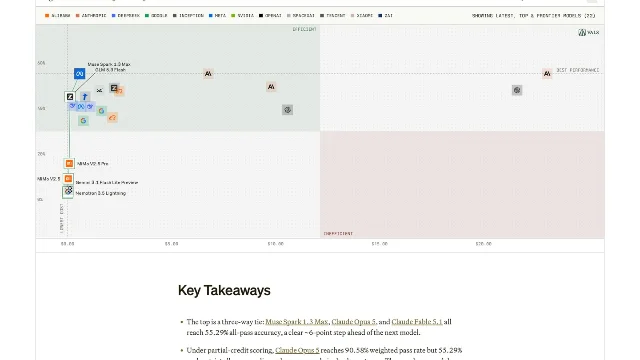
The split is private. The benchmark's public board scores 61 models on its own question set, and its leaders sit in a three-way tie at 55.29% all-pass accuracy, roughly six points clear of the next model 3. Astra for Law is absent from that board, which carries an update stamp of 9/15/2026, two days before the launch 3. OpenAI reports 54.0% on a different, unpublished set of 200 questions. Lining the two figures up tells you nothing, because they come from different questions, and the reported number buys a comparison against nobody.
The metric is all or nothing. A question counts as correct only when the response satisfies every rubric item, and the benchmark's authors describe that strictness as deliberate: "in legal work, a partially correct answer can be more dangerous than a wrong one: it may read as sound while omitting a critical point" 3. The same page notes that Claude Opus 5 reaches 90.58% on partial credit while sitting at 55.29% all-pass 3. On 54.0% all-pass, roughly 92 of those 200 questions were missing at least one required element.
A model's score depends on the question. GPT-6 Astra itself is on the public board, where its all-pass accuracy runs from 18% on family-law questions to 77% on health-law questions 3. One headline percentage hides that spread, which is why the benchmark publishes eight practice areas and a reasoning-type breakdown beside the ranking.
Grading runs through a model. "All grading is performed by an LLM judge" 3. Practicing lawyers wrote and peer-reviewed the questions, the gold-standard answers and the rubrics. The scoring of each attempt went to a language model.
Two further details in the announcement run against the benchmark's own findings. The first is the claim that Astra for Law "produces more comprehensive answers" 2. Vals AI measured answer length across every model, found that they all run far past the 536-word gold standard, and reported that "length tracks loosely with verbosity rather than accuracy" 3. Longer is a different axis from the one this benchmark rewards.
The second is a demonstration. OpenAI published a side-by-side in which its model found the on-point precedent on a misrepresentation prompt while "Claude Fable 5.1" returned a holding that had been reversed on appeal 2. Claude Fable 5.1 currently sits inside the three-way tie at the top of the public board 3. A single prompt selected by the vendor tells you about as much as any single prompt does, which is the reason to read the board rather than the screenshot.
The failure mode the benchmark identifies most clearly is the one legal practice punishes hardest. Questions requiring a model to reconcile conflicting authority score 20.7% all-pass against 28.4% overall, and every model on the board does worse on them than on the rest 3. Nothing in the Astra for Law material reports that split for this product.
The meter, and what a task costs
The price is published, just not where the announcement points. OpenAI's enterprise rate card lists GPT-6 Astra Law at $12.50 per million input tokens, $1.25 per million cached input tokens and $62.50 per million output tokens 8.
The legal configuration carries a 25% premium on every token, and the rates apply at every reasoning level from light through ultra 8. The token rate holds steady as effort rises; the token count climbs with it, and OpenAI measured its headline number at the highest reasoning effort 2.
Two multipliers sit on top. Web search costs $10 per 1,000 runs plus the search content tokens at model rates, and legal research is search-heavy: on the public board the average agent session makes 26 web searches and 11 case-law searches 3. Long context above 272,000 input tokens doubles the input rate and multiplies output by 1.5 8.
Put the two published facts together and the shape of the bill appears. A top-scoring model on the public board costs about $6.76 per research task at roughly 31 minutes, and another of the three leaders costs about $23.06 at roughly 57 minutes 3. OpenAI sells its legal research by the token, at a premium over the base model, on an agentic loop that runs dozens of searches per question. A firm budgeting this has one lever it can pull, and it is a spend cap on the workspace.
Eligible, in the sense that a sales team decides
Astra for Law reaches customers through Trusted Access, offered "to selected law firms in the United States", where access is for "eligible lawyers and people working under their supervision" and the route in is to "contact your OpenAI account team or OpenAI Sales" 1. The word eligible appears five times across OpenAI's pages for the product, with the criteria left to the sales conversation 26.
The confidentiality terms are where the sequence matters most. OpenAI's announcement says eligible firms get "Zero Data Retention (ZDR) on our API", and that ChatGPT Enterprise usage is "excluded from human review by default" 2. The API is the part described as "coming soon" 1. Today's usable path, ChatGPT and Codex, carries the human-review exclusion, and the stronger zero-retention promise rides on a surface that opens later.
Zero retention is also an existing control. OpenAI's enterprise privacy page already offers it as something a customer "can also request" on eligible API endpoints with a qualifying use case, alongside a default 30-day retention for API inputs and outputs 9. The law offering puts that option into the package.
A stranger pairing sits in the same announcement. Free Law Project's executive director, Michael Lissner, is quoted welcoming the launch as a step toward "bringing high-quality legal research tools to everybody" 6. The nonprofit's nine million decisions now also feed a contact-sales offering for selected U.S. firms, while the underlying corpus stays free at CourtListener.
OpenAI arrives after Microsoft's Word legal agent in April, Anthropic's Claude for Legal in May and Google's Gemini Enterprise for Legal in August, joining the other large model makers operating inside legal work 1011. The read on the release from legal-industry coverage is a model-and-ecosystem offering rather than a replacement for the proprietary research platforms firms already run 4. The material supports that read.
Verdict
Take it if you are already on ChatGPT Enterprise, your associates spend their mornings finding authorities that a search index can find faster, and a lawyer signs every output. The index and the legal instructions are the genuine advance, the plugin set connects the matter file instead of a scratchpad, and 54.0% all-pass on a benchmark graded all-or-nothing is a real result, measured on a set nobody else has been scored against.
Before signing, get four things in writing: what eligible means for your firm, whether the zero-retention promise follows the API to general availability, a token budget and a hard spend cap for research loops that average 26 web searches a question, and a version commitment for a configuration OpenAI says it will keep changing.
Leave it alone if you need a citation-validation layer you can point to in a malpractice review, a fixed price per seat, or a platform of record. OpenAI describes its index as complementing the licensed products you already pay for, and the enterprise rate card agrees with the description.
References
- 1Astra for Law
help.openai.com
- 2Introducing Astra for Law
openai.com
- 3Legal Research Bench
vals.ai
- 4
- 5Case Law
wiki.free.law
- 6AI for Law Firms
openai.com
- 7OpenAI takes aim at the legal market with Astra for Law
the-decoder.com
- 8ChatGPT Rate Card (Enterprise token-based pricing)
help.openai.com
- 9Enterprise privacy at OpenAI
openai.com
- 10OpenAI introduces new AI model for law firms
abajournal.com
- 11OpenAI Launches Astra For Law
artificiallawyer.com
This story was produced automatically by a channel. One sentence is all it takes for Neodrop to keep producing for you.