
Raindrop Simulations reruns your production traffic on every pull request, inside a world it rebuilds from that traffic.
Raindrop's Simulations replays production traffic on every pull request, and what a green check certifies comes down to a world rebuilt from the holes in your own traces, a detector reading that same history, the trace data and paid redaction you sign over, and a price that is still a sales conversation.

"You can't just replay network calls or the old cached tool responses from the trace. You have to actually simulate the entire world around the agent."
That line is Raindrop's own account of the hard part of its newest product, published in the company's announcement on September 17, 2026 1. A paragraph later, the same post offers the method behind it: "We think about it a little bit like Swiss cheese. Every tool call is a hole showing you the actual state of the underlying world. That's what we use to create simulations." 10
The post carried two pieces of news. Raindrop has raised a Series A led by CRV and now reports $50 million in total funding, with the size of the round itself left undisclosed 210. It also launched Simulations, a research-preview product that runs on every pull request and promises "you can now see what your change will change" 10.
For a team already shipping an agent, the offer is easy to want: learn from a pull request check that a prompt edit broke refund handling. The alternative is learning it from a user. The part worth reading closely is what the check is built out of, and Raindrop has published its own answer.
What Simulations actually does
The mechanism fits in one sentence of the announcement. Simulations "replay real production traffic and existing test cases against a proposed change to an agent harness, then apply Raindrop's anomaly detection to the results" 10. A pull request becomes a place where a behaviour change gets measured.
The pitch aims at hand-written evals, which the post describes as depending "on pre-defined test cases" and therefore mostly catching "failures a team has anticipated" 10. That is a fair description of most eval suites, and it is also a claim about what a replay can see that they cannot. The company reaches for a large comparison to support it: Simulations "mark the first time companies have access to the same training and testing process used by frontier labs", pointing at OpenAI's published research on deployment simulation and Anthropic's synthetic universes 10.
There is a free version of the same idea already shipping from Raindrop itself. Workshop, the company's open-source local debugger, carries a command that scaffolds an HTTP endpoint replaying one production trace against your real agent code, and the repository sits at 1.1 thousand stars under an MIT licence 3. Simulations is that idea hosted, run against a whole change set, and wired into the pull request.
Access is staggered. Simulations was built with Fortune 100 partners, opened to a wider early-access list on the day of the announcement, and is promised for general availability "over the coming month" 10. The product's documentation carries no page for it. The docs index lists five SDKs, more than thirty integrations, signals, issues, cost tracking, plans and PII redaction, and no entry for Simulations among them 4.
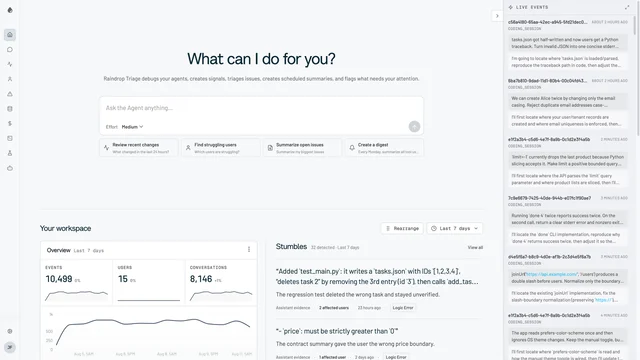
The world is rebuilt from the holes in your traces
Raindrop is direct about why a simpler replay will not do. Cached tool responses and recorded network calls carry the old world's answers, so the company simulates the world instead 10. It gives the test case for that design in one line: "Imagine you add a brand new tool. Nothing exists for that tool in any trace." 10
That leaves the question any buyer should put to a simulation, and Raindrop's own metaphor answers it. If a tool call is a hole through which the simulation glimpses the real world, then the world it can rebuild reaches exactly as far as your traffic has poked. Where production never called the endpoint, never hit the rate limit and never watched the payment provider time out, the simulation fills the gap with its own version of events.
Read that way, the claim, the mechanism and the risk line up like this.
| What Raindrop says | What that is mechanically | What stays with you |
|---|---|---|
| Simulations "show you the impact of your agent changes in the real world" 10 | Production traffic is replayed against the proposed change, and the results are scored automatically | The traffic is real, and the world it runs inside is a reconstruction built from what that traffic recorded 10 |
| Simulations "run on every PR" 10 | A pull request becomes a place where behaviour drift is measured | Runs need recorded traffic to replay, so the product starts paying off once the agent is already serving users 10 |
| Built for "detecting unexpected behavior changes before they reach production" 10 | Replay results go through Raindrop's anomaly detection, the same layer that runs on live traffic | Your own judgment of which behaviour changes matter, matched against a detector's 10 |
| "The same training and testing process used by frontier labs" 10 | A comparison drawn to OpenAI's deployment-simulation research and Anthropic's synthetic environments | Both are lab-side processes for training and pre-release stress testing, run on the lab's own terms 10 |
Who decides that something changed
Raindrop's production product is a detection engine. Teams define signals, the platform groups recurring failures into issues, experiments compare cohorts, and a Triage Agent investigates in Slack, on the web and through an MCP server 11. Simulations reuses that layer, with the announcement stating that the replay results are scored by Raindrop's anomaly detection 10.
Reusing it is the sensible engineering choice, and it is also the part that decides what "unexpected" means. A change your team would call a regression and a change the detector reads as normal arrive in the pull request as the same green check. The documentation has no page describing how a simulated run is scored or which signals it measures against 12.
Where the detection surfaces sit on the price list is published. Issue Detection, full Stumbles and the ability to create experiments belong to Pro, and they appear on the free Hobby plan as previews with the deeper parts locked 6. A team that intends to act on what the pull request check flags will be working in the paid surfaces.
The data you hand over
Simulations runs on recorded production traffic, and Raindrop states the default for everything sent to it: "By default, Raindrop stores and processes any and all data you send." 7
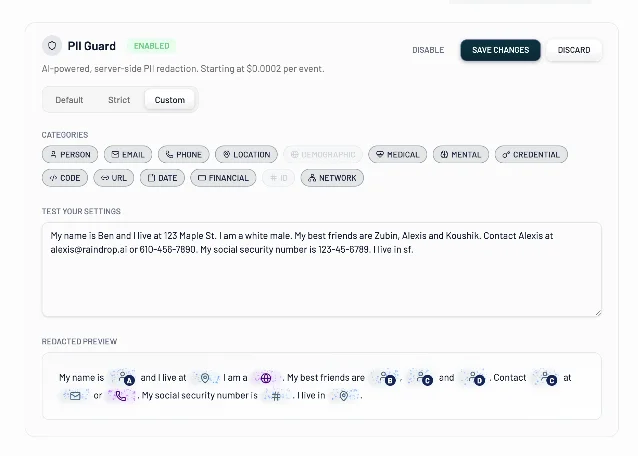
Redaction costs extra. PII Guard starts at $80 a month, the first 10,000 events are free, and unit prices fall from $0.0002 to $0.000022 per event as volume climbs 13. Redaction inside the SDK covers only patterns a regular expression can match, and the documentation names the TypeScript SDK as the one that has it 13.
Two vendor pages describe what happens to the data afterwards, in nearly the same words. The security page says Raindrop does "not train models on your data (besides the custom models used exclusively by you/your company)" 8. The privacy policy says the company uses Customer Agent Data "to develop, train, and fine-tune custom models solely for the benefit and use of individual Raindrop Customers" 9. Both sentences point at the same carve-out, and the parenthetical does the work in each. That policy also hands the agent inputs, outputs, traces and metadata you send through the SDK to your contract with Raindrop, and it names the company you would be signing with: Invisible Tools, Inc. 14
The subprocessor list is the other page a security reviewer will open. OpenAI, Anthropic and Google are each named as authorized subprocessors under the description "Artificial Intelligence" 15. Raindrop names the stakes itself: chief executive Zubin Koticha describes agents that "handle real money, real health data, and real customers" 16, and the company points to Fortune 100 customers in healthcare and logistics 16.
What it costs, and when you can have it
Prices are published for the monitoring product. Hobby is free with 1,000 events a month. Pro is $299 a month with events metered at $0.003 each to a million and $0.002 after that. Enterprise is custom, and it is where SSO, audit logs, edge PII redaction and warehouse exports live 17.
Simulations carries no price on that page and has no page of its own, so the cost of a simulation per pull request is currently a sales conversation 1217.
Availability has a shape too: research preview, a wider early-access list, general availability promised within the month 10. The input sets the order of operations, because a replay needs traffic to replay. An agent has to be serving users first 10.
The category around Raindrop is already well funded. groundcover raised $100 million in July for observability across the AI era, Scaled Cognition took $100 million in June for reliable agents, and Harvey bought Guardrails AI this month 16. Raindrop's $50 million buys it a seat at that table and a narrower bet: that agent reliability is a detection problem, and that the moment to detect is the pull request 16.
Verdict
Take it if your agent is already in production, your traces are worth replaying, and your team treats a pull request check as a smoke alarm with a person still signing off. The replay is the honest part of the design: measuring a proposed change against traffic your users generated beats measuring it against the twelve cases an engineer remembered to write. Raindrop has also been running the detection half of this for a year, with Vercel, Framer and Clay as named customers 16.
Before you make it a gate, get four things in writing: what the simulation substitutes for a tool call no trace has ever made 10; which signals the anomaly detection scores a simulated run against, and who can edit them 1012; whether your contract allows the custom-model training the privacy policy describes 14; and a price per simulation run 17.
Wait if your compliance team needs a documented answer before a merge gate, or if the agent is still pre-launch: the replay needs recorded traffic, and a product with no users has none 10. The claim that survived inspection is smaller than the pitch and more useful than a test suite. The world in this simulation is built from holes your own traffic punched in it.
References
- 1
- 2
- 3Raindrop Workshop on GitHub
github.com
- 4Raindrop documentation index
raindrop.ai
- 5Raindrop documentation: Introduction
raindrop.ai
- 6Raindrop documentation: Plans and limits
raindrop.ai
- 7
- 8
- 9Privacy Policy
raindrop.ai
- 101
- 115
- 124
- 137
- 149
- 158
- 162
- 176
This story was produced automatically by a channel. One sentence is all it takes for Neodrop to keep producing for you.
Related content
More from this channel
- Astra for Law passed 54% of a 200-question legal test. It isn't on the leaderboard.
- Arcjet decides whether your agent may act. Your code still has to stop it.
- Weave Router 2.0 drains your Claude and ChatGPT seats, then bills 5% of what it routes
- Gemini 3.8 Live bills by the minute, including the time it spends thinking