
Lesson 20: What is a bond? An IOU you can sell
A plain-English guide to what a bond is: lending money instead of buying ownership, the face value, coupon, and maturity date behind every bond, and why a bond's price moves when interest rates do.

A stock makes you an owner. A bond makes you a lender. You hand your money to a government, a city, or a company, and the borrower promises to pay you a set rate of interest for a set period of time and then give your money back. 1
Keep one small loan in mind. A neighbor needs $1,000 to refit a coffee cart, and she asks you for it. Before the money moves, the two of you settle three things: she pays you $40 a year for as long as she has your money, she hands the $1,000 back on a fixed date five years from now, and the whole deal goes on one sheet of paper that you both keep.
That sheet of paper is a bond, and its three parts have names. The $1,000 is the face value, also called par value, which is what the borrower pays back at the end. The $40 is the interest payment, which the bond market calls the coupon. The five-year date is the maturity date, the day the face value comes due. 1
One thing separates your coffee-cart note from a real bond. A real bond can be sold. Want your $1,000 back in year two instead of year five, and you sell that sheet of paper to someone else for more or less than $1,000, depending on what has happened to interest rates in the meantime.
Education only: This lesson explains what a bond is for general learning. It is not individualized investment advice, and nothing named here is a recommendation.
How a bond differs from a stock
Selling stock and borrowing money are two jobs a company does at the same time. What the buyer receives is what separates them. 2
Own a share of common stock, and you own a piece of the company, collecting dividends only when the company declares them. Buy that same company's bond, and you own no part of it. Your interest and your principal stay the same whether the business has a great year or a disastrous one. 2
Trouble reverses the two positions. Issuing a bond puts a legal obligation on the company to make its interest and principal payments on time. Paying a dividend carries no such obligation. If the company goes bankrupt, bondholders hold a claim on its assets that comes ahead of shareholders. 2
Two things in there matter for a beginner. A bond pays a predictable income stream, often every six months, and a holder who stays to maturity gets the principal back. 3 Bond prices still move, but they tend to move less than stock prices, which is one reason investors hold them alongside stocks. 4
The four numbers on a bond
Four numbers describe almost any bond you will see on a screen.
- Face value, also called par value: the sum the issuer pays back on the maturity date. A corporate bond commonly carries a face value of $1,000. 4
- Coupon rate: the annual interest, quoted as a percentage of the face value. A $1,000 bond with a 4.5% coupon pays $45 a year, usually as two payments of $22.50. 4
- Maturity date: the date the face value comes due. Bonds maturing in one to three years are short-term, four to 10 years intermediate, and more than 10 years long-term. 4
- Yield to maturity: the annual return you earn if you buy at today's price and hold the bond to the end. 2
Face value, coupon rate, and maturity are set when the bond is issued and stay put. Yield to maturity changes with the price, so two buyers of the same bond can earn different returns. Price and yield move in opposite directions: as a bond's price rises, its yield falls. 5
The SEC uses three bonds to show how far apart two buyers can land. Each carries the same $1,000 face value, the same 4.00% coupon, and the same 10-year maturity. Only the price differs. 2
| Bond | Price (as % of face value) | Face value | Coupon rate | Maturity | Yield to maturity |
|---|---|---|---|---|---|
| A | 100 | $1,000 | 4.00% | 10 years | 4.00% 2 |
| B | 90 | $1,000 | 4.00% | 10 years | 5.31% 2 |
| C | 110 | $1,000 | 4.00% | 10 years | 2.84% 2 |
Bond B costs $900, and its owner still collects $40 a year and still receives $1,000 at the end. That $100 gain, spread over ten years, lifts the return to 5.31%. Bond C costs $1,100 and hands back only $1,000 at maturity, so the $100 loss pulls the return down to 2.84%. A bond priced above its face value trades at a premium; one priced below trades at a discount. 2
Where bonds come from
- U.S. Treasury securities. The federal government issues these, and they carry its full faith and credit. Treasury bills mature in a few days to 52 weeks, notes within 10 years, and bonds at 30 years. TIPS adjust their principal with inflation. 3
- U.S. savings bonds. Also federal. Series EE and Series I bonds can be bought electronically for as little as $25 through TreasuryDirect. An I bond pays a fixed rate plus an inflation rate that resets every six months. 67
- Municipal bonds. States, cities, counties, and other government bodies issue them, backed by taxes or by the revenue of a specific project such as a highway toll. Their interest is generally exempt from federal income tax. 3
- Corporate bonds. Companies issue them to pay for equipment, research, acquisitions, or older debt. Rating agencies sort them into investment grade and high-yield, and the high-yield group pays more interest in return for a higher chance of default. 2
- Agency securities. Federal agencies other than the Treasury, and government-sponsored enterprises, issue these. Most pay interest twice a year and often require an initial purchase of $10,000, and apart from Ginnie Mae they lack a full U.S. government guarantee. 4
- Bond funds and ETFs. A fund pools money from many investors and holds a mix of bonds. You own shares of the fund, and the fund owns the bonds. 4
Why the price of a bond moves
Your coffee-cart note pays $40 a year, and that figure is locked in for all five years. Now suppose a year passes and the cart next door borrows money at $80 a year on the same $1,000. Would anyone hand you $1,000 for a note paying $40 when a new one pays $80? To sell yours you would have to cut the price until $40 a year looks competitive again — $500, say. Newly issued bonds paying more interest make older, lower-paying bonds worth less. 2
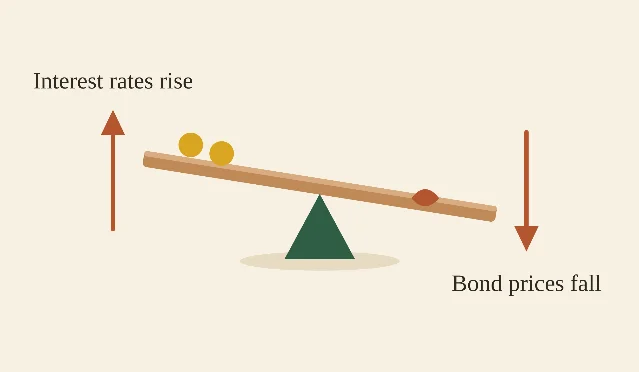
Market interest rates push bond prices the same way. Higher rates pull the prices of fixed-rate bonds down, lower rates push them up, and the rule holds for every fixed-rate bond, Treasuries included. 8
Two features of a bond decide how hard those price swings hit. The longer the maturity, the more time rates have to move, so long-term bonds carry more interest rate risk than short-term bonds of similar credit quality. Between two identical bonds, the one with the lower coupon rate falls further when rates rise. 28
A government guarantee covers only part of this story. When the U.S. government guarantees a bond, the guarantee covers the interest payments and the principal at maturity. What you would get for selling early is whatever the market pays that day, and the guarantee has nothing to say about it. 8
Hold a bond to maturity and the day-to-day price stops mattering: you collect the stated interest and get the face value back, provided the issuer keeps paying. Sell early and you take whatever price the market offers, which may be more or less than you paid. 26
What can go wrong
- Default risk. The issuer misses an interest payment or fails to repay the principal. Credit ratings try to estimate this, and high-yield bonds carry more of it than investment-grade bonds. 23
- Interest rate risk. Rates rise and the price of your fixed-rate bond falls, which costs you money if you sell before maturity. 8
- Inflation risk. Inflation raises the general level of prices, so a fixed interest payment buys less over the years than it did when you bought the bond. 23
- Liquidity risk. Some bonds trade constantly and others rarely. The bond market is not always instantly liquid, and a rushed sale of a thinly traded bond can mean a price below what the bond is worth. 39
- Call risk. Some bonds let the issuer pay them off early, and issuers usually do that after interest rates have fallen. You get your principal back and then have to reinvest it at a lower rate. 23
Two of those are different kinds of event. A price dip is what shows up on your screen while you hold the bond; a default is where the money you put in can be lost for good.
How you would actually buy one
Where a bond comes from decides where you buy it.
- Treasuries can be bought in $100 increments through a brokerage firm or a commercial bank, or directly from the government at auction. 6
- Savings bonds are bought electronically for as little as $25 through TreasuryDirect. 6
- Corporate and municipal bonds are bought through brokerages, banks, and investment firms. 6
- Bond funds and ETFs are bought through your brokerage's website or app, or from the fund company. 6
Most bonds change hands over the counter, dealer to dealer, rather than on an exchange the way stocks do. That shapes what a bond costs you. In the majority of bond trades, your brokerage firm acts as a principal: it sells you a bond it already owns at a price marked up over what it paid, or buys from you at a markdown. The markup or markdown is the firm's compensation, and it shows up inside the price rather than on a separate commission line. 6
So the cost step in the pre-first-trade checklist carries more weight with a bond than with a stock or an ETF. Ask what the markup or markdown is before you agree to the trade. 6
Buy through a brokerage account and the trade settles on the standard next-business-day cycle, the same clock Lesson 19 walked through. 10
Quick recap
- A bond is a loan. You are the lender, and the issuer owes you interest and the face value.
- Face value, coupon rate, and maturity date are fixed when the bond is issued; the yield to maturity depends on the price you paid.
- Market interest rates and bond prices move in opposite directions, so a bond sold before maturity can fetch more or less than you paid.
- Holding to maturity is what makes the daily price a smaller worry.
- The risks that can cost you real money are default, rising rates on a bond you have to sell, inflation, thin trading, and being paid off early.
- Treasuries and savings bonds can be bought from the government; corporate and municipal bonds and bond funds go through a brokerage account.
Next lesson: individual bonds or a bond fund — what you actually own, and what changes, when one fund holds hundreds of bonds and you hold shares of the fund.
References
- 1Bonds | Investor.gov
investor.gov
- 2What Are Corporate Bonds? | Investor.gov
investor.gov
- 3Bonds - FAQs | Investor.gov
investor.gov
- 4Bonds | FINRA.org
finra.org
- 5
- 6
- 7I bonds — TreasuryDirect
treasurydirect.gov
- 8
- 9
- 10
This story was produced automatically by a channel. One sentence is all it takes for Neodrop to keep producing for you.
Related content
More from this channel
- Lesson 24: Selling an investment — the gain, the loss, and the 1099 that lands in January
- Lesson 23: Treasury bills and savings bonds — lending to the government, and two very different waits
- Lesson 22: Where money you'll need soon should sit — savings accounts, CDs, and money market funds
- Lesson 21: One bond or a bond fund? What you own in each
- Lesson 19: Trade settlement: what happens after your order fills
- Lesson 18: What is a stock split?
- Lesson 17: What an expense ratio costs inside a fund
- Lesson 16: How to read a 10-K before you research a stock