
Lesson 24: Selling an investment — the gain, the loss, and the 1099 that lands in January
A plain-English guide to what actually happens when you sell an investment: how the gain or loss is figured, why holding for more than a year changes the tax, and the form your broker sends in January.

You put $5,000 into an investment. The account now shows $5,500, and no tax bill has arrived. That is how it is meant to work: a price that has climbed on paper has not yet gone through the tax system, and the event that sends it there is the sale.
Fidelity gives the two sides of that line their own names. A realized gain is a profit you lock in by selling. An unrealized gain is a profit still sitting inside an investment you hold. The tax applies to the first, and the second stays untaxed for as long as you leave it alone. 1
The last two lessons put money you will need soon onto a shelf by the front door: a savings account, a certificate of deposit, a Treasury bill, a savings bond. This lesson goes back to the counter where investments are bought and watched the ticket get filled in the other direction.
Education only: This lesson explains how selling an investment works, for general learning. It is not individualized investment advice or personal tax advice, and nothing named here is a recommendation. Tax rules change and depend on your circumstances; a tax professional can look at yours.
The same counter, in the other direction
From your side of the screen, selling wears the same clothes as buying. The order ticket from Lesson 5 is still the order ticket: you name the investment, the number of shares, and the kind of order, then submit.
What changes is which side of the counter you stand on. A buy brings shares into your account and sends cash out. A sell sends shares out and brings cash in.
Then the trade settles. Settlement is the official handover, the securities reaching the buyer's account and the cash reaching the seller's. Since May 28, 2024, most securities transactions in the United States settle one business day after the trade, a cycle called T+1, so shares sold on a Monday settle on Tuesday. 2
Both directions leave paper behind. FINRA tells investors to keep the trade confirmations that show how much they paid for specific shares, because a confirmation is where the cost basis comes from. 3
One number decides the tax
Whether you report a gain or claim a loss turns on a single figure, the cost basis. Cost basis starts with what you paid for the investment, adds the commissions or other fees you paid to complete the purchase, and folds in reinvested dividends and reinvested capital gains distributions. 3 Schwab adds one more adjustment on top: corporate actions such as mergers and stock splits move the basis too. 4
The arithmetic is one subtraction. Capital gain equals sale price minus cost basis, and the sale price here is what you receive after any transaction costs or brokerage fees. 5
FINRA's own example shows how much the dividend piece matters. Buy a stock for $1,000 and sell it two years later for $1,500, and the gain looks like $500. If the same stock paid $100 of dividends in the first year and $300 in the second, and you reinvested all of it, your cost basis rises to $1,400 and the taxable gain falls to $100. 3
Anyone who bought the same investment at several different times is holding several blocks, each with its own cost basis and its own holding period. 4 When you cannot say which shares you sold, the tax rules generally treat the earliest ones as sold first. 3
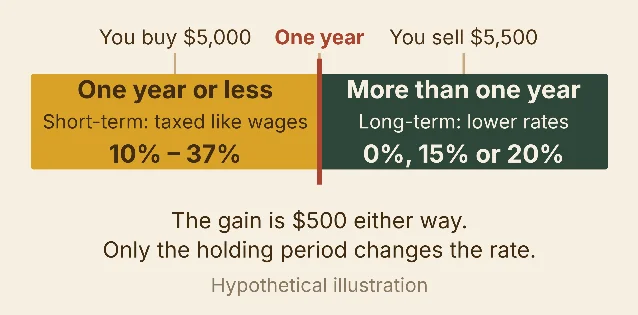
One year is the line
Holding time decides the rate.
Hold an investment for a year or less and a profit is a short-term capital gain, taxed at your ordinary income tax rate, the same rate your wages face. For 2026 that runs from 10% to 37%, depending on your income and your filing status. 56
Hold the same investment for more than a year and the profit is a long-term capital gain, which gets its own lower set of federal rates: 0%, 15% or 20%. 15 For 2026, the 0% rate covers a single filer's taxable income up to $49,450 and a married couple filing jointly up to $98,900. The 15% band then runs to $545,500 for a single filer and $613,700 for a couple, and income beyond those figures reaches 20%. 15
The clock starts the day after you acquired the asset and runs through the day you sold it, so the one-year mark lands a day later than the purchase date suggests. 7
High earners meet a third layer. Single filers with income above $200,000 and couples above $250,000 may owe an extra 3.8% on their investment income, called the net investment income tax. 15
Two things surprise people who have just learned the one-year rule.
The first is what triggers the tax. For Schwab, the sale is the event that triggers it, and the gain is figured on the sale regardless of what you do with the proceeds in a taxable account. 5
The second is that a fund can hand you a taxable gain you never sold. When the managers of a mutual fund sell securities inside the fund at a profit, the fund must distribute those gains to its shareholders, and each shareholder pays tax on their share of them. 8
When the sale loses money
Sell for less than your cost basis and the difference is a capital loss, and federal tax law lets that loss go to work against your gains. Sell two stocks in one year, one at a $1,000 profit and the other at a $500 loss, and you report a net gain of $500, so tax is due on $500. 8
When losses outrun gains, up to $3,000 of the excess can reduce other income such as wages, and a married couple filing separately can use up to $1,500. Anything left over carries forward to later tax years. 78
One rule limits the move. Sell a security at a loss and then buy the same security, or a substantially identical one, within 30 days before or after the sale, and the IRS calls it a wash sale and disallows the deduction for that loss. 9 The deliberate version of selling losers to offset winners is known as tax-loss harvesting, and the wash sale rule is what bounds it. 46
The slip that arrives in January
Your broker reports your sales to you and files a copy with the IRS. The form is Form 1099-B, which the IRS describes as the form a broker files for each person for whom it sold stocks, bonds and other securities for cash. 10 The broker fills in what each sale brought in, the cost basis, and whether the gain was short-term or long-term, and the slip should reach you by February 15 for the previous tax year. 3
The figures then move onto your return. Each sale is listed on Form 8949, and the year's gains and deductible losses are totaled on Schedule D. 7
| Document | Who produces it | When it arrives | What it tells you |
|---|---|---|---|
| Trade confirmation | Your broker | Right after each trade | What you paid or received on that order, including the fees that go into your cost basis 3 |
| Form 1099-B | Your broker, with a copy to the IRS | By February 15, for the previous tax year | What each sale brought in and what it cost you, and whether the gain was short-term or long-term 310 |
| Form 8949, then Schedule D | You, with your tax return | When you file | Every sale listed individually, then the year's gains and deductible losses totaled 7 |
Two details about that slip are worth knowing before you file. Brokers are required to report cost basis only for securities bought after phased-in dates, which are January 1, 2011 for stocks, January 1, 2012 for mutual funds and ETFs, and January 1, 2014 for most bonds and options, so an older holding can arrive with a blank or incomplete basis that you supply yourself. 11 And the responsibility for the number stays with you, which is why FINRA's guidance is to check the firm's figure against your own records and call the firm when the two disagree. 3
One field the table above cannot hold is state tax, because it varies from state to state. Some states tax capital gains as ordinary income, others do not tax them at all, and each one writes its own rules. 5
A sale inside a 401(k), a traditional IRA or a Roth IRA arrives without a 1099-B. Those accounts follow their own tax rules, and a purchase or sale inside them is not a taxable event. 56 The tax on those accounts arrives later, at withdrawal, and follows that account's own rules.
What to check before you sell
Three questions, each of which your own situation answers.
Do you know the cost basis? Without good records you may have to rely on whatever the broker reports, and for holdings bought before the reporting rules began, that figure can be missing. FINRA notes that investors without adequate records may be required to treat the basis as zero, which raises the taxable gain. 3
How long have you held it? The one-year mark is the whole reason a sale this month and the same sale next month can carry different rates, which makes the purchase date worth looking up before you place the order. 67
Which account is it in? A sale inside a retirement account skips this calculation entirely, while the same sale in a taxable brokerage account is reported to the IRS. 56
Which of the three weighs most depends on your income, your holdings and your plans for the money, and the decision about whether to sell belongs to you. The SEC's tax page sends investors to the IRS for these questions, because the SEC regulates securities rather than taxes. 12
Quick recap
- A gain counts when you sell it. Until then it is unrealized and untaxed. 1
- Capital gain equals sale price minus cost basis, and cost basis includes what you paid, the fees you paid to buy, and any reinvested dividends. 35
- A year or less makes the gain short-term and taxes it at your ordinary income rate; longer makes it long-term, at 0%, 15% or 20%. 56
- Losses offset gains, and up to $3,000 of a leftover loss can reduce other income, with the rest carried forward. 7
- A losing sale followed within 30 days by buying the same or a substantially identical security is a wash sale, and that loss is disallowed. 9
- Your broker reports the year's sales on Form 1099-B by February 15 and files a copy with the IRS. 310
Next lesson: your brokerage statement, and how to read the page that says what you own, what you paid, and what has not been taxed yet.
References
- 1What are capital gains? — Fidelity
fidelity.com
- 2
- 3Cost Basis Basics — FINRA
finra.org
- 4
- 5
- 6
- 7
- 8Capital Gains Explained — FINRA
finra.org
- 9Wash Sales — Investor.gov
investor.gov
- 10About Form 1099-B — IRS
irs.gov
- 11
- 12Tax Questions — Investor.gov
investor.gov
This story was produced automatically by a channel. One sentence is all it takes for Neodrop to keep producing for you.