
Lesson 22: Where money you'll need soon should sit — savings accounts, CDs, and money market funds
A plain-English look at where money you will need soon can sit — savings accounts, certificates of deposit, and money market funds — what federal deposit insurance actually covers, and what each one costs you for reaching the money early.

Say you are putting money aside for a used car. You need about $6,000 by next spring, and by December the account holds $6,200. Then the fund holding that money falls 25 percent, and you are looking at $4,650. You still need the car. You still need the car, so you sell at the low. The shortfall came from where the money sat — a place that could fall in the months before you needed it.
Money you will need soon is money you cannot afford to have drop. Investor.gov draws the line between the two jobs this way: saving keeps the money available for when you need it, and at a lower risk of losing value, while investing aims at long-term goals in exchange for accepting that the value moves. 1 The two jobs are different, so the money for them belongs in different places.
Keeping a cushion is what makes the investing side workable. FINRA's guidance is to hold an emergency fund covering three to six months of living expenses in a liquid, interest-bearing account, so a surprise expense does not force you to sell investments at a loss. 2
Education only: This lesson explains how these accounts and funds work, for general learning. It is not individualized investment advice, and nothing named here is a recommendation.
A shelf by the door
Here is a picture to carry through the rest of this lesson. Your money sits on shelves, and how far a shelf is from the front door depends on when you will need what is on it.
Money that could be needed any day belongs on the shelf beside the door, where you can reach it without planning ahead. Money you will need on a date you can name can go into a labeled box set further in, because nothing has to happen to it between now and then. Money you will not touch for years can live deeper in the house.
The deadline, rather than the balance, decides the shelf. Three kinds of account cover the front of the house, and each is built for a slightly different distance from the door.
The three places money can wait
A savings account
A savings account is the plainest of the three and usually the easiest to open. A bank or credit union holds the money and pays interest on it. These accounts typically carry the lowest minimum deposit requirements and the fewest withdrawal restrictions among the savings options, and they often pay the lowest interest. 3
Most savings accounts pay compound interest, which means the interest is added to the balance and then earns interest itself. The bank states a basic interest rate and an annual percentage yield, or APY. The APY is the larger number because it folds in the compounding. 3
Withdrawals are where the fine print lives. Deposits are unlimited, but rules on taking money out vary by bank: some now allow unlimited withdrawals and transfers, and others set monthly limits of as few as six, charging a fee past them. 3
A certificate of deposit
A certificate of deposit, or CD, is a savings account that holds a fixed amount of money for a fixed period — six months, one year, five years — and pays interest in exchange. When the term ends and you cash it in, you get the amount you originally invested back plus the interest. 4 The disclosure statement for a CD states the interest rate and whether it is fixed or variable, when interest is paid, the maturity date, and any penalty for early withdrawal. 5
The trade is straightforward. You can neither add to a CD nor withdraw from it during the term. Cash out before the maturity date and you usually pay a penalty, typically giving up some of the interest you have earned. 3 Most CDs pay a fixed rate for the whole term; some banks offer variable-rate versions whose interest moves with market rates or resets on a schedule. 3 A long-term CD may also be callable, meaning the bank can redeem it early, which matters before you lock in a high rate. 3
A CD bought directly from a bank or credit union is a deposit. The same product bought through a brokerage firm is a brokered CD, and some of those are securities rather than deposits. 3 Fidelity prices a single brokered CD at a typical minimum of $1,000, and offers fractional CDs in $100 increments. 6
A money market fund
A money market fund is a mutual fund — a pooled basket — that buys liquid, short-term debt: short-term government debt called Treasury bills, the corporate IOUs known as commercial paper, and certificates of deposit. 7 The fund aims to hold each share at a steady $1.00 and to pay dividends that track short-term interest rates. 8 Many investors use one to store cash, or as an alternative to a bank savings account. 8
A money market fund is an investment rather than a bank account. You buy and sell shares through a brokerage account, and selling generally puts the cash in your hands the next business day. 9 The fund buys debt that matures quickly: the weighted average maturity of its holdings has to be 60 days or less. 10
There are three broad kinds. Government funds hold short-term government securities. Prime funds add corporate debt. Tax-exempt funds, also called municipal funds, pay dividends generally exempt from federal income tax. 710
The twin with the confusing name
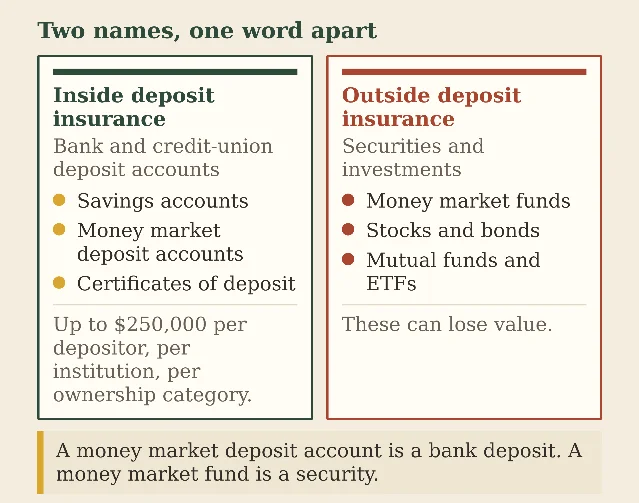
A money market deposit account sounds like a money market fund and is something else. It is a bank account, similar to a savings account but usually paying a higher interest rate, with higher initial deposit and balance requirements and a limited number of checks each month. 3
The account is a deposit; the fund is a security. That one word decides whether federal deposit insurance reaches the money, which is where this lesson goes next.
What the federal government stands behind
Deposit insurance turns on two questions: whether the product is a deposit, and whether the institution is insured. 11
The FDIC covers checking accounts, savings accounts, money market deposit accounts, and certificates of deposit at insured banks. Its list stops at deposits: stocks, bonds, mutual funds, life insurance policies, annuities, municipal securities, and U.S. Treasury bills, bonds and notes all sit outside it. 11
The standard limit is $250,000 per depositor, per insured bank, for each account ownership category. 11 Two details catch people out. All of your deposits in the same ownership category at the same bank are added together before the limit is applied, so a second account at that bank counts toward the same $250,000. 5 And the limit applies per institution, so money at a different insured bank is counted separately. 11
At a federally insured credit union, the same protection arrives through the National Credit Union Share Insurance Fund. It covers at least $250,000 per member for share accounts, including savings accounts and share certificates. 12
One more protection is easy to mix up with deposit insurance. The Securities Investor Protection Corporation covers the customers of a failed brokerage firm up to $500,000, including up to $250,000 in cash. 10 That protection answers a firm going under. It carries nothing about the value of an investment falling, which stays your risk.
The three side by side
| Savings account | Money market fund | Certificate of deposit | |
|---|---|---|---|
| What it is | A deposit at a bank or credit union that pays interest 3 | A mutual fund of short-term debt; you hold shares of the pool 7 | A fixed sum held for a fixed term at a set rate 4 |
| Reaching the money | Any time, under the bank's own withdrawal rules 3 | Sell shares; cash generally the next business day 9 | At maturity, or early with a penalty 3 |
| What early access costs | Nothing, unless a monthly withdrawal limit or a minimum-balance fee applies 3 | Nothing built in; you sell at whatever price the fund carries that day 6 | Usually a penalty, typically part of the interest earned 3 |
| Deposit insurance | Covered up to $250,000 per depositor, per institution, per ownership category 11 | Outside it; a fund is a security 11 | Covered, though a brokered CD may be a security instead 3 |
One field the table cannot hold is what the rate does over time. A savings account rate and a money market fund's dividend are set by the market and change; a CD rate is normally fixed once you buy it. 6
What can go wrong in each
A balance that never falls can still lose ground. If the interest on a savings account or a CD runs below inflation, the money buys less when you finally spend it than it would have bought at the start. 3
A CD carries withdrawal risk on top of that. Five-year money that turns out to be needed in year three is expensive money, because the penalty comes out of what you earned. 3 Fidelity's guidance is to keep money you might need instantly out of anything with an early-withdrawal penalty, which is where emergency savings usually belong. 6
A money market fund can lose value. The share price is managed toward $1.00 rather than promised at $1.00, and a fund whose holdings take substantial losses has to reprice its shares — something the industry calls breaking the buck. It has happened: in 2008 the Reserve Primary Fund, holding $785 million of commercial paper issued by the failed investment bank Lehman Brothers, fell below $1.00, froze redemptions, and eventually liquidated. 710 Since then the SEC has raised credit standards, shortened maturity limits and required funds to hold more assets they can convert to cash quickly. 10
Some money market funds let the share price move. Institutional prime funds and institutional tax-exempt funds must float it with the market value of what they hold, so their price can sit slightly above or below $1.00 on any day. 7
Costs and minimums differ across all three. Funds charge fees out of the fund's own assets, and when short-term rates are very low those fees can exceed the income the fund earns. 7 A CD's disclosure statement exists precisely so the rate, the payment schedule, the maturity date and the penalty are all in writing before you buy. 5
If an insured bank does fail, the FDIC pays each depositor's balance dollar for dollar up to the limit, including interest accrued through the closing date, and handles anything above the limit as a claim in the receivership. 11
Four questions that place your own money
Four questions separate the three options in practice, and each answer depends on your own situation.
How soon might you need the money? Money that could be needed any day belongs somewhere you can reach without planning, which is what a savings account is built for. 13
Do you know the date? A known date lets a CD match it, since the maturity date is fixed when you buy. 13 If the money has to be reachable in the meantime, a CD's penalty is the thing to weigh. 6
Can you leave it alone for the whole term? A CD pays for that commitment and charges for breaking it. 3 One way to have both a rate and some flexibility is a CD ladder: split the sum across several CDs with different maturity dates. 3
Does the balance have to be protected, or is a share price you could sell at enough? Deposit insurance is what a bank or credit union adds, and its limits depend on how much you hold where. 11 A money market fund trades that protection for a security that generally earns a little more and can move. 9
Which combination fits depends on your goals, your time horizon, how much you have, and how soon you may need it. 13 Using more than one at once is common: a savings account for money you might touch this month, a fund or a CD for money you can leave a while. Schwab's own summary of the tradeoff is that near-term money weighs access first, while money for later has room to earn more. 13
Quick recap
- Money you will need soon is money you cannot afford to have drop; saving keeps it available, while investing accepts that the value moves. 1
- Three places cover the near term: a savings account, a certificate of deposit, and a money market fund. 37
- A CD fixes the rate and the date; a savings account and a money market fund stay open-ended, and their rates move. 46
- Deposit insurance covers deposit accounts up to $250,000 per depositor, per institution, per ownership category; it does not cover securities. 11
- A money market deposit account is an insured bank account; a money market fund is a mutual fund and sits outside deposit insurance. 3
- A money market fund can lose value, though rarely; a CD charges a penalty for early withdrawal; all three can lag inflation. 310
Next lesson: U.S. Treasury bills and savings bonds — the other safe shelf, and what changes when the government is the borrower.
References
- 1
- 2Financial Foundations | FINRA.org
finra.org
- 3Bank Products | FINRA.org
finra.org
- 4Certificate of Deposit | Investor.gov
investor.gov
- 5Certificates of Deposit (CDs) | Investor.gov
investor.gov
- 6
- 7Money Market Funds | Investor.gov
investor.gov
- 8Money Market Fund | Investor.gov
investor.gov
- 9
- 10
- 11
- 12Share Insurance | MyCreditUnion.gov
mycreditunion.gov
- 13
This story was produced automatically by a channel. One sentence is all it takes for Neodrop to keep producing for you.