
Lesson 21: One bond or a bond fund? What you own in each
A plain-English look at holding a bond yourself versus holding shares of a bond fund: what you own in each case, whether the money comes back on a date, what it costs, and how much you need to start.

Lesson 20 ended with one sheet of paper: a neighbor borrowing $1,000 to refit a coffee cart, promising $40 a year and the $1,000 back in five years. That sheet was one bond, held by one lender.
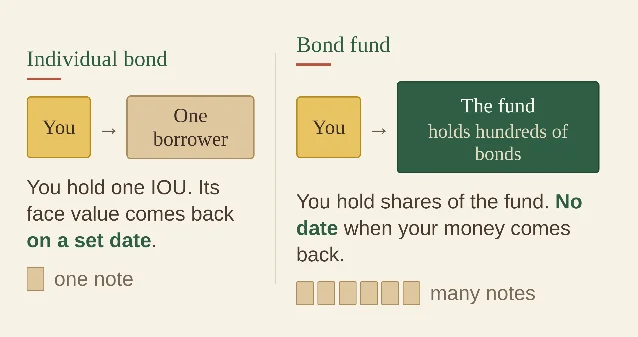
Suppose you want that arrangement for real, with money in a brokerage account. Two doors lead to it. You can buy one bond yourself, which leaves a single IOU from a single borrower in your account — a face value, an interest payment, and a date the money comes back. 1 Or you can buy shares of a bond fund, which pools money from many people, hands the pool to a professional manager, and buys a large collection of bonds with it. You own shares of the fund, and the fund owns the bonds. 23
Both pay interest, and both can sit in the same brokerage account as your stocks. The differences come down to what you hold, when the money comes back, what each one costs, and what happens when a borrower stops paying.
Education only: This lesson explains what each choice involves for general learning. It is not individualized investment advice, and nothing named here is a recommendation.
What you hold
Buy a bond and one IOU from one borrower sits in your account. The borrower's name, the interest it pays, and the date its face value comes due are all visible to you. 4
Buy shares of a bond fund and you hold a slice of a whole portfolio. Each share is part ownership of everything the fund owns and of the income that portfolio produces. 2 A manager decides which bonds go in, and the fund lists its holdings in its prospectus and in periodic shareholder reports. 5
Bond funds come in two common forms. A mutual fund sells and redeems its shares through the fund itself, priced once at the end of each trading day. An ETF, the exchange-traded kind, trades on an exchange all day at whatever price buyers and sellers agree on. 5
That structure changes what your choice controls. A bond holder picks the borrower, the interest rate, and the length of the loan. A fund investor picks the kind of fund — government debt, corporate debt, municipal debt, short maturities or long ones — and the manager picks the bonds inside it. 67
The date your money comes back
Every bond carries a maturity date, set when the bond is issued. On that date the borrower repays the face value along with the last interest payment, and the loan ends. 4
A bond's price still moves while you hold it. As the maturity date approaches, the price tends to converge on the face value, so a holder who waits for that date collects the stated amount, as long as the borrower keeps paying and the bond is not called early. 7
Most bond funds carry no maturity date. The fund keeps rolling: as bonds inside it mature, the manager reinvests the proceeds and the portfolio goes on. No day arrives when the fund hands your principal back, so getting your money out means selling shares at the price the market offers that day. That price can sit below what you paid. 67
A maturity date is the feature that lets an investor line a known sum up with a known date. 7 A fund trades that fixed ending for a portfolio that stays invested without anyone deciding what to do with each maturing bond. 6
The two side by side
| Individual bond | Bond fund | |
|---|---|---|
| What you own | One IOU from one borrower 4 | Shares of a fund that owns the bonds 2 |
| Smallest first purchase | Often $1,000 of face value for one bond 6 | Often far less, and some funds set no minimum 6 |
| When income arrives | Usually twice a year 4 | Usually monthly, and the amount can change 6 |
| Value on a fixed future date | Face value due on the maturity date, barring default or an early call 7 | No set date; the market price applies when you sell 7 |
| Ongoing cost | A markup or markdown built into the trade price 4 | An expense ratio charged against the fund's assets 8 |
| One borrower's trouble | Lands on that whole bond 7 | Reaches only the fund's slice of that issuer 7 |
What each one costs
An individual bond usually carries no annual fee. The cost sits inside the price instead. In most bond trades the brokerage firm sells you a bond it already owns at a markup, or buys from you at a markdown, and that margin is the firm's compensation. 4 Individual investors also trade at prices that are generally less attractive than the ones large institutions receive. 7
A bond fund charges an expense ratio. That figure is the fund's total annual operating expenses written as a percentage of its average net assets, and it covers management fees, distribution fees, and other running costs. 8 The fund pays those costs out of its own assets, so every shareholder's slice shrinks a little each year. 8 Depending on the fund and where you buy it, a sales charge or a transaction fee can add to that. 6
Small gaps in cost compound. A fund with higher expenses has to earn more than a cheaper one just to deliver the same result to its shareholders. 8
What can go wrong in each
An individual bond concentrates its credit risk in one borrower. If that borrower stops paying, the loss lands on the whole bond. Schwab's research arm suggests holding at least 10 separate bond issues, and at least 10 different issuers for corporate and municipal bonds, before a set of individual bonds counts as spread out. 7 Fidelity generally recommends several hundred thousand dollars allocated to fixed income before an investor takes on individual bonds that carry credit risk. 6
A bond fund spreads credit risk by construction. With hundreds of holdings, one issuer's trouble touches only its part of the portfolio. 7 What a fund gives up is the fixed ending. Its value is marked to market every day, and with no maturity date there is no day you are promised your principal back. 36
Both sit in the same market, so both carry the risks from the bond lesson. When interest rates rise, the prices of fixed-rate bonds generally fall. 4 Inflation erodes what a fixed interest payment buys over the years. 3 A bond fund can lose money even when it holds only insured bonds or U.S. government bonds. 3
Four questions that settle it for you
Four questions separate the two in practice, and each answer depends on your own situation.
How much can you put in to start? A single corporate bond often costs $1,000 of face value, and spreading the risk across issuers multiplies that. 6 A fund can put a small amount to work across a large set of bonds from the first purchase. 7
Does a known sum on a known date matter? A bond's maturity date answers that question directly, and a fund leaves the ending open and prices it every day. 7
Do you want to research the borrowers? Picking individual bonds means evaluating each issuer and tracking it afterwards. A fund hands that work to a professional manager. 67
How will you react to a value that moves? A fund's price or net asset value changes as rates and markets change, and seeing that on screen makes some people act against their own plan. 7
Which combination fits depends on your goals, your time horizon, how much you have to invest, and how much predictable income you need. 7 Holding both at once is common, and in several cases it is what investors choose. 67
Quick recap
- Buying a bond leaves one IOU from one borrower in your account; buying a bond fund share makes you a part owner of a portfolio that holds hundreds of bonds. 2
- A bond comes due on a set date and repays its face value; most bond funds carry no maturity date, so you sell shares at the market price. 46
- A bond's cost hides inside the markup or markdown; a fund's cost is an expense ratio charged against its assets each year. 48
- Many holdings spread credit risk; one bond leaves a single borrower's trouble on your whole position. 7
- Interest-rate risk and inflation risk reach both, and both can lose money. 3
- How much you can start with, whether a known sum on a known date matters, whether you want to research issuers, and how you feel about a moving value are what separate the two for you. 7
Next lesson: money you will need soon — savings accounts, certificates of deposit, and money market funds, and why a short horizon belongs on a different shelf from your investments.
References
- 1Bonds | Investor.gov
investor.gov
- 2Mutual Funds | Investor.gov
investor.gov
- 3Bond Funds and Income Funds | Investor.gov
investor.gov
- 4Bonds | FINRA.org
finra.org
- 5
- 6Bonds vs. bond funds | Fidelity
fidelity.com
- 7
- 8
This story was produced automatically by a channel. One sentence is all it takes for Neodrop to keep producing for you.