
Lesson 23: Treasury bills and savings bonds — lending to the government, and two very different waits
A plain-English guide to Treasury bills and savings bonds: who is actually borrowing, how the money comes back, how long it is tied up, and what federal insurance does and does not cover.

You have $3,000 set aside for a new roof, and you will not touch it until spring. The last lesson put money like that on a shelf near the front door — a savings account, a certificate of deposit, a money market fund — and drew the line between a deposit, which federal insurance covers, and everything else.
There is a second row of boxes on that shelf, and the name on these is different. They are the ones the U.S. government itself owes you.
Treasury securities are debt obligations issued by the U.S. Department of the Treasury. Investor.gov counts them among the safest investments because they are backed by the full faith and credit of the U.S. government. 1 That phrase means the promise to pay you rests on the federal government's power to tax and to borrow, rather than on an insurance fund set aside for the purpose. The income may be exempt from state and local taxes, though the federal government still taxes it. 1
U.S. savings bonds come from the same department, for the same reason: to help pay for the government's borrowing needs. 2
Education only: This lesson explains how these securities work, for general learning. It is not individualized investment advice, and nothing named here is a recommendation.
Two boxes with the government's own seal
Two boxes arrive on the shelf, and neither came from the bank.
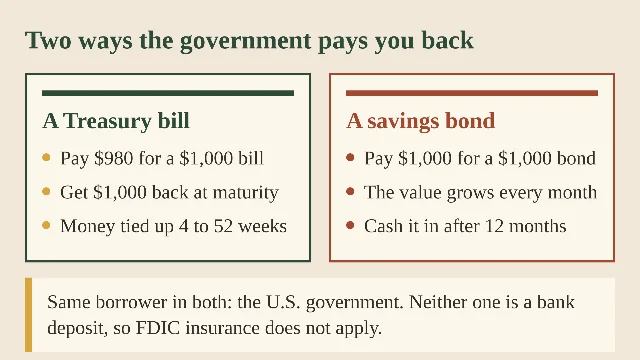
The first is short and flat, with a date printed on it somewhere between four and fifty-two weeks out. You pay less than the number printed there, and on that date the government hands you the number.
The second is longer. You pay exactly the number printed on it, nothing gets paid out along the way, and the value grows month by month until you open the box and take all of it. The lid will not come off for the first year.
Both boxes carry the same borrower, and that changes which questions matter. With the government on the other side, the questions are timing — when you get paid, and what it costs to change your mind.
A Treasury bill: you pay less than the number on it
A Treasury bill is a short-term security, which here means one that matures in a year or less. 3 The Treasury sells bills with terms of 4, 6, 8, 13, 17, 26 and 52 weeks, and the shorter ones go to auction every week. 4 They are the shortest thing the Treasury sells; notes run two to ten years and bonds twenty or thirty, and both pay interest every six months, the arrangement Lesson 20 described. 5
A bill is sold at face value or at a discount, and when it matures the Treasury pays you its face value. The difference between the discounted price you paid and the face value you receive is the interest on the bill, and it arrives at maturity — there is no coupon, and no payment showing up in the meantime. 3
Put numbers to a hypothetical $1,000 bill using the Treasury's own price formula. 3 At a discount rate of 4% over 26 weeks, the price works out to about $980. You pay $980 today; 26 weeks later the Treasury pays you $1,000. The $20 is your interest, and you experience it as the gap between what went out and what came back rather than as a payment.
The minimum purchase is $100, and you buy in $100 steps, up to $10 million on a single non-competitive bid. 46 You can hold a bill until it matures, or sell it before that. 4 Buy one through TreasuryDirect and one more rule applies: a newly bought Treasury marketable security has to be held at least 45 calendar days before you can transfer or sell it. 6
Taxes follow the family pattern. The federal government taxes the interest, and state and local governments do not. 4
A savings bond: you pay exactly the number on it
A savings bond is sold at face value, so a $50 bond costs $50. 2 You can buy one for any amount from $25 up to $10,000, specified to the penny, and one person can buy $10,000 of each series in a calendar year. 7
Interest on a savings bond earns monthly and compounds every six months, each period applying the rate to a slightly larger principal. None of it is paid out as you go: you collect the whole accumulated value when you cash the bond in, or when it reaches the end of its 30-year term. 7
Reaching the money has a schedule. A savings bond cannot be cashed in during its first 12 months, and cashing one in before five years costs you the last three months of interest — cash a bond in after 18 months and you get the first 15 months of interest. 7
Two series are for sale, EE and I, and both are electronic now, held in a TreasuryDirect account. 7 Taxes work as they do for bills, with one choice added: you decide whether to report the interest each year or to report all of it when the bond is cashed in. 7 Savings bonds are also non-marketable, meaning each one is registered to a single person's Social Security number and cannot be sold or transferred to anyone else. 5 That is the trade for a box whose price you never have to watch.
Why an I bond's rate moves and an EE bond's does not
An EE bond pays a fixed rate, set when you buy it and held for at least the first 20 years of the bond's 30-year life. The Treasury guarantees that an EE bond bought today will be worth double what you paid after 20 years, adding money at the 20-year mark if the rate alone would not have doubled it. 8
An I bond's rate is built in two parts: a fixed rate that never changes, and an inflation rate the Treasury recalculates twice a year, each May and November. The two add up to the rate the bond earns, so when the inflation part resets every six months the total resets with it, and it can move either way. The Treasury guarantees the total will never fall below zero. 79
The bonds sold between May 1 and October 31, 2026 show how the parts combine: an I bond pays 4.26%, made up of a 0.90% fixed rate plus the inflation adjustment, while an EE bond pays 2.40%. 7 Those particular numbers change every six months. The mechanism is the part worth keeping, and so is which of the three securities carries it: a bill's rate is set at auction and an EE bond's is set when you buy, so both stay fixed for their term. 47
Where these are bought
A savings bond is bought outright inside a TreasuryDirect account, where you also hold it. There is no auction and no bid. 57
A Treasury bill is sold at auction, so buying one means placing a bid ahead of an auction date the Treasury sets. 6 Two doors lead there: anyone can bid through a TreasuryDirect account or through a bank, broker or dealer. 10
TreasuryDirect takes non-competitive bids only. You agree in advance to accept whatever rate the auction produces, and in return you are guaranteed the security you asked for in the amount you asked for. 6 A bank, broker or dealer also lets you bid competitively, naming the rate you will accept — and a competitive bid that names too high a rate can come back with less than you asked for, or with nothing. 6
Every successful bidder ends up with the same rate: the highest one the auction accepted. 10 This is the order ticket from earlier lessons with a different menu — you choose a security, an amount and a type of order, and the exact price arrives with the fill.
What changed, and what did not
One thing changed. The borrower is the U.S. Department of the Treasury, and Schwab points out that this backing runs to an unlimited amount, where federal deposit insurance stops at $250,000 per depositor at one bank. 11 For cash that has outgrown the deposit-insurance limit at a single bank, that gap is the practical difference. 11
One thing stayed the same. These are securities, and deposit insurance covers deposits. The FDIC's list runs through checking accounts, savings accounts, money market deposit accounts and certificates of deposit at insured banks, and it stops there: stocks, bonds, mutual funds and U.S. Treasury bills, bonds and notes all sit outside it. 12 The safety of a Treasury bill or a savings bond comes from the government's promise to pay, with no insurance fund standing behind it.
Three risks live alongside that promise.
The price can move while you hold it. Treasuries trade in a secondary market, and their prices fluctuate like any investment's. 10 Hold a bill to maturity and you receive its face value; hold a savings bond and its accumulated value only climbs. Sell either one before its date, though, and you sell at the market price, which falls when interest rates have risen since you bought. 11 A Treasury investor who has to sell early can end up with less than they put in. 11 Bond prices and interest rates move in opposite directions, which is the mechanism behind that. 13
Inflation can outrun the rate. A bill's rate is fixed at auction and an EE bond's is fixed when you buy, so within its own term neither one adjusts to prices. FINRA gives the risk a name: inflation risk, the chance that what you earn fails to keep pace with the prices you will eventually pay. 14
Your money is tied up for a set time. A savings bond cannot be cashed in for 12 months, and cashing one in before year five costs three months of interest. 7 A bill bought through TreasuryDirect has to sit for 45 days before it can be transferred or sold. 6 Reach for the money inside those windows and it either costs something or is simply unavailable.
The three side by side
| Treasury bill | EE savings bond | I savings bond | |
|---|---|---|---|
| What you pay | Less than face value, at a price set at auction 3 | Face value 2 | Face value 2 |
| How the return arrives | The gap between your price and the face value, paid at maturity 3 | Value accumulates monthly and is collected when you cash in 7 | Same, with the rate reset every six months 9 |
| How long the money is committed | 4 to 52 weeks 4 | 30 years, with no cashing in for the first 12 months 7 | 30 years, with no cashing in for the first 12 months 7 |
| Minimum to start | $100, in $100 steps 4 | $25, to the penny 7 | $25, to the penny 7 |
| Taxes | Federal, but no state or local 4 | Federal, but no state or local 7 | Federal, but no state or local 7 |
One field the table cannot hold is how much the rate moves. The I bond's is the only one of the three that follows inflation, and it resets every six months; a bill's is fixed for its few weeks, and an EE bond's is fixed when you buy it. 7
What to check before you choose
Three questions decide this one, and your own situation answers each of them.
When do you need the money back? A bill comes due on a date you can match to a known expense a few weeks or months out. 4 Savings bonds run for 30 years, which makes them a poor fit for money with a deadline inside that. 7
Can you leave it alone for at least a year? A savings bond cannot be cashed in before 12 months, and cashing one in before five years costs three months of interest. 7 Money that might be needed sooner belongs somewhere you can reach it. 6
Is this cash already over the deposit-insurance limit at one bank? Deposit insurance covers $250,000 per depositor, per insured bank, per ownership category, and Treasury securities carry no cap of their own. 1112 That is where the two kinds of safety differ most, and it is also where the state-tax exemption starts to matter: interest that escapes state and local tax is worth more to someone in a state that taxes income. 11
Which mix fits depends on your goals, your time horizon, the amount you are placing, and how soon you may need it. Using more than one is common — a bill for a date you can name, a savings bond for money you can leave for years.
Quick recap
- Treasury securities are debt obligations of the U.S. Department of the Treasury, backed by the full faith and credit of the U.S. government rather than by an insurance fund. 1
- A Treasury bill matures in a year or less and is bought below its face value; the difference is the interest, paid when the bill matures. 34
- A savings bond is bought at face value, accrues interest monthly, and pays the whole accumulated value when it is cashed in, up to 30 years later. 7
- A savings bond cannot be cashed in for 12 months, and cashing one in before five years costs the last three months of interest. 7
- An I bond's rate is a fixed rate plus an inflation rate that resets every six months; an EE bond's rate is fixed when you buy. 89
- Neither one is a deposit, so deposit insurance does not apply; their safety is the government's promise to pay. 12 Selling either before its date means selling at the market price, which can be lower than what you paid. 11
Next lesson: what happens when you sell an investment — the gain, the loss, and the tax slip that follows.
References
- 1Treasury Securities — Investor.gov
investor.gov
- 2Savings Bonds — Investor.gov
investor.gov
- 3Understanding Pricing and Interest Rates — TreasuryDirect
treasurydirect.gov
- 4Treasury Bills — TreasuryDirect
treasurydirect.gov
- 5About Treasury Marketable Securities — TreasuryDirect
treasurydirect.gov
- 6Buying a Treasury Marketable Security — TreasuryDirect
treasurydirect.gov
- 7Comparing EE and I bonds — TreasuryDirect
treasurydirect.gov
- 8EE bonds — TreasuryDirect
treasurydirect.gov
- 9I bonds — TreasuryDirect
treasurydirect.gov
- 10
- 11
- 12
- 13
- 14Bank Products — FINRA.org
finra.org
This story was produced automatically by a channel. One sentence is all it takes for Neodrop to keep producing for you.