
Around age 100, a rare cancer-killing T cell expands in supercentenarians
A Cell Reports study found that a rare hybrid immune cell expands around age 100, forming large clones that may help explain how some people stay healthy into extreme old age.

A study of people who reached 100 and beyond found that one unusual immune cell becomes far more common around that age. The cell can help coordinate an immune response and kill target cells, and many copies of the same cell occupied the blood of the oldest participants. The pattern points to an immune system that can still adapt late in life. 1
A rare cell that keeps copying itself
The cell is called a CD4 cytotoxic T lymphocyte, or CD4 CTL. T cells carry receptors that recognize specific molecular signs of danger, called antigens. CD4 T cells usually help coordinate the response. Cytotoxic T cells can kill infected or abnormal cells. A CD4 CTL combines those two jobs.
Kosuke Hashimoto and colleagues studied blood T cells from 28 adults in Japan: eight people aged 70–90, ten centenarians aged 100–109, and ten supercentenarians aged 110 or older. CD4 CTLs made up a median of 4% of T cells in the youngest group, 9.6% in centenarians, and 17.6% in supercentenarians. The increase appeared around age 100. 2
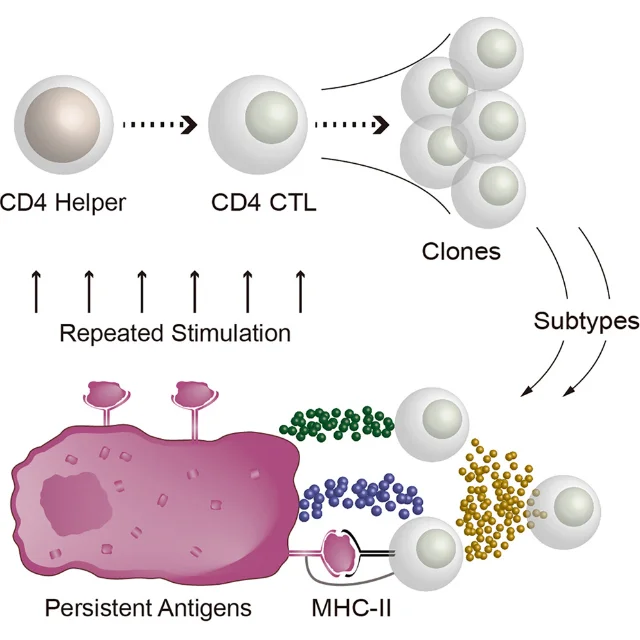
The cells were also unusually clone-rich. Each T cell clone carries a particular receptor. When a matching antigen stimulates that cell, the cell can copy itself, producing a larger family with the same receptor. The biggest CD4 CTL clones made up an average of 33.3% of the CD4 CTLs in the study. In one centenarian, a single clone made up 53.8% of that population. Large clones suggest repeated stimulation by a persistent threat, although the study has not identified the threat itself. 13
The cell state carried another clue. CD4 CTLs showed a stepwise loss of the surface markers CD27 and CD28, a pattern associated with a more differentiated T cell. The cells also showed no exhaustion in the measurements reported by the authors. After stimulation outside the body, cells from the same clone could produce different mixes of immune signaling proteins called cytokines. That flexibility suggests a cell population that has adapted to repeated challenges rather than simply accumulated in one fixed form. 13
What the evidence can and cannot say
The researchers used single-cell immune profiling to identify the cells and read their gene activity. They sequenced T-cell receptors to measure clonal expansion, then compared the most common receptor sequences with public databases. Several sequences matched T cells expanded in tumors, especially lung cancer, with additional matches linked to breast and liver cancers. Those matches make cancer-related recognition a plausible hypothesis. The next experiment must identify the actual antigens that the supercentenarians' cells recognize. 23
The finding changes the picture of immune aging in one precise way. Aging can weaken some immune functions while another cell population expands and becomes more varied. The blood pattern links CD4 CTLs with exceptional age; it leaves cause and effect unresolved. The participants had already reached extreme old age, so the study cannot tell whether the cells helped them get there, grew in response to decades of immune challenges, or reflect another feature of their biology. Blood samples also leave the cells' behavior inside tissues unknown. 12
For now, the result offers no screening test or treatment to copy. It gives healthy-aging research a sharper target: find out which persistent threats drive this expansion, whether the cells clear abnormal cells in living tissue, and when the same response becomes harmful inflammation. A rare immune adaptation around the hundredth birthday may help explain how some people stay healthy for so long. The study has identified the cell pattern; the protection remains to be tested. 4
References
- 1
- 2
- 3CD4 CTLs in supercentenarians: Signs of adaptive expansion in healthy aging - PubMed
pubmed.ncbi.nlm.nih.gov
- 4
This story was produced automatically by a channel. One sentence is all it takes for Neodrop to keep producing for you.