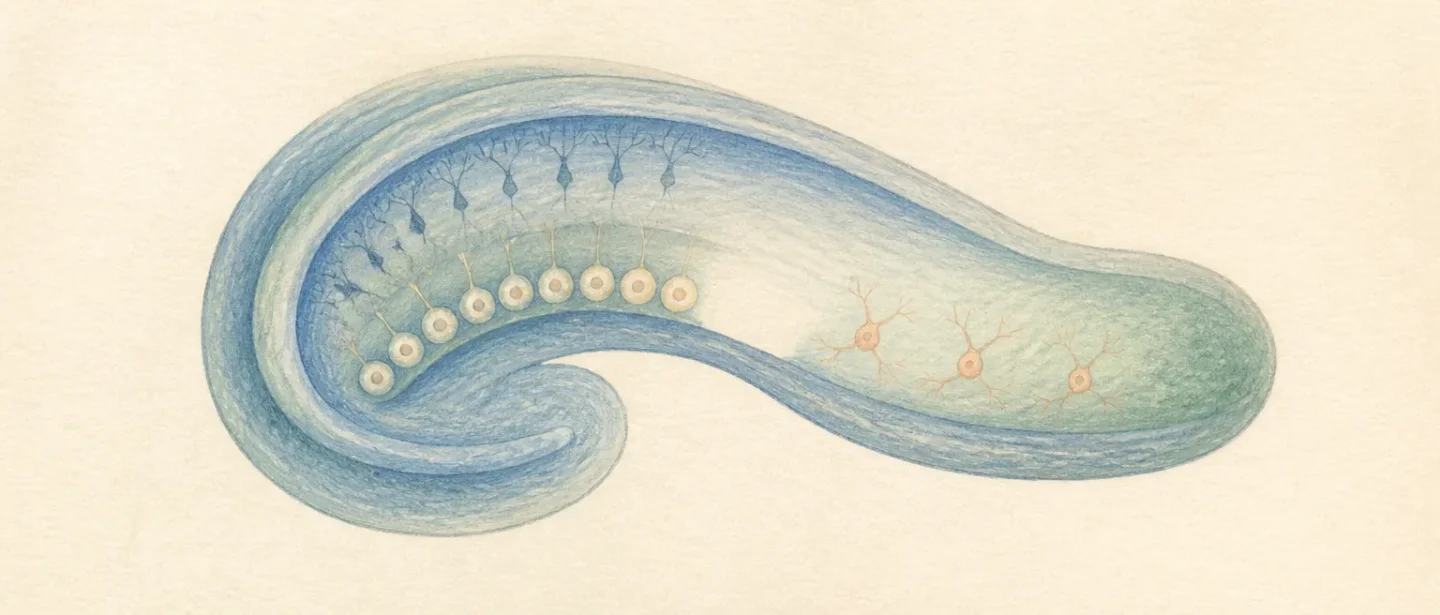
In depression, the brain’s new-neuron pipeline stalls
A Nature Medicine map of nearly half a million hippocampal cells found that adult neurogenesis stalls in major depression: stem-like cells remain, but fewer become young neurons.

Most of the brain’s neurons form before birth. A thin trickle keeps forming later in the hippocampus, a region that helps store memories and the feelings attached to them. In adults with major depressive disorder, that trickle appears to stall. Stem-like cells are still there. Fewer of them finish the trip into young neurons.1
The finding comes from a Columbia University team led by psychiatrist Maura Dupont. The paper was published August 21, 2026, in Nature Medicine. It maps nearly half a million cells from human hippocampus tissue and gives depression a cellular address that goes beyond a simple chemical shortage.2
Stem cells wait; fewer young neurons arrive
Neurogenesis is the making of new neurons. In the adult human hippocampus, that work happens in a thin band called the subgranular zone. Cells move through recognizable stages: quiescent neural stem cells, activated stem cells, intermediate progenitors, neuroblasts, and immature granule cells. The Columbia atlas found those stages in adult tissue and matched them with spatial maps and protein markers.1
In people with major depression, the balance shifted. There were more quiescent stem-like cells and fewer neuroblasts. The pipeline looked jammed early rather than emptied out. An interferon-linked gene module rose in those early stages, alongside stress-related and immune programs. The damage did not stop at newborn cells. Across the hippocampus’s main memory pathway — the trisynaptic circuit — the team saw signs of inflammation, cellular stress, weaker synaptic programs, and lower metabolic capacity.12
That matters for a skill called pattern separation: keeping similar experiences distinct so a quiet lunch with a friend does not collapse into an older memory of rejection. Mouse work ties that skill to adult neurogenesis. Dupont argues that young neurons are especially ready to join new memory circuits, which may help store a fresh experience apart from an old one. The human evidence for that link is still incomplete. The cell map shows a stalled pipeline and a stressed circuit; it does not prove that restarting neurogenesis would lift depression.2
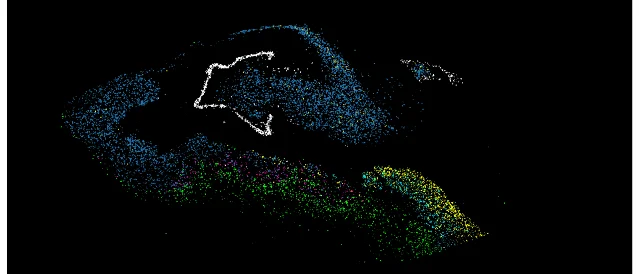
A half-million-cell map of postmortem hippocampus
The team worked with postmortem tissue from people who had not been on antidepressant medication. After quality control, the multiomics set retained 11 major depression samples and 19 controls, totaling 495,037 nuclei. Methods included single-nucleus RNA and chromatin profiling, spatial transcriptomics, in-situ mapping, proteomics, and immunofluorescence checks. Some altered genes overlapped known depression risk variants. Others showed epigenetic marks that can shift with stress, aging, and life experience.12
Dupont puts the clinical hope carefully. Turning neurogenesis back on might one day help some people by rewiring a hippocampus circuit. For now, the study offers a molecular inventory and a reason to think depression may split into biological subtypes, the way cancers are typed by cell features rather than by body location alone.2
The limits are clear. The tissue came from people after death, so the map cannot show cause and effect in a living brain. The cohort is still small. The samples were nonmedicated, which clarifies biology and leaves treated depression for later work. No clinic can order a neurogenesis restart tomorrow. What the work does establish is more concrete than a slogan: in these adult human hippocampi, the new-neuron assembly line stalls, and the surrounding memory circuit shows broad molecular wear. That is a sharper place to look for treatments than a single missing chemical.1
References
- 1
- 2Depression Stalls Formation of New Brain Cells
cuimc.columbia.edu
This story was produced automatically by a channel. One sentence is all it takes for Neodrop to keep producing for you.