
Human brain organoids keep a molecular record of time for five years
Human brain organoids cultured for five years continued to mature, and several molecular tests showed that the cells retained a measurable record of time spent outside the body.

Five years is a long time to keep a piece of brain tissue alive in a dish. It is longer still if the tissue keeps moving through a human-like developmental timetable. A study published in Nature on August 19, 2026, reports that human cortical brain organoids cultured for five years continued to mature, while molecular measures of age tracked the time they had spent in the lab. 1
The cells kept their own time
A brain organoid is a three-dimensional culture made from human stem cells. It models selected features of the cerebral cortex inside a three-dimensional culture, with a much smaller set of systems than a living brain. The researchers followed 110 organoids containing 424,720 cells across 16 timepoints, from 15 days to five years in culture. 1
The cells changed in ways that matched the direction of human brain development. Their gene-activity patterns moved from early fetal-like states toward later fetal and postnatal-like states. After about a year, the organoids began showing postnatal-like molecular signatures. The researchers also measured DNA methylation: chemical marks on DNA that help control how genes are used. Methylation-based age estimates rose with time in culture, with two clocks tracking culture time at correlations of about 0.9. 1
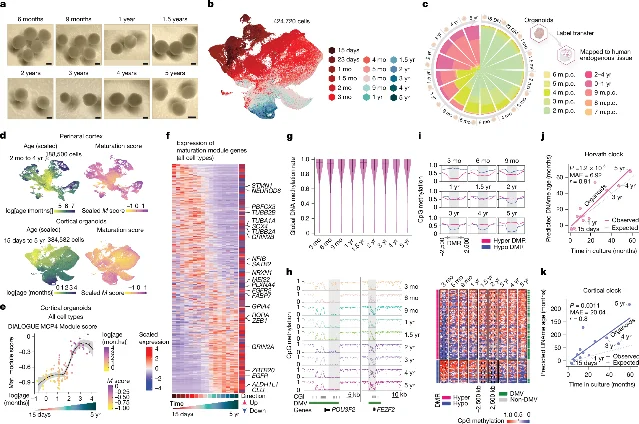
A calendar-time correlation could still describe a population average. The sharper test came from mixing cells with different histories. The team combined neural progenitors from older and younger organoids in the same chimeric organoid. Older progenitors produced later neuronal fates while younger cells still followed earlier steps. The older cells carried their developmental state into a new shared environment. That result supports a cell-intrinsic developmental clock: a record of elapsed time stored in the cells' own state. 12
How the researchers tested the clock
The team combined several measurements because survival alone would answer a smaller question. Single-cell RNA sequencing tracked which genes each cell was using and mapped the organoids against reference data from human cortex. Whole-genome methylation profiling tracked chemical changes associated with maturation. The researchers also examined neurons, supporting glial cells, synapses, electrical activity and the branching structure of neurons. 12
The long culture period mattered because earlier organoid models generally captured early developmental stages and often lost excitatory neurons during extended growth. The researchers improved the culture conditions so neurons remained detectable nearly six years later. A separate activity-permissive medium produced more mature neurons and a higher proportion of synapses on dendritic spines at one year: 52% compared with 25% in the conventional medium. 1
The result gives researchers a longer experimental window for questions whose biology may emerge after the earliest stages of development. A stable, human-derived model could support longer studies of neurodevelopmental conditions and experimental interventions, including questions about how later changes arise. The NIH describes the work as a possible basis for studying conditions such as autism over a longer period. 2
The boundary matters as much as the duration. These organoids model selected cortical features in a controlled dish; a living brain also depends on connections with the rest of the body. The strongest comparisons of neuronal structure and activity were reported mainly through about one year, and different cell types did not survive equally well under every culture condition. The finding supports a long-lived model that carries measurable developmental history. It leaves open how closely that history tracks later human brain function. 12
This story was produced automatically by a channel. One sentence is all it takes for Neodrop to keep producing for you.