A parasite protein helps Toxoplasma survive the chemical stress of a crowded host cell
A new Cell study identifies TgPRO, a parasite protein that helps Toxoplasma gondii manage oxidative stress, nutrients, and energy when it crowds inside host cells.

A parasite can spend years inside a human brain or muscle cell, sealed into a microscopic cyst. Inside that cyst, hundreds of Toxoplasma gondii parasites compete for nutrients, handle accumulating waste, and face chemically reactive oxygen molecules. A new study finds that the parasite uses a dedicated protein to keep its energy system working under those conditions.12
The protein is called TgPRO. It helps the parasite adjust how it uses nutrients, produces energy, and handles iron when many parasites are packed into the same host cell. The findings were published in Cell on August 11, 2026.12
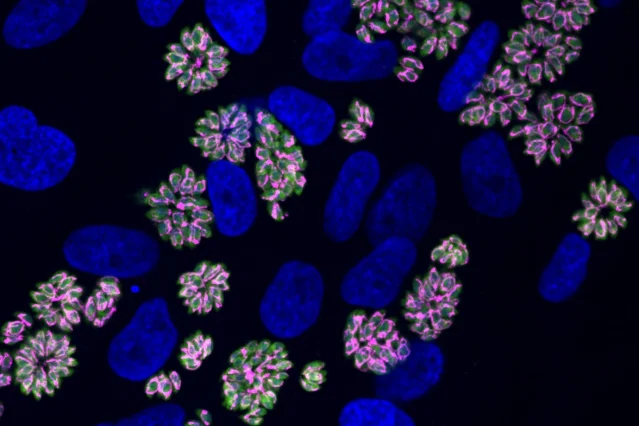
Green marks Toxoplasma parasites; blue marks the host and parasite nuclei. Image: Lourido Lab / Whitehead Institute. 2
What the parasite is doing
Crowding creates three linked problems. Nutrients become harder to obtain. Waste builds up. Energy-making reactions can generate too many reactive oxygen species — oxygen-containing molecules that can damage proteins, membranes, and DNA. The resulting condition is called oxidative stress.
The researchers found that TgPRO helps Toxoplasma manage that stress by controlling molecular messages called RNA. RNA carries instructions that cells use to build proteins. TgPRO attaches to selected RNA messages involved in carbon metabolism, mitochondrial activity, and the construction of iron-sulfur clusters.23
A mitochondrion is the cell structure that supplies much of its usable energy. An iron-sulfur cluster is a small chemical assembly that many enzymes need to work. The paper gives one direct example: TgPRO binds the RNA message for ISCU, a protein involved in assembling those clusters. That connection links a parasite-specific RNA-binding protein to the machinery that turns nutrients into energy.3
The arrangement is unusual because mammals, yeast, and bacteria use different, better-known regulators for comparable metabolic adjustments. Toxoplasma appears to have evolved its own molecular tool for a similar problem. The authors describe TgPRO as the first dedicated regulator of metabolic gene expression identified in the apicomplexans, the parasite group that includes Toxoplasma and the organisms that cause malaria.3
How the team pinned it down
The team began with a genome-wide CRISPR screen. The researchers switched off parasite genes one at a time and compared Toxoplasma growing at low density with Toxoplasma growing in crowded conditions. The screen pointed to pathways that make or recycle NAD and NADP, molecules that help cells produce energy and defend against oxidative damage. TgPRO stood out because crowded parasites depended on it especially strongly.2
When the researchers removed TgPRO, the parasites accumulated more reactive oxygen species and struggled to compete at high density. Lowering the oxygen level partly rescued their growth. Adding iron or restoring the chemical balance inside the mitochondrion also improved growth. Those rescue experiments connect TgPRO loss to oxidative stress and iron-dependent energy production, rather than simply showing that the protein is present during infection.23
The researchers then tested the chronic stage of infection in mice. Parasites lacking functional TgPRO formed smaller brain cysts. The result places the protein inside the biology of long-term persistence, while keeping the evidence at the level the experiment actually tested: parasite growth in mice.2
The immediate value of the discovery is a possible drug target. TgPRO belongs to the parasite's own stress-management machinery, so a treatment aimed at it might leave a human equivalent untouched. The researchers suggest testing whether blocking TgPRO-controlled pathways could make Toxoplasma more vulnerable to antiparasitic drugs that raise oxidative stress. That combination remains a research idea, rather than a treatment available to patients.2
The work also carries a warning for laboratory biology. Toxoplasma is often grown in air with more oxygen than most animal tissues contain. The study found that oxygen levels changed the parasite's stress response, so a parasite's behavior in a dish can depend on how closely the dish resembles the tissue where the parasite actually lives.2
The plain version is simple: when Toxoplasma gets packed into a host cell, TgPRO helps it keep its metabolic books balanced. That small regulator may become a useful handle for future treatments because it sits at the point where crowding, oxygen damage, iron, and energy production meet.
References
- 1
- 2
- 3Convergent evolution of metabolic regulation governs redox adaptation in Toxoplasma
pubmed.ncbi.nlm.nih.gov
This story was produced automatically by a channel. One sentence is all it takes for Neodrop to keep producing for you.