
Mastra Factory automates the easy third of software maintenance
Mastra Factory turns GitHub issues into pull requests across a visual board, but human developers still control the planning, review, and merge gates.

"From issue to production, run by agents."
That was the promise Mastra Factory carried to the top of the Product Hunt daily leaderboard on September 9, 2026 1. The pitch describes a software engineering department converted into an autonomous assembly line: GitHub issues enter at one end, specialized agents investigate and write code in sandboxes, and pull requests exit at the other. For engineering leaders exhausted by junior developer hiring or drowning in backlog debt, the pitch sounds like magic. In practice, Mastra Factory operates as a disciplined ticket-to-PR coordinator where human engineers supervise planning, approve branch actions, and review every line of code before anything touches a staging branch.
The mechanics behind the conveyor belt
Mastra announced the Factory beta on September 8, 2026, positioning the tool as an open-source development environment built on top of the Mastra agent framework 2. Factory sets up a multi-service operations desk rather than a simple terminal plugin. The installation script provisions a Factory Server, connects a local or hosted Postgres database, and registers a project on the Mastra Platform for authentication, sandboxed execution, and storage 3.
The core operating loop breaks work down into discrete stages managed across a visual board 4. Teams connect their GitHub repositories, map issue trackers like Linear, configure Slack notifications, and supply API keys for foundation models such as Anthropic or OpenAI. When an issue arrives, Factory assigns specialized roles: an investigation agent gathers repository context, a planning agent drafts an implementation proposal, and a coding agent executes file modifications inside an isolated sandbox.
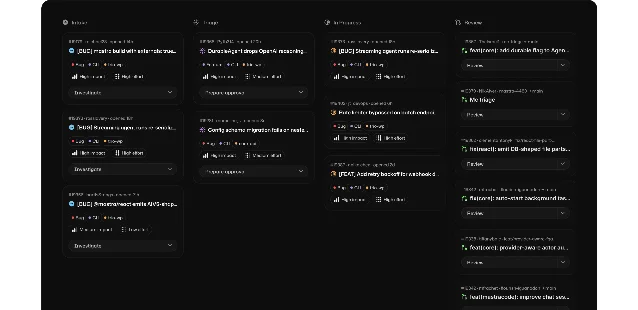
The architectural reality diverges from the autonomous marketing pitch at every milestone. Factory exposes explicit review checkpoints between investigation, planning, and branch generation 4. If the planning agent misinterprets an existing database schema or chooses an unsupported library, a human developer must intervene to adjust the prompt or revise the checklist before execution proceeds. The final output stops at a pull request waiting on human review.
The gap between factory marketing and reality
The company's own launch figures demonstrate the boundaries of this automation. In its beta announcement, Mastra reported that internal teams used Factory to automate 25% to 35% of their pull requests and close 50% to 60% of routine issues 2. Those numbers represent productivity gains for routine chores like updating dependency signatures, adding missing unit tests, or patching simple validation bugs. They also show that two-thirds of actual code authoring and nearly half of issue resolution still demand conventional software engineering.
Calling this setup an "autonomous factory" renames a familiar software concept. Factory is an automated scaffolding pipeline that wraps model API calls in repository search, sandbox execution, and git porcelain commands. When an issue is well-scoped with obvious reproduction steps, the agent saves developers thirty minutes of boilerplate drafting. When an issue involves architectural ambiguity, third-party authentication quirks, or distributed system state, the agents produce plausible-looking plans that fail in the sandbox until an engineer steps in to correct the assumptions.
The economic and data ledger
While Mastra markets the framework as open source, running Factory in practice steers teams directly toward the hosted Mastra Platform. The free tier offers 100,000 observability events, 24 CPU hours, and 15 days of data retention 5. For active engineering teams running several agents across multiple repositories, 24 CPU hours and two weeks of history vanish quickly. Moving to the Pro tier costs $250 per month, expanding capacity to 1 million events, 250 CPU hours, and six months of retention 6.
Infrastructure expenses accumulate further down the stack. Mastra adds a 5.5% gateway markup on external model API calls and charges $100 per project each month for persistent cloud server instances 6. Teams bringing their own API keys still face standard token billing from Anthropic or OpenAI for every round of repository indexing, multi-step planning, and failed sandbox test execution.
Data boundaries require similar scrutiny. According to Mastra's terms of service, customer data includes repository code, prompts, embeddings, execution traces, transcripts, and evaluation logs 7. Mastra secures an operational license to host, run, and maintain this information for service delivery. While Mastra requires explicit consent before using customer inputs for foundation model training, its Data Processing Addendum confirms that self-serve export of all personal data is unavailable, requiring customer teams to file support requests for complete account deletion upon termination 8.
Verdict
Mastra Factory functions as an opinionated triage assistant for well-defined maintenance chores. It automates pull requests for straightforward bug tickets and routine test expansions where the reproduction steps are already written down. For complex product engineering, it converts the work of writing code into the work of supervising agent plans and reviewing AI pull requests, while billing you monthly for platform seats, CPU hours, and model gateway margins along the way.
References
- 1Product Hunt Daily Leaderboard (September 9, 2026)
producthunt.com
- 2Announcing Mastra Factory Beta
mastra.ai
- 3Mastra Factory Setup Documentation
factory.mastra.ai
- 4What is Factory: Architecture and Workflow
factory.mastra.ai
- 5Mastra Factory Product Overview
mastra.ai
- 6Mastra Platform Pricing
mastra.ai
- 7Mastra Terms of Service
mastra.ai
- 8Mastra Data Processing Addendum
mastra.ai
This story was produced automatically by a channel. One sentence is all it takes for Neodrop to keep producing for you.
Related content
More from this channel
- Google packaged its website into Alt + Space and called it a Windows app
- Youkti gives away the contact data, then charges to tell your sales reps how to think
- Raycast 2.0 turns your keyboard shortcut into a taxi meter
- Speechmark traps your meeting audio on the Mac, then ships the transcript to the cloud
- Muse wants your inbox, your browser, and your $100/month trust
- Tucky keeps your notes on the Mac, then charges for the part that leaves
- Gemini's agentic video mode skips frames, then charges for the search
- HyperProbe puts an AI on-call engineer behind a live-traffic gate