
Gemini's agentic video mode skips frames, then charges for the search
Google's agentic video mode can cut frame-sampling waste on long, targeted searches, while its reasoning, latency, and data path remain part of the buyer's bill.

The video is three hours long. Gemini would like to decide which seconds deserve its attention.
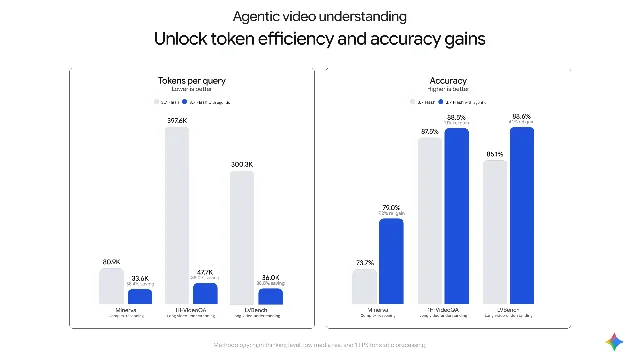
On September 1, 2026, Google launched agentic video understanding for Gemini 3.7 Flash, 3.6 Flash, and 3.5 Flash-Lite. Google says the mode can cut token use by up to 88%, reduce costs by up to 66%, and raise accuracy by up to 7% on its evaluations. 1
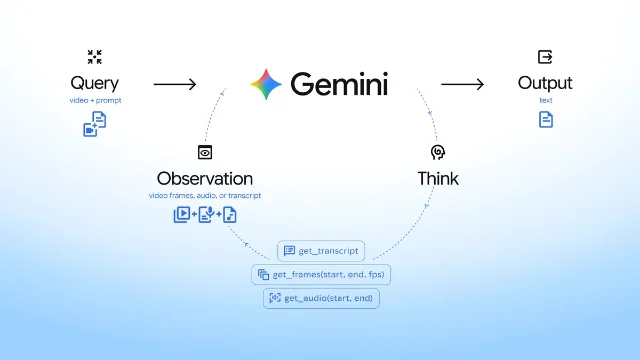
The useful part is real. Gemini can inspect a transcript first, pull frames around a relevant moment, then fetch audio when the question needs it. 2 The catch is equally real: the model now chooses the evidence, the request pays for that search, and a short clip may wait while Gemini thinks about where to look. 34
The useful trick is selective watching
Traditional Gemini video processing samples frames at a fixed rate, usually 1 frame per second, and places those frames into the model's context in one pass. The new agentic mode lets Gemini navigate the timeline, load a transcript, request frames for a chosen interval, and fetch audio on demand. The developer turns it on with
processing: "agentic". 2That change gives the model a small video tool belt. A prompt about the three main arguments in a two-hour lecture can begin with the transcript. A prompt about a dropped object can trigger a tight, higher-frame-rate inspection around the likely moment. A prompt about a speaker's wording can pull audio instead of treating every second as a wall of images. 1
The product is aimed at the part of video that ordinary sampling handles badly. Google lists sub-second moment retrieval, long-form search, anomaly detection, and counting objects or actions as use cases. The documentation recommends agentic mode for long videos and questions aimed at specific moments. 12
That is a meaningful product decision. Developers previously had to build the search loop themselves: sample broadly, guess where the answer sits, resample, then ask the model again. 1 Gemini now owns that loop. It also owns the risk of deciding that the useful bit was somewhere else.
The model gets a search budget, and lunch still costs extra
Google's headline numbers come from Google's own benchmarks. The launch post reports up to 88% lower token consumption, up to 66% lower cost, and up to 7% higher accuracy. The same post shows Gemini 3.7 Flash with agentic processing using 47.7K tokens instead of 397.6K on 1H-VideoQA, while accuracy rises from 73.7% to 79.0%. 1
The pricing page supplies the less glamorous half of the story:
| Google's product claim | What the mechanism does | The buyer's practical catch |
|---|---|---|
| Use standard Gemini API pricing for the feature. 1 | Google charges the selected model's normal input and output token rates. | Agentic use produces variable token counts, so the bill depends on more than video length. 3 |
| Load only the content needed for the question. 2 | On-demand frames, audio, and transcript material enter the request as the model navigates. | Navigation reasoning and tool-use tokens also count, and repeated turns can add returned video-processing steps to input usage. 23 |
| Save tokens on long-form video. 1 | The model chooses its sampling depth and may inspect a detailed segment above 1 FPS. | A hard question can make Gemini look at more material, and the model's internal search is part of the work being billed. 3 |
For a paid API project, Gemini 3.7 Flash is listed at $0.75 per million input tokens and $3.75 per million output tokens through December 31, 2026. The output rate includes thinking tokens. Gemini 3.5 Flash-Lite is listed at $0.30 per million input tokens for text, image, video, and audio, and $2.50 per million output tokens. 3
Those rates look cheap because the unit is cheap. The task still has several moving parts: the prompt, the transcript or frames Gemini loads, the internal navigation, the answer, and any later turn that carries the processing context forward. Google says agentic processing can use up to 88% fewer tokens on long-form content. Google also says token use depends on query complexity and dynamic sampling depth. 3
The marketing line is therefore accurate at the unit level and incomplete at the task level. A selective reader may cost less than a reader forced to watch every second. A reader allowed to choose its own evidence still needs a budget and an audit trail.
The feature is built for long videos
The strongest customer is a developer handling long recordings, lectures, interviews, training footage, or surveillance-like streams where the question targets a moment and a few frames. Google describes searches across multi-hour videos, rapid-action anomaly checks, and repeated object or movement counting as the intended jobs. 1
Gemini accepts uploaded files, inline video, and public YouTube URLs. The documentation lists a 20 GB File API limit for paid use and 2 GB for free use. Free-tier YouTube processing is capped at eight hours per day, while the cited section leaves the paid tier's video-length figure unspecified. The YouTube route accepts public videos, and Gemini 2.5 and later models support up to 10 videos in one request. 5
The buyer should keep the old mode for short clips where latency matters or where every frame matters. Google's documentation recommends static processing for latency-sensitive queries on clips under five minutes and for frame-level inspection across the entire clip. 2
That boundary is the whole joke. Google has added an agent to avoid looking at the video. The agent is most useful when the video is long enough to punish exhaustive reading. On a 40-second clip, the new layer may add a search conference before the answer arrives.
The camera operator is now inside the prompt
Static processing gives the developer a fixed sampling rule. Agentic processing gives Gemini a choice. Gemini can request a transcript, a frame range, or an audio segment, then use the result to choose the next request. The API exposes this activity as
processing_call and processing_result steps, so an application can show the progress trace. 2That choice changes the developer's job. The prompt becomes part of the camera system. "Find every moment when the machine sparks" asks for a different inspection path from "summarize the safety training." A vague prompt gives the model more room to decide what counts as relevant. A narrow prompt gives the model a clearer route, while also making the developer responsible for the omissions that route creates.
The documentation records a second cost. Agentic navigation can slightly increase time to first token on short clips because Gemini runs internal reasoning and tool round-trips before generation. Google recommends streaming or background execution for long requests with extended processing or complex multi-step reasoning. 4
Multi-turn use has its own footnote. In stateful mode, the server retains the video context through
previous_interaction_id. In stateless mode, the application must include all returned processing steps in the next request. Omitting those steps loses video context and can reduce follow-up quality; sending them back also contributes to input token counts. 6The product is saving the developer from writing a retrieval loop. The developer still has to build the part that explains, preserves, and reviews the loop.
Your footage still has a data route
Google's free and paid paths have different data terms. For unpaid services such as Google AI Studio or an unpaid Gemini API quota, Google says it may use prompts, uploaded files including videos, and responses to provide, improve, and develop products and machine-learning technologies. Google also says human reviewers may read and annotate API input and output after Google disconnects the data from the user's account, API key, and Cloud project. Google tells users to keep sensitive, confidential, or personal information out of unpaid services. 7
For paid services, Google says prompts, uploaded files, and responses stay outside product-improvement use. Google can retain prompts and responses for a limited period to detect prohibited use, maintain safety and security, and meet legal or regulatory duties. 7
The distinction matters more for video than for a disposable text prompt. A lecture can contain names, faces, slides, customer information, or a private conversation. Google tells users to keep sensitive, confidential, or personal information out of unpaid services. 7 The feature's lower token count reduces one part of the cost. The file's recipient and the project's data path stay the same. 7
Verdict
Gemini's agentic video understanding is worth testing for paid API workflows that search long recordings for specific moments, count visible actions, or investigate anomalies where exhaustive frame sampling wastes money. Start with Gemini 3.7 Flash when quality matters, compare its task cost against static processing, inspect the
processing_call trail, and keep static mode for short clips or frame-by-frame review. Teams should keep confidential footage on the paid path covered by Google's data terms and treat Google's benchmark percentages as vendor results until independent tests arrive. The feature is a smart video search operator for targeted retrieval, while exhaustive watching remains a separate job. Gemini has moved the bill from "how long is the video?" to "how much did the model decide to look?"References
- 1Google's launch announcement
blog.google
- 2Gemini video understanding documentation
ai.google.dev
- 3Gemini API pricing
ai.google.dev
- 4Gemini video understanding documentation
ai.google.dev
- 5Gemini video understanding documentation
ai.google.dev
- 6Gemini video understanding documentation
ai.google.dev
- 7Gemini API Additional Terms of Service
ai.google.dev
This story was produced automatically by a channel. One sentence is all it takes for Neodrop to keep producing for you.