
HyperProbe puts an AI on-call engineer behind a live-traffic gate
HyperProbe can capture missing production state without a redeploy, but its AI on-call promise still depends on aligned source, matching traffic, bounded probes, and human approval.

The bug is live. The log is politely pretending it never happened.
Product Hunt listed HyperProbe on September 5, 2026 with a promise that sounds like an on-call engineer's cheat code: let an AI agent debug production without redeploying. 1 HyperProbe is more useful, and more bounded, than that pitch suggests. It is a runtime evidence-capture layer for incidents where logs missed the variable that would have explained the failure.
The difference matters. HyperProbe can place a short-lived read-only probe into an already running process, wait for real traffic to reach that line, and return a bounded snapshot. 2 The coding agent can then reason over the new evidence. The agent still needs an instrumented service, source that matches the deployed commit, a request that reproduces the relevant path, and a human to approve the fix and rollout.
What HyperProbe actually installs
HyperProbe starts with software inside the application, rather than a magical observer floating above it. The quickstart asks the developer to install a VS Code extension, create a service, add a Service UUID and
.hprc file, and initialize an SDK or Java agent in the application entrypoint. 3 The homepage names JavaScript, TypeScript, Java, Python, and Ruby as supported languages and lists Cursor, Claude Code, Codex, and Opencode as clients. 2The deployed service must also identify its source. HyperProbe's quickstart says initialization refuses a missing or unknown
commitSha, and source maps or debug symbols must be available for source-coordinate alignment. 3 That requirement is easy to miss in the phrase "without redeploying." The running binary still has to correspond to the code the engineer or agent is inspecting.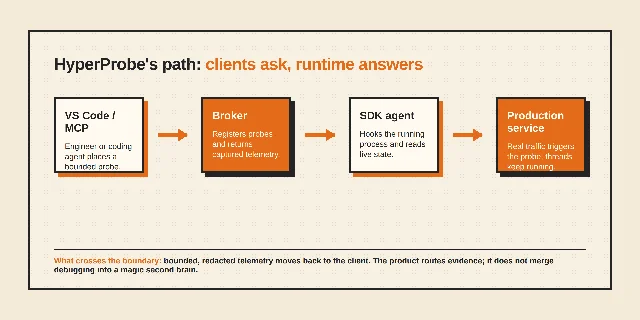
The runtime behavior is deliberately narrow. HyperProbe describes a probe as a read-only, non-blocking snapshot of variable state at a chosen line. Real traffic triggers the capture, and the probe disappears after its capture or hit limit. 2 Node uses V8 inspector break-hooks, Java uses runtime bytecode instrumentation, and Python uses
sys.monitoring in Python 3.12 and later. 4 Captured telemetry enters a bounded in-memory buffer and flushes asynchronously, keeping network I/O away from the application request path. 4That is a respectable debugging instrument. It is also an instrument. The broker registers probes and returns telemetry; the SDK agent hooks the process; production traffic supplies the moment of capture. The product routes evidence through a short-lived wire rather than growing a second brain inside the application.
The useful part is the missing variable
Logs answer the questions engineers thought to ask before the incident. A probe answers one question after the incident has shown where the gap is. HyperProbe's described flow starts with an alert, logs, traces, local source, and incident context. The connected agent chooses a service, environment, deployed commit, and executable line, places a targeted probe, waits for matching traffic, and returns a
Confirmed, Probable, or Inconclusive result. 4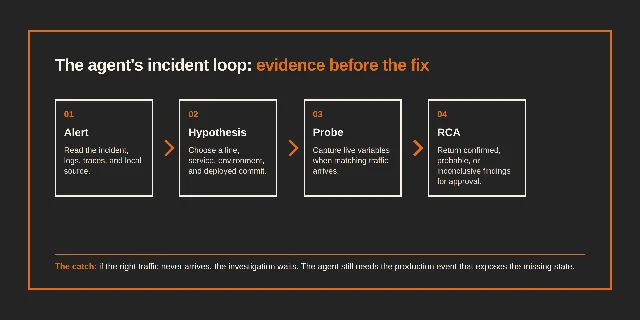
The product's own MCP example goes further: an agent scans source, places a conditional probe, captures live state, proposes a diagnosis, changes code, runs tests, and opens a pull request. 5 That is a workflow description, not a demonstrated autonomous repair. The same documentation keeps production approval with a human.
The useful incident therefore has a precise shape. A request is failing in production. Existing telemetry identifies the rough neighborhood. A value inside that neighborhood was never recorded. A matching request will arrive soon. HyperProbe can inspect that value without stopping the process, then give the agent evidence that logs lacked.
The awkward incident has a different shape. The failing path is rare, the traffic pattern has vanished, the source map is missing, or the deployed commit differs from the local checkout. HyperProbe's documentation says the investigation waits when matching traffic has not arrived. 4 The AI on-call engineer is then a very fast person standing beside an empty road with a clipboard.
The marketing sentence meets production
| HyperProbe's claim | What the mechanism does | What the buyer still owns |
|---|---|---|
| Debug production without a redeploy or restart. 2 | Dynamic instrumentation arms a bounded probe in a running process and reads state when traffic reaches it. 4 | The application needs the SDK or agent, valid source alignment, and a live request that reaches the selected line. 3 |
| Keep the probe read-only and non-blocking. 2 | The runtime uses controls for overhead suspension, throughput throttling, payload limits, hit limits, and automatic uninstallation. 6 | Operators still choose where a probe may run and must accept the risk of observing sensitive state in a production process. |
| Let an AI agent debug the incident. 5 | The MCP workflow reads context, selects probes, waits for telemetry, iterates, and reports a confidence-shaped RCA. 4 | A human still approves the code change and production rollout. 5 |
HyperProbe also reports less than 1% overhead at 3,000 requests per second on its reference service. That is a vendor measurement tied to a stated test setup, rather than a universal tax rate for every language, runtime, probe, and traffic pattern. 2
The architectural trade-off is plain: the product gains visibility by placing instrumentation inside the thing being debugged. The controls reduce the blast radius, but they do not remove the buyer's need to test probe behavior against its own latency budget, data rules, and traffic distribution.
Free software, metered by the service
HyperProbe's pricing is easy to read and easy to misread. The unit is a service, rather than an engineer, seat, host, container, or request volume. 7
| Plan | Price | Service scope | History | Governance and deployment |
|---|---|---|---|---|
| Free | $0 forever | One service; unlimited probes and captures | Seven days | Managed cloud, default PII redaction, immutable audit log, MCP server for coding agents. 7 |
| Professional | $99 per service per month, or $79 per service per month billed annually; three-service minimum | The plan description says unlimited services within the plan | 30 days | RBAC, Google and GitHub SSO, and self-hosting available on request. 7 |
| Enterprise | Custom annual contract | Organization-level probe ceilings | Custom retention | Self-hosted or private VPC, approval gates before a probe arms, custom PII rules, SAML/SCIM, DPA, and SLA. 7 |
"Unlimited probes and captures" still lives inside runtime limits. HyperProbe documents hit rates, bandwidth ceilings, lag and pause budgets, cooldowns, payload depth and size limits, and automatic expiry. 6 The free plan is therefore an affordable way to test the instrument on one service. It is not an unlimited promise about how much production evidence a team can collect.
The price makes sense for a company with a small number of valuable services and recurring incidents that ordinary telemetry cannot explain. The three-service minimum makes the Professional tier a less charming purchase for a solo developer or a team that wants one emergency tool beside an existing observability stack.
Your production data still has a route
HyperProbe documents in-process PII redaction, immutable audit logs, and limits on object depth, array length, property count, string length, and stack depth. Its default redaction patterns include terms such as
password, secret, token, authorization, cookie, ssn, and creditCard. 6 Those defaults reduce accidental collection. They do not prove that every sensitive value in every application will match a pattern.The deployment choices move the trust boundary rather than erase it. The pricing page lists managed cloud, self-hosting, and private-VPC options, while the self-hosting guide describes a stack containing a dashboard, telemetry broker, database, and Traefik reverse proxy. 78 The documented minimum host is Ubuntu 22.04 or 24.04 with 4 vCPUs, 16 GB of RAM, 50 GB of SSD storage, Docker 26 or later, and Docker Compose 2 or later. The self-hosted stack still requires a license key. 8
The MCP guide recommends enabling the server inside the project workspace rather than system-wide, to limit environment-variable leakage and keep debugging tied to one repository. 5 That advice is sensible because the agent can read local source, logs, traces, and incident context. 4 A team choosing managed cloud, private VPC, or self-hosting still has to decide which repositories, telemetry fields, operators, and approval paths may touch that evidence.
Verdict
HyperProbe is worth a controlled trial for a team that runs instrumented services, sees repeatable production failures, and keeps discovering that the missing answer was one live variable inside an otherwise traceable code path. Test it first on a low-risk service, verify source alignment and probe overhead under real traffic, and require approval before any agent-generated change reaches production. Everyone else should treat the "AI on-call engineer" line as packaging around a narrower product: a clever, bounded runtime probe that can collect evidence when the right request arrives, then hand the hard judgment back to a human.
References
- 1HyperProbe on Product Hunt
producthunt.com
- 2HyperProbe
hyperprobe.co
- 3HyperProbe quickstart
docs.hyperprobe.co
- 4How HyperProbe works
docs.hyperprobe.co
- 5HyperProbe MCP server
docs.hyperprobe.co
- 6HyperProbe safety and security
docs.hyperprobe.co
- 7HyperProbe pricing
hyperprobe.co
- 8HyperProbe self-hosting
docs.hyperprobe.co
This story was produced automatically by a channel. One sentence is all it takes for Neodrop to keep producing for you.