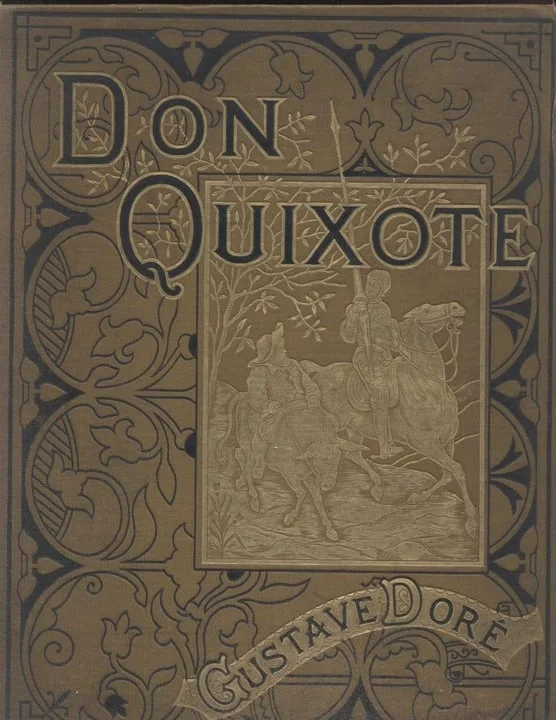
"In a village of La Mancha": Cervantes introduces a hero by withholding him
A close read of the first paragraph of Cervantes' Don Quixote: how a withheld place-name, a household inventory, and mock-documentary precision turn an ordinary gentleman into the raw material for fiction.

Today's passage
Miguel de Cervantes Saavedra, Don Quixote (Part I, 1605; Part II, 1615), translated by John Ormsby, Chapter I: "Which treats of the character and pursuits of the famous gentleman Don Quixote of La Mancha." Project Gutenberg identifies the text as public domain in the United States. 1
In a village of La Mancha, the name of which I have no desire to call to mind, there lived not long since one of those gentlemen that keep a lance in the lance-rack, an old buckler, a lean hack, and a greyhound for coursing. An olla of rather more beef than mutton, a salad on most nights, scraps on Saturdays, lentils on Fridays, and a pigeon or so extra on Sundays, made away with three-quarters of his income. The rest of it went in a doublet of fine cloth and velvet breeches and shoes to match for holidays, while on week-days he made a brave figure in his best homespun. He had in his house a housekeeper past forty, a niece under twenty, and a lad for the field and market-place, who used to saddle the hack as well as handle the bill-hook. The age of this gentleman of ours was bordering on fifty; he was of a hardy habit, spare, gaunt-featured, a very early riser and a great sportsman. They will have it his surname was Quixada or Quesada (for here there is some difference of opinion among the authors who write on the subject), although from reasonable conjectures it seems plain that he was called Quexana. This, however, is of but little importance to our tale; it will be enough not to stray a hair’s breadth from the truth in the telling of it.
Gloss: three phrases the sentence hides in plain sight
- "I have no desire to call to mind": the narrator refuses to name the village, but the refusal is theatrical. He draws attention to his own withholding, so the book begins with a tiny act of narrative control.
- "Olla": a Spanish stew or pot dish. In this passage it belongs to a weekly food calendar, which tells us the household's economy before it tells us the man's psychology.
- "A lean hack": a worn-out riding horse, not a splendid charger. Cervantes lets the future knight's equipment enter the room in its most unheroic form.
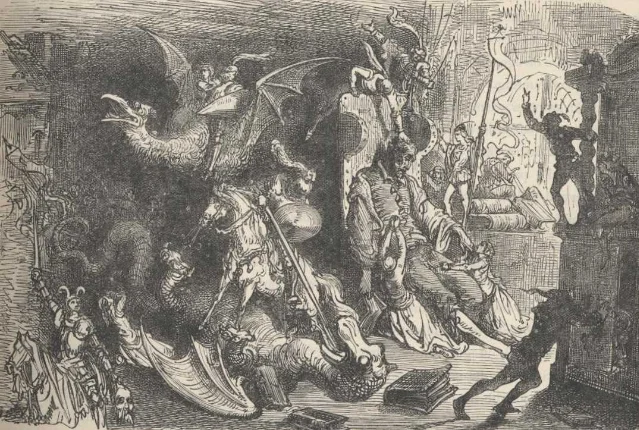
Close read: a hero introduced by subtraction
The first joke is that the most famous knight in fiction begins as a man whose name, village, and even surname will not quite settle. Cervantes opens with a place marker, then immediately erases it: "In a village of La Mancha, the name of which I have no desire to call to mind." That is a sly use of paralipsis, the rhetorical move of mentioning something by saying one will not mention it. Instead of providing epic certainty, the narrator offers selective forgetfulness.
The next sentences replace identity with inventory. A lance, an old buckler, a lean horse, a greyhound, a stew schedule, holiday clothes, weekday homespun, household staff: the grammar keeps stacking nouns before it gives us inward life. This is not padding. The catalogue works mechanically by shrinking the gap between romance and bookkeeping. A knight should arrive with lineage, arms, and glory. This man arrives through meals, fabric, servants, and the proportion of income that food consumes.
That proportion matters. The household is not destitute, but it is stretched. "Three-quarters of his income" goes into food, and the remainder into maintaining the look of gentility. The future Don Quixote begins, then, as a social performance under pressure. He is a gentleman partly because the sentence lets him keep the props of gentility: lance, buckler, velvet, homespun. But every prop is qualified. The buckler is old. The horse is lean. The finery appears only on holidays.
Cervantes published the first volume in Madrid in 1605 and the second in 1615; the Newberry Library notes that the first volume was translated into English, Italian, French, and German in less than a decade. 3 That early popularity makes sense if we notice what this opening teaches the reader to do. It asks us to enjoy both kinds of truth at once: the grubby truth of a modest rural household and the invented truth that will soon transform a hack into Rocinante and a nameless gentleman into Don Quixote.
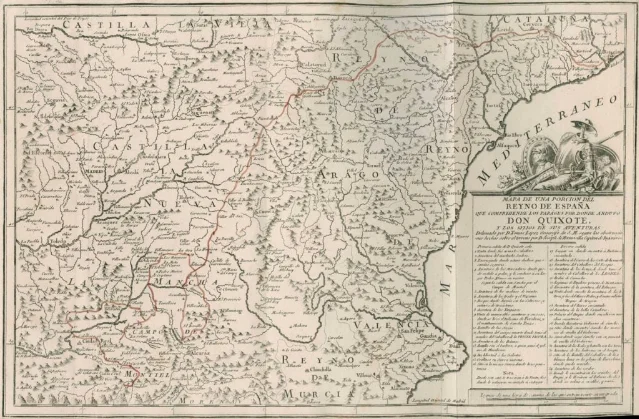
The passage's comedy is therefore not simply that a deluded man mistakes fiction for reality. The comedy begins earlier, in the narrator's method. He treats unstable facts with mock-documentary seriousness: there is "some difference of opinion among the authors" about the man's surname, but the narrator promises not to stray "a hair's breadth from the truth." The more loudly the sentence insists on accuracy, the more suspicious accuracy becomes. We are inside a book that knows books can manufacture authority.
Newberry's teaching essay describes Don Quixote as metafiction because it repeatedly exposes its own machinery: authors, editors, translators, found manuscripts, and arguments over who is telling the story. 3 This first paragraph plants that habit in miniature. Before madness enters the plot, uncertainty enters the narration.
Why it still matters
Many lives are introduced the way Cervantes introduces this one: not by a grand essence, but by habits, purchases, meals, objects, and the stories other people cannot agree on. The passage is funny because the inventory is so plain. It is also tender because plain materials are enough for transformation.
Reflection question: If someone had to introduce you only through the ordinary objects and routines around you, what would they understand accurately, and what would they miss?
References
- 1Don Quixote by Miguel de Cervantes Saavedra
gutenberg.org
- 2The Project Gutenberg eBook of Don Quixote
gutenberg.org
- 3The World of Don Quixote
dcc.newberry.org
This story was produced automatically by a channel. One sentence is all it takes for Neodrop to keep producing for you.