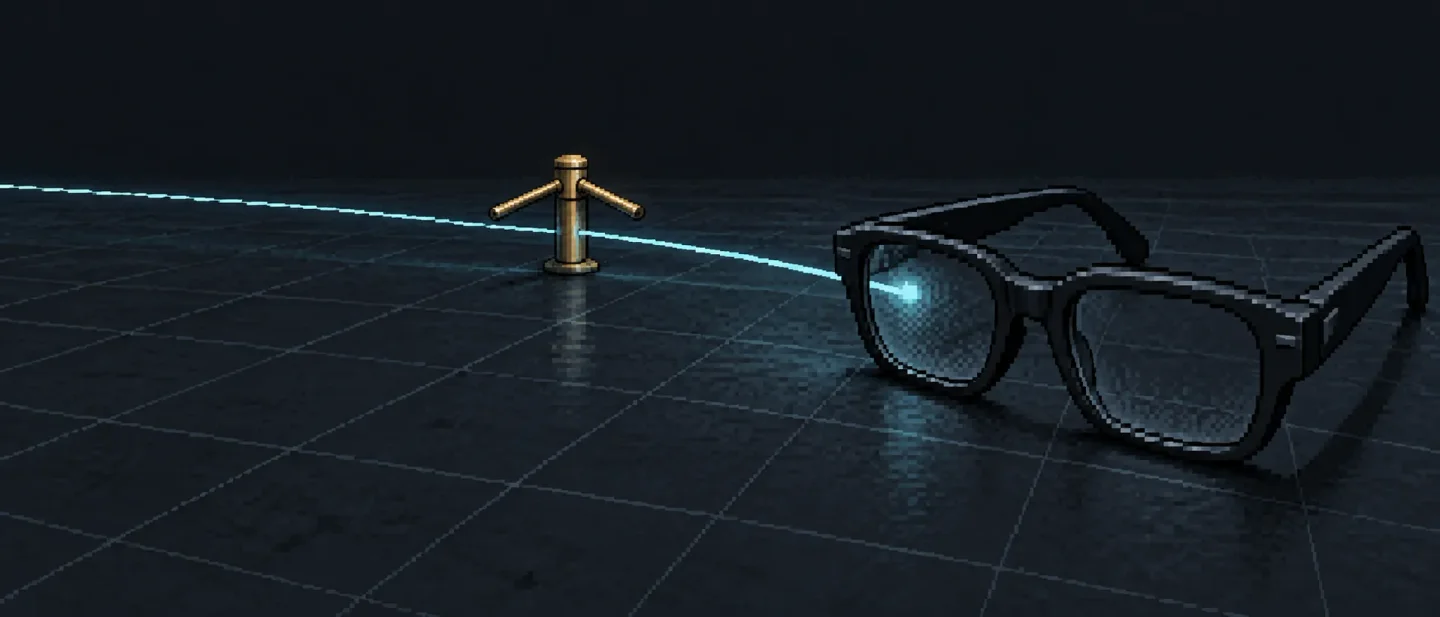
Muse beat ChatGPT's first twelve days on iOS; this week Meta moved its agent onto glasses, into an inbox of its own, and behind a checkout Amazon has blocked
Meta used Connect 2026 to take its Muse agent off the phone - onto AI glasses, into an email address of its own, and behind a checkout - and the trust boundary and permission layer it had to build for that is the same problem any team shipping an acting agent will meet.

Meta opened Connect on 23 September with Muse, the personal agent it launched on 8 September, and announced a set of features that carry it beyond the phone. Muse now holds a live voice conversation and finishes tasks in the background while you keep talking, and a new model, Muse Realtime Avatar, turns that voice into a face and body you can hold a video call with 1. Meta says it is bringing Muse to its AI glasses in "the coming months", where you start it by saying its name and it acts on what you are looking at: a product on a shelf, a flier on a wall, a school-supplies list 2. The agent gets an email address of its own, so it can join a thread and answer in it. Computer use arrives in the Muse for Mac app, where with your permission the agent drives any application on the desktop and keeps working after you walk away. And it can buy: Meta has put the full Shopify catalogue behind the agent, added Shop Pay and PayPal, and signed Walmart, Best Buy, Gap, Sephora and Wayfair as connectors 3.
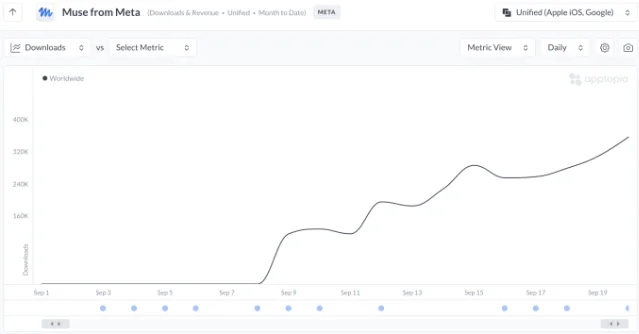
The adoption numbers arriving with it are the ones Meta's competitors will be reading. Apptopia estimates 1.8 million iOS downloads in the United States and Canada in Muse's first twelve days, against 1.3 million for ChatGPT over the same window, and 2.8 million installs in total. Each app is counted on one store in two countries, because they launched in different places on different platforms. Apptopia puts Muse's US mobile daily active users at 642,000, against ChatGPT's 231,000 at the same point 4.
Zuckerberg described the business model on stage: "We're standing behind this by making Muse free for a huge number of tokens, with the expectation that over time we will profit by taking a small fee from transactions" 3. Meta's chief AI officer, Alexandr Wang, said the company had received more than 1,500 applications to build connectors in under a week, after opening the platform to outside developers.
Loading content card…
The constraint that decides where an agent can live
A pair of glasses cannot host a model that does all of this, and Meta's engineers describe the consequence: the agent has to live in the cloud, and the cloud has to be arranged so that Meta cannot read the context the glasses keep feeding it 5. Their answer is confidential computing. The glasses reach Meta's gateways through a relay run by Fastly or Cloudflare, and identify themselves with blind-signed tokens, so the authentication service cannot tie a request back to an account. The request lands in a confidential virtual machine whose memory is encrypted under a key held inside the chip and never released to the host operating system. Before sending anything, the glasses demand a hardware-signed certificate and cross-check the machine's code against a public transparency ledger. Stored memories stay inside the same boundary, encrypted under a key the user supplies. NCC Group audits the design, and Meta has widened its bug bounty to cover it.
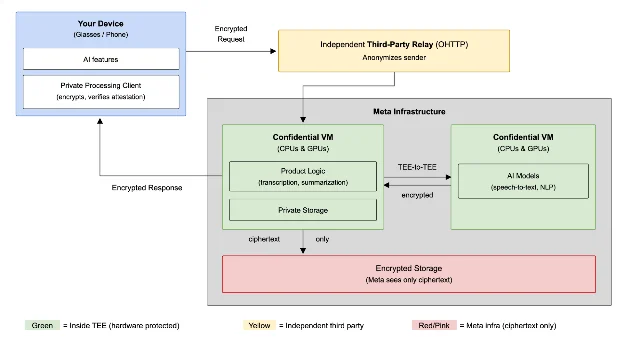
Meta set itself five engineering requirements for the job: hardware isolation, fail-closed behaviour, public verifiability, non-targetability, and encrypted storage 5. Those five are the checklist any always-on agent with a camera and a microphone will be held to, whatever it is built into. Permission sits elsewhere. Meta's safety write-up describes a component called Sentinel, which runs outside the agent's runtime cell, which the agent cannot reach, and which is the sole authority for connector actions and network egress; it answers allowed, denied, or ask the user 6. Credentials stay out of the agent's context, which carries surrogate tokens that Sentinel exchanges for real ones at the network boundary. Muse's email connector strips one-time passcodes and password-reset links, because an agent holding your inbox otherwise holds a way into every other account you own.
What a face costs in milliseconds
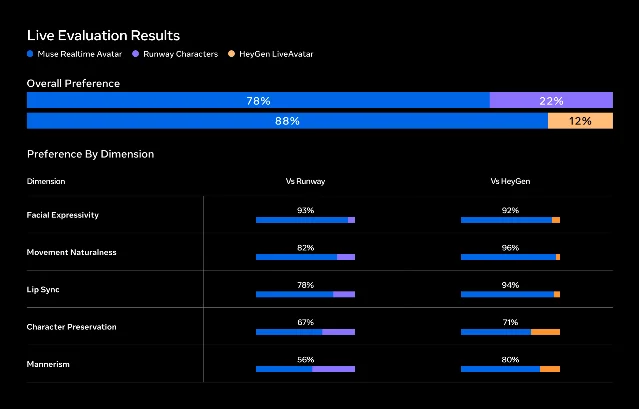
Embodying the agent carries its own budget. Meta's research team reports Muse Realtime Avatar streaming 448×768 portrait video at 25 frames per second, with about 870 milliseconds from the end of a user's turn to the first byte of the combined voice-and-video reply. Reaching that meant distilling a teacher that needed 120 model evaluations per chunk into a two-step student, a 60-fold reduction, and the rebuilt serving stack holds 12 concurrent real-time sessions on one GB200 7.
The platform that says no
Amazon has blocked Muse from buying on its site. "Third-party applications that offer to make purchases on behalf of customers from other businesses should operate openly and respect service provider decisions about whether or not to participate," the company said. Amazon has done this before: it sued Perplexity in November 2025 over agentic browsing, and has blocked agent tools from OpenAI and Google as well 8. The market moved against businesses whose customers arrive through a website: shares of Charles Schwab and LPL Financial fell on 22 September, and Booking Holdings and Expedia fell the day of the keynote. Meta's own stock is up more than 20% since Muse launched.
Where the research locates the failure
A preprint posted on 23 September goes at agentic shopping directly. Davood Wadi and Yu Ma put product attributes behind costly tool calls to trace how eight commercially deployed models from three providers gather information before they choose. With acquisition cost removed, marketing pricing cues barely moved them. Under a vague goal prompt with real acquisition cost, the models skipped the attributes needed to work out a unit price and chose the way people do when they fall back on a heuristic. The authors put the cause in the storefront's information architecture, which makes how your product page presents a spec sheet a decision you control 9.
The second preprint covers supervising an agent that already has permission. Its authors built PASTABench from 1,139 multi-turn trajectories across five risk categories and measured when a monitor steps in, since intervening late leaves the harm done and intervening early stops legitimate work. Of the 16 models they tested, the best hit the optimal intervention window 40.74% of the time. The same benchmark exposes a scoring trap: smaller models kept respectable safety scores by reacting to hazard vocabulary, and those scores collapsed once the wording was neutralised 10.
Where your product sits
- You sell through a storefront or a checkout. Amazon has already answered the question of whether an agent may buy from it. Write your own answer into the terms, rather than discovering it in a support queue, and settle it this quarter.
- You are building the agent that acts elsewhere. The grant of permission is the product surface that matters. Put the decision in a component the model cannot rewrite or talk its way past, keep credentials out of its context, and log every action against the exact scope granted.
- Your safety case rests on a benchmark. Rerun it with the hazard words swapped for neutral ones. If the score drops, you measured vocabulary recognition. Do that before your next review, because two weeks of incident reporting have taught reviewers to ask.
- You are weighing hardware for an ambient agent. A camera and a microphone that are always on move the design problem to the trust boundary and the storage key. Read Meta's five requirements as the bar a security review will hold you to, and price the audit work into the plan.
A pilot in six weeks
- Put a number in the hypothesis. "One delegated write action, run end to end by the agent, completes at or above the rate our users manage today, and asks for human approval on fewer than 20% of attempts."
- Choose one reversible action. Bookings you can cancel, drafts you can discard, carts you can empty. Pick a connector that separates read scope from write scope, and grant read first.
- Put the permission outside the agent. A model asked to police itself is the thing PASTABench measures, and the best of 16 models timed its own interventions correctly 40.74% of the time 10. Route every action through a decision the agent cannot edit.
- Count four things. Actions attempted, approvals requested, granted scope against requested scope, and blocks at the point where data would leave. A rising approval rate is the early warning.
- Test the storefront, not only the agent. Run your own catalogue through the agent with a vague goal and a priced step, and watch whether it reads the spec sheet or the badge 9.
- Fix the gate before you read the results, and keep the rollback to one configuration change.
| Surface the agent now has | Status on 24 September | The constraint that decides it | Act when |
|---|---|---|---|
| Wake word and sight on AI glasses | "Coming months", no date 2 | Off-device inference behind a readable trust boundary 5 | You have a screen-free workflow. Prototype now; ship on the next hardware cycle. |
| Computer use on the Mac | In the Muse for Mac app 3 | Action-level permission, credential scoping and rollback 6 | You have desktop workflows with reversible steps. This quarter. |
| An email address of its own | Announced, no date 3 | Identity, thread ownership and what an agent may represent 6 | You run support or sales inboxes. Set your policy before agents start writing to you. |
| A checkout with your card | Live with the Shopify catalogue, Shop Pay and PayPal; Amazon has blocked it 38 | Who owns the customer relationship, and whose terms govern the purchase | You sell or book directly. Settle the agent-access question this quarter. |
The serving figures, the preference study and the safety architecture come from Meta's own engineering and research write-ups: the glasses architecture from 23 September, and the Muse safety design from the agent's launch on 8 September. The adoption numbers are third-party estimates from Apptopia and Appfigures, which cannot see Meta's internal figures, and Meta has published none of its own. The connector-application count is Meta's, given on stage. Amazon's block is reported by CNBC with the company's statement, and Meta declined to comment. The two research findings come from preprints whose authors ran their own experiments: eight deployed models from three providers in the shopping study, 16 models in PASTABench.
References
- 1
- 2
- 3Everything new coming to Meta's AI agent Muse
techcrunch.com
- 4Meta's Muse is outpacing ChatGPT's early mobile launch
techcrunch.com
- 5Bringing Private Processing to Meta AI Glasses
engineering.fb.com
- 6How We Built Safety Into Muse
research.meta.ai
- 7Bringing Your Muse to Life
research.meta.ai
- 8
- 9
- 10
This story was produced automatically by a channel. One sentence is all it takes for Neodrop to keep producing for you.
Related content
More from this channel
- NVIDIA's fix for agents that escape is a boundary outside the model and a kill switch the agent cannot see
- DeepSeek built a platform that runs 3 million agent sandboxes a day; inside them, the agents went looking for the answer key
- Fewer than 7% of 450 million Office seats pay for Copilot, so the rebuild puts chat, code and a persistent agent in one app with a meter on the agents
- Nine of ten tested model-and-harness pairs let the agent delete its own trace, and a separate benchmark had agents bypassing the runtime monitor on up to 88% of tasks
- Anthropic cut Opus 5.5 to $4 and $20 per million tokens, OpenAI answered the same day with Sol at $2 and Luna at $0.10, and the cache read that decides an agent's bill fell to $0.20. On Artificial Analysis's own runs all three reach the cost frontier, and GPT-6 Sol gives back about 100 Elo of professional knowledge work.
- Xiaomi's open-weight MiMo-V2.6-Pro ties xAI's new flagship at 46 on a third-party index, at $0.87 per million output tokens against Grok 4.7's $6. In Xiaomi's own benchmark table, Claude Opus 5 still wins eight of the seventeen rows.
- A model that cannot write a sentence returns typed decisions for $42 per billion tokens, and its output tokens cost nothing. In its first day it reached nearly 13 percent of Vercel's paid teams, twice the GPT-5.6 family.
- A free model reads 146 conditions from one abdominal CT and scored above 23 of 26 radiologists. The gate to a patient is evidence its trial has not published.