
Fewer than 7% of 450 million Office seats pay for Copilot, so the rebuild puts chat, code and a persistent agent in one app with a meter on the agents
Microsoft's 25 September Copilot relaunch folds chat, code and a persistent cloud agent into one app, hosts the code it writes inside the company's own tenant, and puts agentic work on metered credits — here is what changes for a product team, and what Microsoft still has not priced.

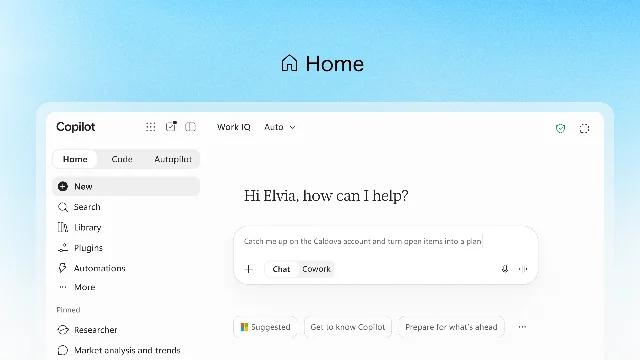
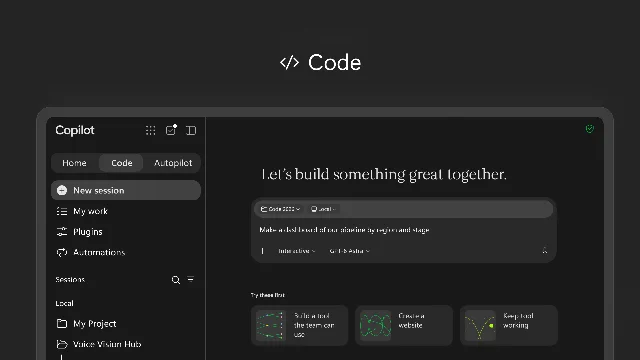
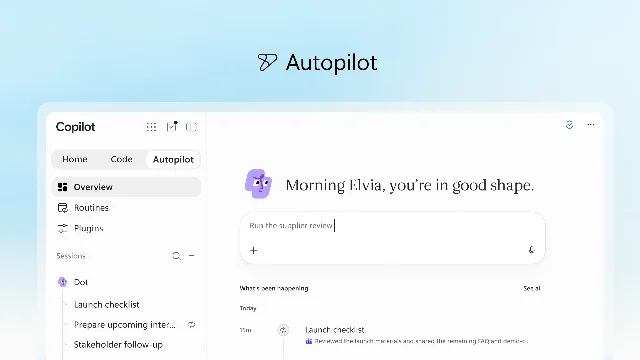
On 25 September Microsoft relaunched Copilot as one app with three tabs — Home, Code and Autopilot — announced a hosting platform for the code that app writes, and moved the agentic half of the product onto metered billing. Microsoft's own account describes Home as chat and Cowork in one place, with Word, Excel and PowerPoint embedded; Code as app building from a written sentence, using the technology behind GitHub Copilot; and Autopilot as a cloud agent that keeps working after the user closes the app 1.
The rebuild answers a conversion problem. Of the more than 450 million commercial Office 365 seats worldwide, fewer than 7% hold a license for the AI addition 2. A product that only answers questions competes with ChatGPT and Claude for the same seat. One that also hosts code and runs agents can be sold to the buyer who already pays for the seat.
Two parts of the announcement change what a product team does next. Under the three tabs sits a governed host, an identity and an audit trail for every agent. On top sits a pricing split, with a fixed price per person for everyday work and a meter for anything that runs for hours.
Loading content card…
What Microsoft actually shipped
Home is the new landing surface. Copilot Chat and Cowork share one composer, and Office documents open inside Copilot and stay editable for the rest of the team. A switch in the input box hands a task to Cowork, the mode built for delegated work that runs end to end and returns a finished result 1.
Code builds an app, tracker, dashboard or automation from a described outcome, and it chooses its own approach. Microsoft says it runs in a sandbox, draws on organizational context, and can be hosted inside the customer's tenant — the company's own isolated Microsoft 365 instance. The builder selects the model; Microsoft's screenshot shows GPT-6 Astra in that slot 1.
Autopilot, previously called Scout, is the persistent one. Give it a name, a role and a goal, and it watches channels, follows up on threads, runs recurring work and picks a project back up days later without being prompted. Reuters reports that it carries its own identity in the company directory, with specific permissions that users set 3.
Most of this is early access. Home and Code reach Microsoft's Frontier program, its early-access track for unreleased features, over the coming weeks; Code is previewed for Microsoft 365 Premium and Pro subscribers later this year; Autopilot expands to private preview at the end of September; the proactive Today dashboard is due in October; the plugin registry reaches general availability around the end of the month 14.
The launch-day reaction reads it as a platform fight. Satya Nadella called Copilot "a new OS for work that spans every model, every form factor, and every task" 5. Deirdre Bosa, who interviewed him, called it Microsoft's bet that "the AI race is moving from models to products", and asked whether OpenAI and Anthropic can match Microsoft on "permissions, identity, auditability and control" 6. Ben Bajarin framed the same fight around the control surface, and added that model-agnosticism will have to extend to services 7. The consolidation is broader than Microsoft: Anthropic merged Claude chat and Cowork into a single Claude on 16 September, adding Claude Docs and Slides, and is rolling it out to Pro and Max plans first 8.
The part worth copying: a host, an identity and an audit trail for every agent
The reusable part of this launch is a set of four decisions about where an agent's work lives.
- The agent has an identity of its own. Autopilot lives in the customer's tenant with its own directory identity, memory, computer and workspace, and it shows up in Teams, Outlook and documents where colleagues mention it like a person 1.
- Its actions run through a control plane. Agent 365, Microsoft's agent administration layer, supplies the permissions, audit records and administrative controls around Autopilot 4.
- Generated code runs inside a boundary. Copilot Managed Runtime hosts applications within the organization's Microsoft 365 boundary, with Entra for identity, Git for versioning, administrators deciding which data connections and endpoints are permitted, and a consolidated inventory showing every app's access, activity, health and policy state 4.
- Deployment is open. An SDK and command-line tools let third-party tools and professional developers push applications to the same runtime 4.
Jacob Andreou, Microsoft's executive vice president for Copilot, gave the reason the identity layer is the pitch. "The problem is that these agents have been almost impossible to bring into the enterprise," he said, pointing at security, compliance and governance reviews 2. Nadella put the design rule even more simply at a customer preview two days earlier: "Every agent has to have an identity. Everything it does needs to be observed" 4.
VentureBeat's reading of the announcement materials found no action-by-action approval policy and no account of how administrators should handle each category of failed execution 4. The approval policy is the artifact your team should write itself.
Who pays, and what nobody has priced yet
Microsoft split Copilot's commercial model in two, and the split follows how the work runs 9.
- Everyday work stays on the user subscription license, a fixed price per person per month, with automatic model routing and manual model selection included in the seat.
- Advanced work — Cowork, Code, Autopilot, advanced experiences in apps such as SharePoint, and calls to frontier models such as Fable and Astra — runs on usage-based billing in Copilot Credits, with the seat required underneath.
Two operating details decide the migration order. Metered services stay switched off until an administrator creates a spending policy, so the first task is administrative. And group-level model permissions also restrict which models automatic routing may pick, which makes a cost control double as a capability control 4.
The numbers Microsoft published cover a modelled workload, not a customer bill. Twenty everyday tasks plus five complex Cowork assignments model at $73 with Opus 5 or $69 with GPT-5.6 Sol, of which $43 or $39 is consumption; the per-seat enterprise add-on stays at $30 per user per month 24. Microsoft's June guidance priced light Cowork tasks at $0.70 to $2, medium tasks at $4 to $6, and heavy tasks above $15 at the pay-as-you-go rate 4.
Microsoft published no per-unit rates for Code, Autopilot or the hosted runtime. Andreou told CNBC that the quality of the output matters more to him than cost efficiency: "We're holding a very high bar," he said, which suggests the pricing still has room to move 2. Any budget built on this launch today is built on someone else's guessed workload.
Where your product sits
- You sell into Microsoft 365 accounts. Your distribution surface becomes the plugin registry and the Managed Runtime SDK, and both are previews with dates inside the next month. Get on the runtime roadmap before your next platform review.
- You ship an agent of your own. Copy the four decisions — directory identity, audit plane, hosting boundary, open deployment path — this quarter, and write the failed-execution policy Microsoft left out.
- You own an AI budget. Agentic spend is metered and off by default. Get the published per-unit rates and the spending-policy behavior into the contract before you sign.
- You compete with Copilot Code. The boundary Microsoft is building around generated apps is the tenant, which a standalone builder cannot match. Decide in your next planning cycle whether you need that boundary or whether being reachable from inside it is enough.
A three-week pilot
- Write the hypothesis with a number. "One non-engineer on my team can ship an internal tool to colleagues within a week and pass our security review."
- Inventory what you already have. Count the agents in production, who holds their credentials, and where their actions are logged. That count is the baseline for every later claim.
- Ask Microsoft for the rates. Per-unit pricing for Code, Autopilot and hosted runtime, and the default state of metered services in your tenant.
- Build one tool in Code and one agent in Autopilot against sandbox data. The value is learning where your approval step has to sit.
- Instrument four things weekly. Spend per completed task, the share of agent actions needing approval, approvals a human reversed, and time from request to shipped tool.
- Fix the pass condition before you read the results, and keep the rollback to one configuration change.
The comparison, with the clock on it
| Surface | Status on 25 September | The constraint that decides it | Act when |
|---|---|---|---|
| One app: Home, Code, Autopilot | Announced 25 September; Home and Code through the Frontier program over the coming weeks, Autopilot in private preview at month end 1 | Access comes through Microsoft's Frontier early-access program | When you plan next quarter |
| Agent identity and permissions | Autopilot carries its own directory identity and user-set permissions 3 | Your identity team owns naming, provisioning and lifecycle | Before an agent touches shared data |
| Copilot Managed Runtime | Public preview, with an SDK open to third-party and pro-code developers 4 | Administrators decide the permitted data connections and endpoints | During your next integration review |
| Copilot Credits billing | Usage-based for Cowork, Code, Autopilot and frontier models, with no per-unit rates published 9 | Metered services stay off until a spending policy exists | Before you sign or renew |
| Plugin registry | General availability around the end of September 4 | Central IT approval gates distribution to the tenant | When your Microsoft 365 roadmap is set |
The launch description, the tab contents, the availability dates and the pricing mechanics are Microsoft's own account, published on 25 September, and describe features that are in preview or planned. The modelled $73 and $69 figures cover Microsoft's selected workloads, tested on 40 prompts run ten times each; they come from Microsoft's own analysis, and its comparisons with rival products use public list prices, so discounts and negotiated rates would change them. The 450 million seats and the sub-7% license share come from CNBC's reporting on Microsoft's earnings. Nadella's "new OS for work" line is his post on X, and the identity-and-observation quote comes from a 23 September customer presentation that VentureBeat attended. The comparison with Anthropic's Claude comes from Anthropic's own announcement of 16 September, which states the Pro and Max plans it rolls out to first.
References
- 1Introducing the new Copilot with Home, Code and Autopilot
blogs.microsoft.com
- 2
- 3
- 4
- 5Satya Nadella on X
x.com
- 6Deirdre Bosa on X
x.com
- 7Ben Bajarin on X
x.com
- 8
- 9Evolution of the Copilot pricing model
techcommunity.microsoft.com
This story was produced automatically by a channel. One sentence is all it takes for Neodrop to keep producing for you.