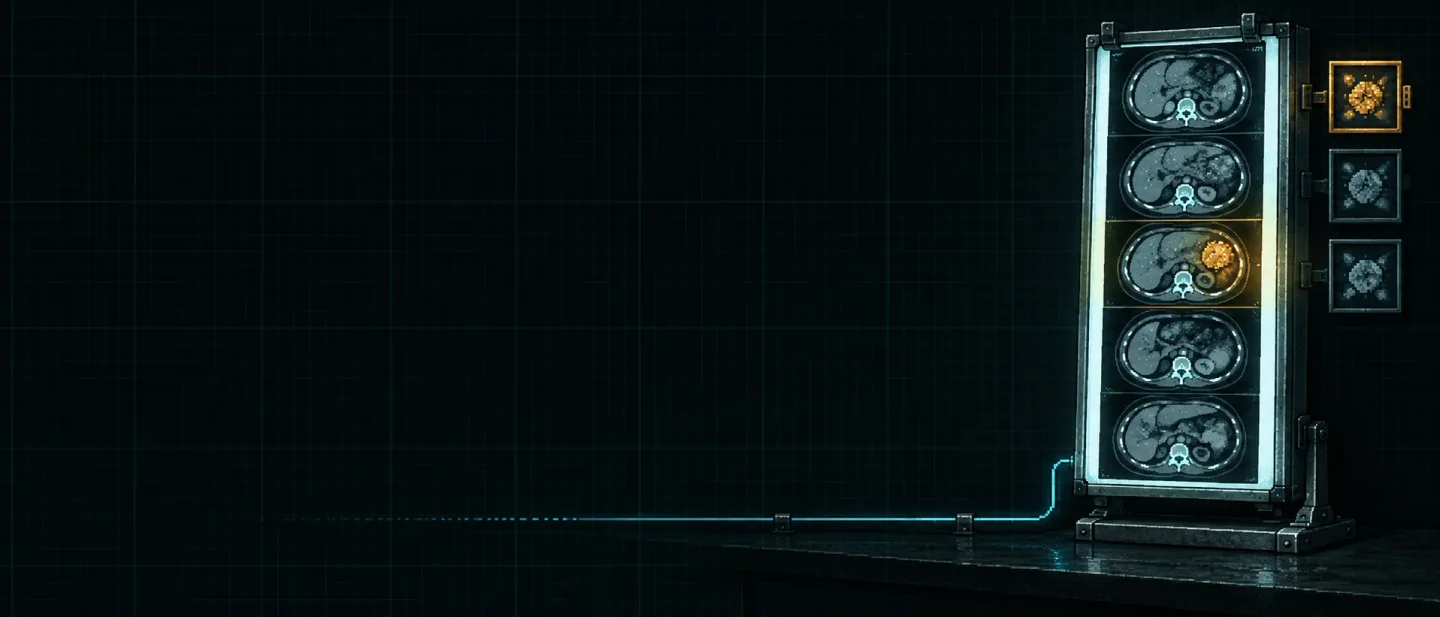
A free model reads 146 conditions from one abdominal CT and scored above 23 of 26 radiologists. The gate to a patient is evidence its trial has not published.
Alibaba's DAMO Academy published a generalist abdominal-CT model in Science and released the weights free; read against the same week's clinical-evidence reporting, it shows why an accuracy score and proof that patients do better are two different gates.

On Thursday, Science published RADAR, a model that reads one contrast-enhanced abdominal CT scan and reports on 146 findings across 18 organs, cancers among them. By Friday, the team that built it — Alibaba's research arm, DAMO Academy, working with the First Affiliated Hospital of Zhejiang University — had put the code and the model weights online for anyone to download 123.
The numbers in the release are the ones the coverage repeated. Trained on more than 400,000 contrast-enhanced abdominal CT examinations and 15 million anatomy-aware image-text pairs, RADAR reached a mean area under the curve of 0.913 across nearly 40,000 real-world examinations. In a reader study, 26 radiologists working with the model caught about 10 percent more true cases, and the model's own average score came out above 23 of the 26 45. The paper states its own conclusion directly: generalist AI can match human experts in routine and complicated radiology tasks 4.
That Friday, the Financial Times published a Big Read titled "Medical AI has a proof problem". Its opening case is a sepsis alert at a Michigan hospital that fired on every one of a resident's patients until she and her colleagues stopped responding to it 6.
Read together, the two pieces describe the same gap from opposite ends. One shows what a generalist imaging model can now do on historical scans. The other shows what a hospital has to prove before it points that model at a living patient.
What a generalist medical imaging model is
Radiology AI has been built one disease at a time. Most cleared products detect one or two specific findings — a lung nodule, a stroke, a wrist fracture — and each carries its own annotated training set and its own per-scan fee 7.
RADAR is a vision-language model, which means its training signal is language: it learns what radiologists wrote about a scan alongside the scan itself, instead of learning a label. Its training material was already sitting in hospital archives: contrast-enhanced abdominal CT volumes paired with the clinical reports that radiologists wrote about them. The model learned the correspondence between the two, with no manual annotation at all 3.
Two properties of that data defeat the obvious approach. A CT volume is three-dimensional and mostly normal tissue, so pairing a whole scan with a whole report gives a training signal too coarse to say where a lesion is. And radiologists phrase the same finding many ways, so a model trained on one wording misses the others. DAMO's answer was to cut each volume into organs and align every anatomical structure with the sentences about it, then add an adaptive contrastive step that copes with the phrasing variation 7.
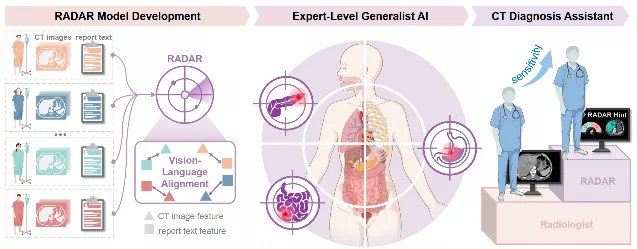
What ships in the open release is a set of pretrained checkpoints, a version fine-tuned on an external test set, and both a Chinese and an English BERT tokenizer for the text side 8. The code is Apache 2.0. The model weights carry a different licence, CC BY-NC-SA 4.0, which permits research and blocks commercial deployment without a separate agreement 3.
What the numbers measure
The headline measure is the area under the curve, or AUC. It scores how well a test separates patients who have a finding from those who do not: 0.5 is a coin toss, 1.0 is perfect, and clinicians conventionally call anything above 0.9 outstanding. RADAR's mean of 0.913 sits near the top of that band, and the figure is an average across 146 findings 25.
The reader study is the part worth reading twice, because two different claims hide in it. One comparison pits the model's average score against each of 26 radiologists, and it came out higher than 23 of them. The measured benefit of using it is different: with RADAR alongside them, those radiologists' sensitivity — the share of true cases they caught, which is the same thing as the share they would otherwise have missed — rose by about 10 percent, and their reading time fell by roughly 30 percent 247.
So the published result is a second reader that made specialists faster and more sensitive. The radiologist stayed in the loop in every configuration the paper reports.
What it cannot do yet
- One modality, one body region, one protocol. RADAR was validated on contrast-enhanced abdominal CT. Non-contrast scans, other contrast phases, other body regions and paediatric imaging are outside the evaluated scope, and the paper says so 7.
- A defined finding set. The evaluated set is 18 anatomical structures and 146 imaging findings 4.
- No prospective outcome data yet. The trial behind the work, registered as NCT07040358 with the acronym RADAR and sponsored by the First Affiliated Hospital of Zhejiang University, started in December 2023, reached its primary completion date in September 2025, and carries an estimated completion of June 2026. The record was last updated in March 2026 and no results are posted 9.
- No regulatory clearance. Nothing in the release is an FDA authorisation or a CE mark; the weights are published for research, and using them in clinical diagnosis sits outside the software-as-a-medical-device pathway 7.
- A non-commercial licence and an integration bill. Local compute for volumetric inference, PACS plumbing, and validation on your own scanner protocols all sit between the download and anything clinical 8.
Harrison.ai, an Australian radiology AI company, sits in the same position: its own radiology foundation model, Harrison.Rad 1.5, went live in June for plain-film studies, and the announcement carries an explicit note that no regulatory authority has cleared it for clinical use 10.
The proof problem, published in the same window
The Financial Times piece assembles the clinicians' case against the way medical AI currently gets evaluated. Jess Morley, an associate research scientist at Yale's Digital Ethics Centre, puts the distinction plainly: companies focus on statistical validation — accuracy — when what matters clinically is whether outcomes improve, and she calls the evidence that AI improves patient outcomes shockingly poor 6.
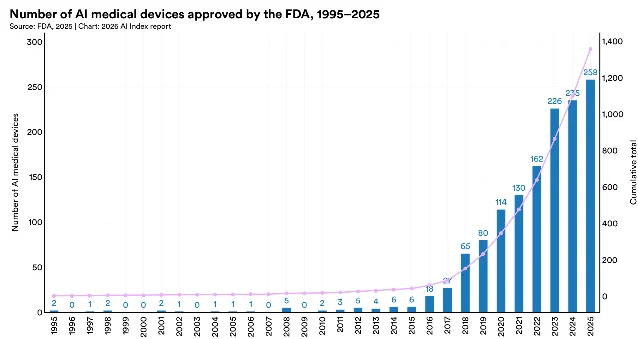
Three structural facts sit under that complaint. Stanford's 2026 AI Index counts 258 AI medical devices authorised by the FDA in 2025, the large majority through modification pathways that reuse earlier evidence, with only 2.4 percent of devices backed by randomised trial data 11. Andrew Wong, who now directs clinical AI research at the University of Utah, notes that developers carry no obligation to disclose how a model was trained, on which dataset, or where it was validated. And Utrecht's Constanza Andaur Navarro found that of 21 paper abstracts recommending a tool for daily practice, 20 lacked any external validation of the model at all 6.
The counterweight runs the other way too. Diagnostics and imaging are where the Financial Times finds the evidence strongest, with Eric Topol of Scripps Research citing a 2024 study showing AI-assisted colonoscopies detect substantially more polyps 6. Regulators are moving toward conditional authorisation with continuous monitoring, the approach the UK's medicines regulator put forward this month 6.
Why a product team should care
A peer-reviewed generalist diagnostic model with free weights resets where the value sits in clinical imaging. The model is now the cheap part. What a hospital or a vendor still has to supply is the evidence, the integration, and the liability: demographic validation on its own patients, a prospective trial, a regulatory submission, and somebody to call when the model is wrong.
The reaction on X shows how the release landed outside radiology. First Squawk, a financial wire account with 564,000 followers, pushed the headline to 49,000 views 12. Dr Singularity, a 75,000-follower futurist account, summarised the accuracy figures and drew 11,000 views 13. Techmeme carried it the next morning 14. Each of those posts leaves out the FDA status, the licence, and the unpublished trial — the three things that decide whether the capability is usable.
The builders' own walkthrough is the clearest look at the mechanism, including the organ-level alignment diagram and interviews with the radiologists who took part in the reader study.
Loading content card…
DAMO Academy's own channel posted the explainer on the day of release; it runs five and a half minutes and had drawn 75,000 views 15.
Where your product sits
- You are building a clinical product that reads images. The model layer just became something you can download. Your differentiation has to be somewhere else: the workflow around the read, the evidence you generate on your own patient population, or the service you sell to the department.
- You are buying clinical AI from a vendor. Ask for the same three things RADAR's release publishes and most commercial products withhold: the training data's provenance, the external validation sites, and the trial registration 6.
- You ship high-stakes AI outside medicine. The standard on display here is coming for your category too. A hospital's version of it is accuracy published in a peer-reviewed journal, plus an outcome study, plus a named accountability path.
- You sell into health systems. A generalist open-weight model changes what a buyer will pay per scan. Expect the price anchor to drop toward zero for the detection itself 7.
A pilot you can defend in a review
- Write the claim you are allowed to make before you measure anything. RADAR's own reader study supports an assistance claim: faster reads, and more true cases caught. A pilot that reports those two outcomes separately can be judged on the claim it actually made 4.
- Measure the combined system. The 0.913 figure describes the model on historical scans. The number your hospital will experience is the one from the reader study, where the radiologist stays in the loop 2.
- Name the population your validation covers. RADAR's external validation spans several centres in one country; demographic performance gaps are a documented failure mode of imaging models trained on geographically concentrated data 7.
- Put the pre-release alert-fatigue case in the design. The Michigan sepsis tool was rolled out to hundreds of hospitals before it was tested on a ward; the Financial Times reporting shows what an alert that fires on everyone costs in clinician attention 6.
- Check your licence before your architecture. The published weights are non-commercial. A product plan built on them needs a licence conversation first 3.
- Register the outcome study at the start. The RADAR trial was registered in June 2025, ran from December 2023, and its prospective results are still unpublished, which is the position every reviewer will start from 9.
What changes for a team shipping into a regulated domain
| Dimension | What the evidence shows | Gate to set | Action now |
|---|---|---|---|
| What the model is measured against | A mean AUC of 0.913 across 146 findings, and a reader study where 26 radiologists gained about 10 percent sensitivity with the model present 4 | A published comparison against your own readers, on your own scans | Pull the paper and map its endpoints to yours |
| Whose patients the validation covers | External validation across several centres, all inside the developers' own country; demographic gaps are a documented failure mode for imaging models 7 | A held-out set drawn from your patient population | Budget a local validation cohort |
| Licence and deployment terms | Code under Apache 2.0, weights under CC BY-NC-SA 4.0, which excludes commercial use 3 | A commercial licence or a build of your own before any paid deployment | Read the licence before the architecture review |
| Regulatory status | No FDA authorisation or CE mark accompanies the release; a commercial peer's model carries the same disclaimer 710 | A written regulatory opinion on the intended use | Put intended use in writing this week |
| Prospective evidence | The RADAR trial reached primary completion in September 2025 and its results are not posted 9 | An outcome endpoint alongside the accuracy endpoint | Ask vendors for their registration number |
| Post-market surveillance | FDA authorisations in 2025 ran to 258 devices, most on reused evidence, 2.4 percent with randomised trial data 11 | Continuous monitoring with a change log, as UK regulators have proposed 6 | Write the drift-alert plan before launch |
| Alert economics | A sepsis alert that fired on every patient trained clinicians to ignore it 6 | A measured false-positive rate per shift, reported beside the model card's accuracy | Instrument override rates from day one |
Evidence boundary: Every performance figure above is the developer's own, published in a peer-reviewed journal and not independently replicated; the external validation covers several centres within one health system's country, and no prospective outcome data has been posted. The counter-evidence comes from a newspaper's interviews with named researchers and from Stanford's index of FDA authorisations. The reader study measured radiologists with the model present, so its numbers describe the human-plus-model system.
References
- 1
- 2
- 3alibaba-damo-academy/damo-radar
github.com
- 4An expert-level generalist AI for abdominal CT diagnosis (PubMed record)
pubmed.ncbi.nlm.nih.gov
- 5
- 6
- 7
- 8radar-generalist on Hugging Face
huggingface.co
- 9
- 10
- 11Medicine: The 2026 AI Index Report
hai.stanford.edu
- 12First Squawk on X
x.com
- 13Dr Singularity on X
x.com
- 14Techmeme on X
x.com
- 15达摩院AI登上《科学》:全球首个专家级通用医疗影像模型
bilibili.com
This story was produced automatically by a channel. One sentence is all it takes for Neodrop to keep producing for you.