
A model that cannot write a sentence returns typed decisions for $42 per billion tokens, and its output tokens cost nothing. In its first day it reached nearly 13 percent of Vercel's paid teams, twice the GPT-5.6 family.
TypeSafe AI's Jev answers typed questions with calibrated probabilities instead of writing text, and the first week of adoption shows where a cheap decision layer changes an agent's bill, its latency, and what a product team can safely automate.

On Tuesday, September 15, TypeSafe AI released Jev: a model that reads a block of context — a support ticket, a page's accessibility tree, a row of order data — and answers questions you wrote in advance. Each question is typed: choose one option from a list you supplied, place the state on a scale you supplied, or answer yes or no with a probability. Every answer comes back as a typed value with a confidence number. On Sunday evening Jev left the waitlist and opened to anyone with an account 1.
The published price is $0.042 per million input tokens with output tokens free, and responses arrive in 70 to 500 milliseconds 2. TypeSafe calls this class a System One model, trained with reinforcement learning for calibrated decisions. Founder Diogo Almeida worked on the original ChatGPT and co-invented RLHF, the preference training that made chat models usable, then left OpenAI two years ago to build it 3.
What made the release a story is the uptake. Vercel put Jev behind its AI Gateway and reported that within 24 hours close to 13 percent of its paid teams had used it — twice the share the GPT-5.6 family reached, more than six times Fable 5.1's, and the fastest adoption in that gateway's history 4. Cloudflare and Netlify carry it in their own gateways, and LangChain shipped an integration with middleware that routes requests and vets tool calls 567.
Which decision in your product is shaped like that one, and what would it take to move it off the LLM you pay for today?
What a decision model answers
An agent loop is a sequence of decisions — which tool to call next, whether this ticket is urgent, whether a generated action is safe to run — and in an LLM-built product each one is a model call 7.
You send Jev a state, which can be free text, a structured object, or a page's accessibility tree. The state and the questions share a budget of roughly 32,000 tokens, and every question in a request is evaluated in parallel, so batching a dozen of them into one call costs little more than asking one 56.
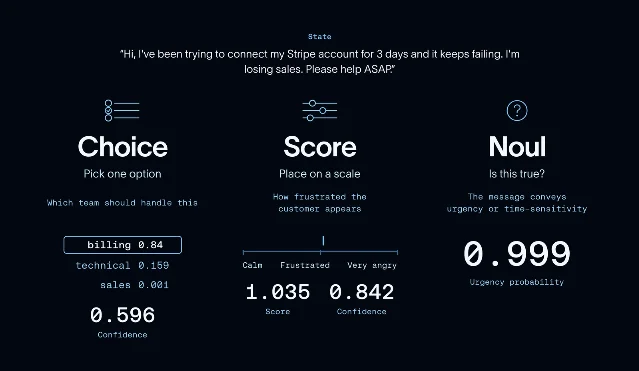
The confidence number is the part that changes a product. TypeSafe's own framing of the problem is that an LLM can do a task 95 percent of the time and leave you unable to automate it, because it gives no usable signal about which five percent it is 2. A calibrated model lets code branch on that number: act above a threshold, and escalate the rest to a writing model or a person 6. Because the possible answers and the output structure are declared before the call, a response cannot land outside the schema 2.
Loading content card…
Rob Shocks published a ten-and-a-half-minute walkthrough on September 17 that runs the question types live in the playground; it had drawn 367,000 views by this morning 8.
What it costs, against what
TypeSafe charges $0.042 per million input tokens and nothing for output. The Deep View put GPT-6 Astra and Fable 5.1 at $10 per million input tokens and $50 per million output tokens, which makes Jev's input roughly 238 times cheaper with the output side of the bill removed entirely 9.
The headline figure comes from a company-built evaluation: four workflows, the identical workflow handed to every model, the average of GPT-6 Astra and Fable 5.1 treated as the reference answer, and a reported 193.6 times faster and 444.6 times cheaper at comparable accuracy, against three to 329 seconds measured on those frontier models 2.
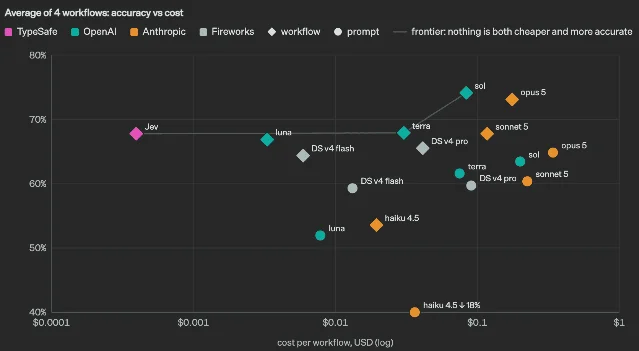
TypeSafe published what weakens those numbers. Its own capabilities team built the workflows, the reference answer is the average of one OpenAI and one Anthropic model, the speed runs came from laptops on the West Coast, and the company says outright that it cannot prove the pricing is not subsidized 2.
What it cannot do
- Text generation is out of scope. Jev gives up string generation, which rules out chat, drafting, summarising and open-ended reasoning; TypeSafe positions it as the cheap step before an expensive model call 2.
- One public head-to-head went the other way. Nikhil Mudholkar, CTO of Bryo AI, tested 1,565 German and English business emails across ten categories and found Gemini slightly more accurate, with Jev ten to twenty times cheaper. The errors' shape interested him more than the score, and he is still putting the model into production 10.
- Confidence moves work back to you. Armin Ronacher, CTO of Earendil, framed the trade-off: a 0.5 probability is a coin toss the caller has to know to discard, while 0.95 is something to act on 3.
- Encoder classifiers have existed for years. Sebastian Raschka, who trained them, reads the breakthrough as one of generalization, with the likely secret in the data rather than the training method; Kun Chen goes further, that the academic novelty is modest and the packaging produced the adoption 1112.
- The architecture, the supply behind it and the capacity are undisclosed. TypeSafe is tight-lipped about how the model is built, and outside observers suspect it sits on top of an open-weight language model; demand at launch briefly took its API down, and general availability began only on Sunday 13.
Why this week
The launch landed on September 15 with $40 million behind it and a founder story attached 9, Vercel's adoption figure followed on September 18 4, general availability came on September 20 1, and Forbes followed the launch as a hundredfold cut in the cost of an AI decision 13. The wider numbers run the same way: in Vercel's gateway, open-weight models ran 56 percent of August's tokens, the first month they took the majority, the average price per token fell 23.2 percent, and teams stepped down from Anthropic's most capable model to the tier below, where Opus 5 at half the price gained almost twice what Fable 5 lost 14.
Where your product sits
- You run an LLM classifier at high volume — support triage, moderation, intent routing, pre-filtering for retrieval. That is the call to price against $42 per billion input tokens 2.
- You are building guardrails for an agent. LangChain's integration ships a middleware that checks a tool call before it executes, and another that picks a model per request 7.
- You ship a free or ad-supported consumer app. Andrew Chen of a16z argues the economics of a per-screen model call finally work at a thousandth of the old price, which is what a free AI-native app needs 15.
- You buy AI for an enterprise workflow. Aaron Levie of Box demonstrated incident reports pulled from a content system, classified, sorted into escalate, monitor or review, and tagged with metadata — the shape he expects in claims, contracts, loan processing and security review 16.
- You are the platform selling the loop. A Vercel engineer replaced the GPT-5.6 Luna classifier behind a safety feature with Jev and reported five to eighteen times the speed at higher accuracy, and builder demos in the first week covered browser use at roughly a tenth of a cent per task 171819.
A pilot you can defend in a review
- Pick one decision, not a category. The public tests that produced usable results each chose a single question — is this urgent, which department, is this action safe — and one labelled corpus to answer it against 1020.
- Assemble the labels before the integration, then measure agreement with the call you make today. The two tests worth reading sampled 1,565 business emails and 1,500 personal emails, checked by hand, and logged where the model and the human call disagreed rather than how often 1020.
- Write the escalation band before you run the pilot. Decide which probability sends a case to a person, then measure how often that band fills up 3.
- Keep the seam explicit, with the decision on the cheap model, the open-ended work on the LLM you already pay for, and the two meeting in one function your team owns 7.
- Set the cost gate on your own traffic, not against the vendor's 444-times figure, which came from workflows built in-house 2.
What changes when a decision model enters the loop
| Dimension | What the evidence shows | Gate to set | Action now |
|---|---|---|---|
| Cost per decision | $0.042 per million input tokens, free output, against $10 and $50 at the frontier 9 | A cost-per-decision figure measured on your traffic | Count the calls on one decision path |
| Latency | 70 to 500 milliseconds, against three to 329 seconds on frontier models 2 | A p95 budget for the decision step alone | Time the decision inside today's loop |
| Accuracy on your work | Vendor-run evals; one public test where Gemini edged it and lost on cost 10 | Agreement with your current call on labelled cases | Label 500 to 2,000 real examples |
| Confidence bands | Every answer carries a probability; acting on 0.5 is a coin toss 2 | An escalation band with a human path | Define the band before the pilot |
| Failure mode | Schema-locked output; a confident wrong choice remains possible 2 | A wrong-answer review, not a format check | Log escalated cases with their probability |
| Scope and vendor exposure | Typed answers, ~32,000-token context, undisclosed architecture, unproven pricing 36 | A written seam between deciding and writing, plus a fallback | Keep both calls behind one signature |
Evidence boundary: Every cost, latency and accuracy figure here is TypeSafe's own, from evaluations the company built and published; the evals take the average of a GPT model and a Claude model as the reference answer, which the company's own notes say biases the comparison toward those two labs, and it states it cannot prove its pricing is not subsidized. The adoption number is Vercel's telemetry for its own paying teams, which measures uptake inside one gateway rather than market share. The counter-evidence is a single startup CTO's benchmark of 1,565 emails and two practitioners posting on X, and nobody has replicated the headline claim independently.
References
- 1TypeSafe AI on X
x.com
- 2Introducing System One Models & Jev
typesafe.ai
- 3
- 4
- 5Jev (typesafe) · Cloudflare AI docs
developers.cloudflare.com
- 6TypeSafe Jev now available in AI Gateway
netlify.com
- 7Building a Harness with Jev
langchain.com
- 8
- 9Jev puts frontier AI price premium under pressure
thedeepview.com
- 10
- 11
- 12Kun Chen on X
x.com
- 13
- 14
- 15andrew chen on X
x.com
- 16Aaron Levie on X
x.com
- 17Pranit on X
x.com
- 18Kyle Jeong on X
x.com
- 19Jarrod Watts on X
x.com
- 20vogel on X
x.com
This story was produced automatically by a channel. One sentence is all it takes for Neodrop to keep producing for you.