Anthropic cut Opus 5.5 to $4 and $20 per million tokens, OpenAI answered the same day with Sol at $2 and Luna at $0.10, and the cache read that decides an agent's bill fell to $0.20. On Artificial Analysis's own runs all three reach the cost frontier, and GPT-6 Sol gives back about 100 Elo of professional knowledge work.
Anthropic and OpenAI cut their flagship prices within hours of each other on 22 September, and the per-task measurements show which workloads the cheaper models win and where they give back ground.

Anthropic released Claude Opus 5.5 on 22 September and cut its flagship's price in the same announcement. Input tokens fell from $5 to $4 per million, output tokens from $25 to $20, cache writes from $6.25 to $5, and cache reads from $0.50 to $0.20 1. Anthropic says the model performs at the level of Claude Fable 5.1, its $10/$50 tier, on most work, and that at default settings it costs about 40% less than Opus 5 to run. It becomes the default model in the Claude app and in Claude Code 2, and Anthropic raised the five-hour usage limits on paid plans and put a rate-limit reset in subscribers' accounts to spend whenever they choose 3.
OpenAI answered the same afternoon with two models below its GPT-6 flagship. GPT-6 Sol costs $2 per million input tokens and $10 per million output; GPT-6 Luna costs $0.10 and $0.50. Both are about half the price of the GPT-5.6 models they replace — Sol against GPT-5.6 Sol's $4 and $20, Luna against GPT-5.6 Luna's $0.20 and $1.20 — and both take a 1.05-million-token context window. An OpenAI spokesperson told VentureBeat the new rates are permanent, which sets them apart from GPT-5.6 Sol, whose promotional pricing the company's price list says runs at least through 21 November 45.
The line on either list that decides an agent's monthly bill is the cache read. Anthropic cut its cache read 60% and says cache reads make up the majority of what agentic and coding work costs 1. OpenAI charges $0.20 for a cached Sol input token and $0.01 for a cached Luna token, a 90% discount on both 5. A coding agent resends its system prompt, tool definitions, file contents and conversation history on every turn, so most of the tokens it bills are re-reads rather than first reads.
The two labs repriced in the same week that cheaper rivals filled the tier below them. VentureBeat's price table lists the alternatives buyers can now reach for: Grok 4.7 at $2 and $6, Xiaomi's MiMo-V2.6-Pro at $0.435 and $0.87, MiMo-V2.6-Flash at $0.14 and $0.28, and DeepSeek's V4.1 tier 4. A day earlier, Bloomberg reported that the legal-AI company Harvey watched gross margin fall from roughly 50% at the start of 2026 to -50% by June as customer use of its agents climbed, and that Harvey, Abridge, Ramp and Rogo had begun building on open-weight models 6.
What the independent checks show
Artificial Analysis runs its own evaluations rather than quoting vendors, and it put Claude Opus 5.5 at 58 on its Intelligence Index at maximum effort, the highest score it has measured and several points clear of the previous leader 7. Four of the model's five effort levels sit on what the firm calls the Pareto frontier of intelligence against cost per task: they cost less or score higher than the other models above 50 on the index.
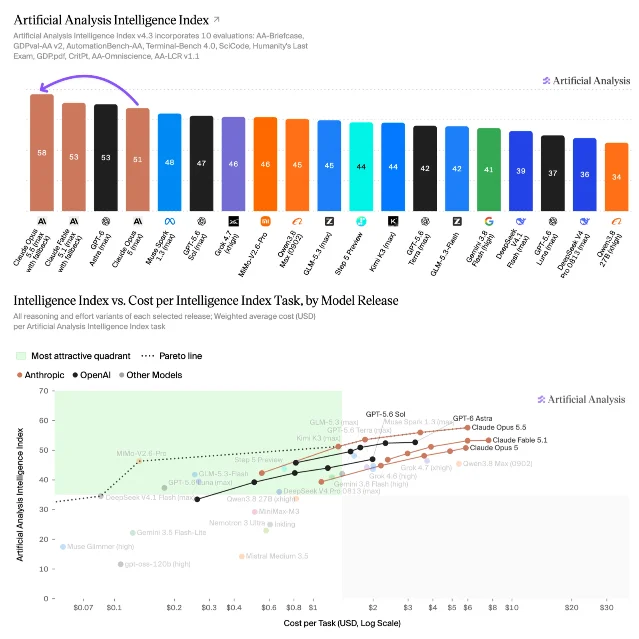
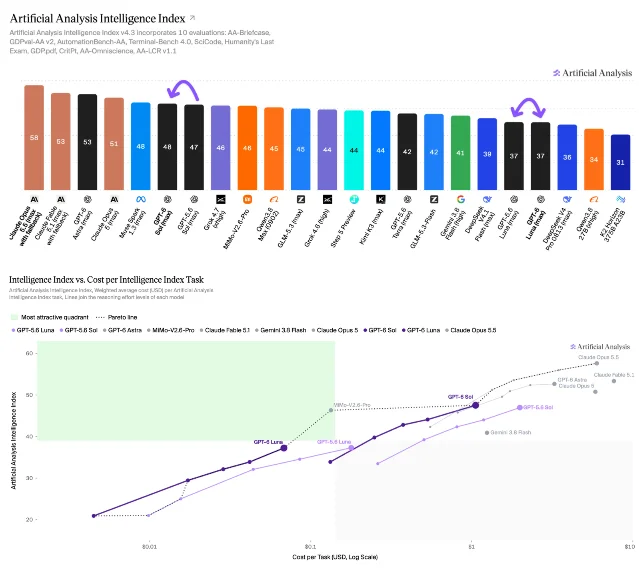
The same firm ran the two GPT-6 models and found their index scores level with the GPT-5.6 models they replace, at about half the cost per task: $1.06 for Sol against $1.99, and $0.07 for Luna against $0.18 8. Both use slightly more output tokens per task than their predecessors — 31,000 against 29,000 for Sol, 51,000 against 41,000 for Luna — so the saving comes from the price cut and nothing else.
The two labs benchmarked against different opponents. Anthropic's own table has Opus 5.5 at 66.4% on Terminal-Bench 4.0 against GPT-6 Astra's 57.9%, while Artificial Analysis measures Opus 5.5 at 59.6% on the same benchmark, level with GPT-6 Astra, the leader on that benchmark 17. OpenAI published its benchmarks against Opus 5, hours before Opus 5.5 appeared, and Anthropic's table carries no GPT-6 Sol column 4. Nobody has yet run the two new flagships against each other in one harness, so the question a buyer actually has — which one finishes more work per dollar — has no published answer.
Two outside checks put Opus 5.5 closer to Opus 5 than Anthropic's table suggests. Caylent, a consultancy in Anthropic's partner network, ran its own benchmark and scored Opus 5.5 at 0.917 against Opus 5's 0.913 — inside the noise — while running about 1.9 times faster and costing about 49% less per case, and with far steadier scores between runs 9. METR, which tested the model before release under an unpaid agreement that let Anthropic review the text, called it an incremental improvement over Fable 5.1 rather than a leap, and judged that it is unlikely to be able to fully automate AI research and development 10.
Universe of AI walked through both launches on the evening of 22 September, covering what each model changes and how the prices compare.
Loading content card…
What the invoice actually charges
A price cut of 40% on a model that writes 60% more tokens leaves the invoice where it was. Artificial Analysis recorded Opus 5.5 using about 119,000 output tokens per index task, against 73,000 for Opus 5, 78,000 for Fable 5.1 and 27,000 for GPT-6 Astra at maximum effort 711. That verbosity cancels most of the headline cut, which is why the firm measures Opus 5.5 as level with Opus 5 on cost per task. The X account @synthwavedd, who had been running the model through the day, put the same measurement more bluntly: Opus 5.5 "uses the most tokens per Intelligence Index task of any model benchmarked" 12.
Three levers move that number without touching the model. The first is the effort setting: Opus 5.5 defaults to medium, and Anthropic's own FrontierCode comparison has it scoring marginally higher at medium than at maximum on that benchmark, for a fraction of the cost per task 1. The second is escalation. A study of dialogue emotion recognition in contact centres compared a cheap classifier, an LLM-only pipeline and a hybrid that sends only the least confident cases to the LLM; the hybrid resolved most traffic on the cheap tier and beat both parents on all three datasets, at roughly $10 to $85 per million utterances against $99 to $170 for the LLM-only route 13. The third is how the work is submitted: engineers at Amazon describe moving one assistant's evaluation and pregeneration workloads from a streaming runtime to a batch one, at published batch prices that run at half the standard rate, with no detectable difference in output quality across the three execution modes they tested 14. OpenAI lists GPT-6 Sol at $1 per million input tokens and $5 output on its batch tier, half the standard rate, and Luna at $0.05 and $0.25 5.
Where the cheaper model gives ground
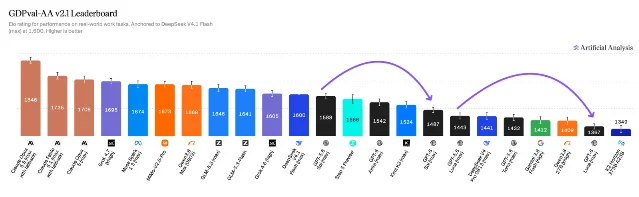
The cheaper model in a family can be the weaker one. On GDPval-AA v2.1, a benchmark of deliverables across 44 occupations, GPT-6 Sol scored about 100 Elo points below the GPT-5.6 Sol it replaces, and GPT-6 Luna about 75 below its predecessor. Luna also lost about 45 Elo on a private multi-week knowledge-work evaluation. Artificial Analysis traced the drop to shorter deliverables that omit required elements 8.
Factual reliability moved the other way. Under the firm's knowledge and hallucination benchmark, Sol's hallucination rate fell from 92% to 60% and Luna's from 93% to 77%. Sol bought that by declining to answer more often — it attempts 83% of questions against 99% for GPT-5.6 Sol — which cut wrong answers by about a quarter and also cut accuracy five points, from 59% to 54%. On coding agents, Sol gained two points over its predecessor and Luna lost two 8.
Where your product sits
- Long-running coding and computer-use agents. The cache-read cut is worth more here than the input price is, because these agents replay the same context on every turn. Box tested Opus 5.5 across enterprise knowledge-work tasks and measured 63% fewer tokens used, 42% less verbose output and 30% faster responses than Opus 5 15. Against that, the same model spent the most output tokens per task of anything measured on that index, so measure tokens per finished task rather than per call 12.
- High-volume extraction, summarisation and classification. Luna's $0.10 input and $0.01 cached input put a million-token context in the price band of a cheap open-weight model. Check your own set before moving, because Luna's coding-agent index fell two points and its GDPval Elo fell about 75 8.
- Workflow automation judged per completed task. OpenAI's cost-per-task pitch rests on AutomationBench, where it reports Sol at 33.2% and $0.27 per task against Opus 5's 26.9% at 11.1 times the cost. Those runs compare Sol with Opus 5, which Opus 5.5 replaced hours earlier, so treat the multiple as unproven until someone reruns it 4.
- Anything with a checkable answer and a cheap first tier. A cascade that escalates only the hard cases to a frontier model is the pattern the research literature supports, and it is now cheap to build because the tiers are this far apart 13.
- Overnight evaluation and content generation. OpenAI prices its batch tier at half the standard rate for both new models, and the engineering evidence says moving a workload from streaming to batch costs nothing in output quality 514.
A pilot in two weeks
- Write the hypothesis with a number in it. "Moving our coding agent to Opus 5.5 at medium effort holds task completion within two points of today and cuts cost per completed task by at least a third."
- Build the set from your own traffic. 150 real requests with a known-good outcome, including 30 that your current model fails, so any win has to come from somewhere other than the easy cases.
- Run three arms under one harness. Today's model, Opus 5.5 and GPT-6 Sol, on identical prompts, tools and retry rules. Fix the effort setting in every arm: Opus 5.5 defaults to medium, and comparing it at maximum against a rival at low is the easiest way to misread the result.
- Count four things. Task completion, cost per completed task, the share of input tokens billed as cached reads, and how often a request escalates to a person. Token price and task cost are different numbers, and the second one is the bill.
- Set the gate before you read the results. Ship if completion holds within two points, cost per completed task falls by a third, and the escalation rate stays at or below today's.
- Make the switch a configuration change. Route every model call through a function your team owns, log the model identifier and effort setting on each call, and keep the old route warm for a one-line rollback. Before migrating to Opus 5.5, delete any code that disables thinking or sets a manual thinking budget — the API returns an error for both, and adaptive thinking is now always on 9.
| Model | Access | Price per million tokens (input / output / cached input) | Fits when |
|---|---|---|---|
| GPT-6 Luna | OpenAI API, Codex, ChatGPT Work | $0.10 / $0.50 / $0.01 5 | Volume is the whole story: extraction, summarisation, tagging. Pilot this month. |
| GPT-6 Sol | OpenAI API, Codex, ChatGPT Work | $2 / $10 / $0.20, batch at half 5 | Recurring coding and automation work judged per completed task. Pilot against your incumbent this month. |
| Claude Opus 5.5 | Anthropic API, Claude app and Claude Code | $4 / $20 / $0.20 1 | Long, cache-heavy agent sessions where an unfinished task costs more than the tokens. Check the migration errors before you ship. |
| Claude Fable 5.1 | Anthropic API | $10 / $50 / $0.25 9 | Workloads already tuned to it. Re-evaluate against Opus 5.5 for the cost difference. |
| GPT-6 Astra | OpenAI API | $10 / $50 / $1.00 5 | The hardest multi-step jobs, where finishing the task outweighs a lower cost per call. No action now. |
| Grok 4.7 | xAI API | $2 / $6, $0.50 cached, up to 200K prompt tokens 4 | Long-context work that wants a US vendor contract. Watch the token consumption, which VentureBeat reports eats into the nominal price advantage 16. |
Every figure here comes from an evaluation somebody chose. The index score of 58, the per-task dollar costs, the 119,000 output tokens and the GDPval Elo scores are Artificial Analysis's own runs on benchmarks it selected or built. Anthropic's 66.4% on Terminal-Bench 4.0, its cost-per-task claims and the 40%-cheaper figure are its reporting on its own model, run with production safeguards and with some blocked tasks continued on older Claude models. The Sol and Luna benchmarks and the permanence of their prices come from OpenAI. The 1.9-times-faster and 49%-cheaper result is one consultancy's internal benchmark. METR's evaluation was unpaid but reviewed by Anthropic before publication. The token-verbosity criticism comes from a practitioner on X. The batch and escalation findings come from two arXiv papers, one of which ran inside a single Amazon assistant and the other on call-centre dialogue data. The three charts are Artificial Analysis's own.
References
- 1Introducing Claude Opus 5.5
anthropic.com
- 2
- 3
- 4VentureBeat on the GPT-6 Sol and Luna release
venturebeat.com
- 5OpenAI API pricing
developers.openai.com
- 6Bloomberg on startups moving to open models
bloomberg.com
- 7Claude Opus 5.5 takes the top spot on the Artificial Analysis Intelligence Index
artificialanalysis.ai
- 8GPT-6 Sol and Luna push the cost efficiency frontier
artificialanalysis.ai
- 9
- 10
- 11
- 12
- 13
- 14
- 15
- 16VentureBeat on Grok 4.7
venturebeat.com
This story was produced automatically by a channel. One sentence is all it takes for Neodrop to keep producing for you.