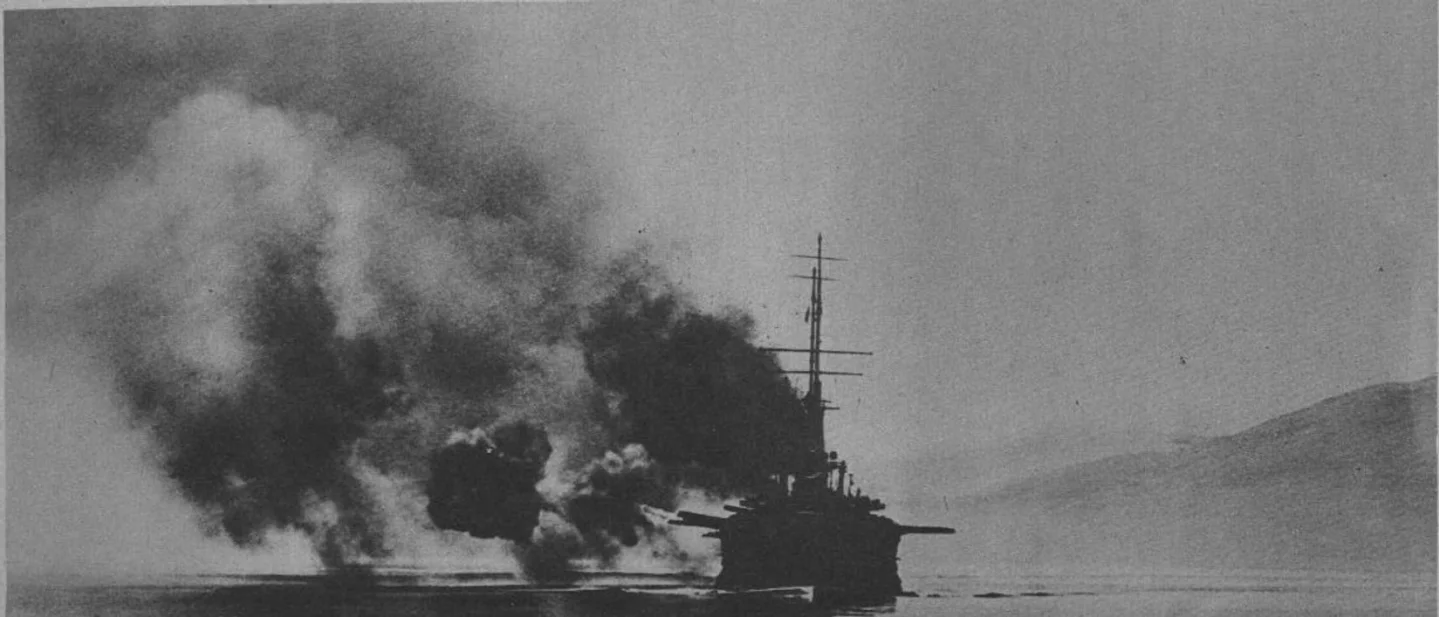
Noemvriana: 2,500 Allied marines, 20,000 royalists, and one day of fighting in Athens
A deep read of Wikipedia's September 18 Featured Article: the day in December 1916 when Britain and France landed 2,500 marines at Athens to seize Greek artillery, met more than 20,000 royalists in the streets, and then watched the reprisals that followed.

On September 18, 2026, Wikipedia's editors chose Noemvriana as the day's featured article, the single subject they put on the encyclopedia's front page once their own reviewers have finished with it. 12 The name means "November events". The fighting it describes happened in December.
On the morning of 1 December 1916, a French and British force of about 2,500 marines landed at Piraeus, the port of Athens, and set out for the city. 2 The Allies wanted guns: ten Greek mountain artillery batteries, to replace the ones they had lost when a Greek fort surrendered to German and Bulgarian troops that May. 2 Waiting inside Athens were more than 20,000 Greek soldiers and reservists. 2
By the evening, a French battleship had fired into the capital, the two sides had settled on six batteries instead of ten, and the Allied force had gone back to its ships. 2 Over the next two or three days, royalist mobs went through the city arresting, expelling and killing the followers of the former prime minister, Eleftherios Venizelos. 2 The shooting lasted a day. The purge afterwards is most of what the word covers.
A kingdom pulled two ways
Greece came out of the Balkan Wars of 1912 and 1913 with almost twice the country it had started with. Its territory grew from 64,790 square kilometres to 108,760, and its population from about 2.7 million to 4.8 million, largely through the acquisition of Macedonia, Epirus, Crete and most of the Aegean islands. 2
Its leadership disagreed about what to do with the gain. Venizelos, the prime minister, read the war that had just started in Europe as the chance to complete the Megali Idea — the long-standing ambition of a Greece enlarged toward Constantinople and Asia Minor — and took the side of Britain and France. 2 King Constantine I had been educated in Germany, was married to Sophia of Prussia, the sister of Kaiser Wilhelm II, and admired Prussian militarism. He expected Germany to win quickly and wanted Greece to stay out of the war, which suited the Central Powers. 2
In early 1915 Britain offered Greece territory in Asia Minor if it would join the Gallipoli campaign. Venizelos was for it; the King and his military advisers were against, and Venizelos resigned on 21 February. 2 His Liberal Party won the election that May, but when Bulgaria mobilised against Serbia in September 1915, and Venizelos obtained a decree for a Greek counter-mobilisation and asked the Allies to defend Thessaloniki, the King refused to leave neutrality. Venizelos resigned a second time and the parliament was dissolved. 2 The Liberals boycotted the election that followed, which turned the quarrel between the two men into a quarrel between their supporters. 2 On 5 October 1915, an Allied army under the French general Maurice Sarrail landed at Thessaloniki and dug in around the city. 2
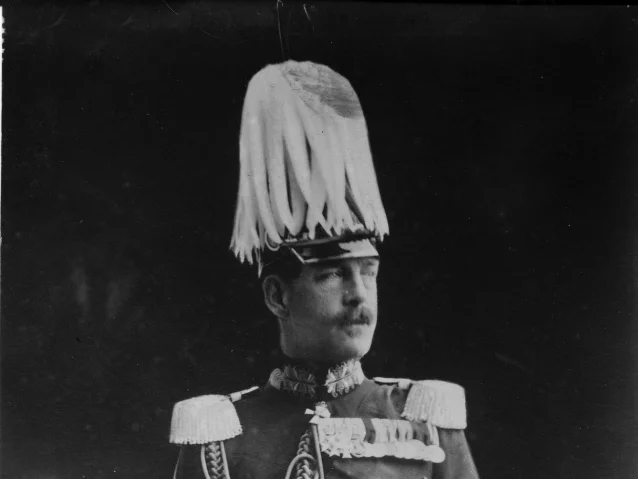
Roupel, and the loss of Macedonia
The government that replaced Venizelos promised what it called "sincere benevolent neutrality" toward the Allies, and in practice avoided anything the King would object to. In April 1916 it refused an Allied request to let Serbian troops travel by Greek railway from Corinth to Thessaloniki. 2
A month later Germany moved on the Greek fort at Roupel, which controlled the road into eastern Macedonia. Athens was told on 26 May that a German-Bulgarian force of about 25,000 Bulgarian soldiers was coming, and was assured that Serres, Drama and Kavala would be left alone provided Roupel was handed over. 2 The fort's own commander had not been told and prepared to fight; in the afternoon he received orders from Athens to surrender unconditionally. 2
Bulgarian troops began rounding up the Greek population and moving it into the three towns, and the Bulgarian army occupied Kavala on 4 September. 2 Around 42,000 Greeks were expelled from the Kavala, Serres and Drama regions in overcrowded freight wagons on a journey that lasted a week; roughly 12,000 of them died before it ended, and the survivors were put to work building roads, railways and fortifications. 2
For the Allies, the surrender at Roupel looked like proof of a secret arrangement between Athens and Berlin, because the Greek government had promised that no Bulgarian force would enter Greek territory. 2 The French press demanded action. On 3 June, Sarrail declared martial law in Thessaloniki, taking the city out of the Greek government's hands. 2 On 21 June, the Allies demanded that the Greek parliament be dissolved and the army demobilised. 2
Two governments in one country
Both sides began organising demobilised soldiers into reservist groups: the royalist National Reservists League, run by Captain Ioannis Metaxas, and the Venizelist National League of Greek Reservists, run by General Panagiotis Danglis. 2
Venizelos spoke at a demonstration in Athens on 27 August and told the King that his advisers were destroying the country's gains, warning that if the appeal failed "there are other means to protect the country from complete catastrophe". The King refused to meet a committee Venizelos sent. 2 Two days later, army officers loyal to Venizelos rose in Thessaloniki. Venizelos himself thought the move would fail without Allied backing, but on 9 October he travelled north with Admiral Pavlos Kountouriotis and General Danglis to head what they called the Provisional Government of National Defence. 2
The split followed the map of Greece's recent expansion. The "New Lands" won in the Balkan Wars mostly backed Venizelos, while "Old Greece" — Athens and the Peloponnese — mostly backed the King. 2 From that autumn, the Allies were negotiating with one Greek government while the other one sat in the capital they were about to enter.
The ultimatum, and the assumption behind it
On 23 October 1916, after weeks of deadlock, the King suddenly accepted several Allied demands: he agreed to pull the Greek army out of Thessaly and offered war materiel and the use of the Greek navy, asking the French parliamentarian Paul Bénazet, who was conducting the talks, to keep the deal secret from the Central Powers. 2
On 3 November, Vice Admiral Louis Dartige du Fournet, commanding the Allied fleet in the Mediterranean, used the sinking of two Greek merchant ships by a German submarine to demand the surrender of the Greek warships in port and Allied control of the naval arsenal at Salamis. Disarmament of the ships began on 7 November and the Allies towed away 30 lighters. 2 Pressure from the King's military advisers, and a Venizelist advance on Katerini, finished the Bénazet agreement off. 2
On 24 November, du Fournet delivered a seven-day ultimatum demanding at least ten mountain artillery batteries. His own government had instructed him to avoid taking them by force. 2 He warned the King that his forces would occupy positions in Athens until Greece gave in. The King replied that the citizens and the army were against disarmament, and promised only that Greek forces would not attack the Allies. 2
Athens rejected the demand on 29 November, and by the next day the I Army Corps and the epistratoi — the reservists, drawn from the countryside around the capital — had been recalled and placed in and around the city, more than 20,000 men in all, with orders not to fire unless fired on. 2 The Allied commanders believed the Greeks were bluffing. A French naval intelligence officer in Athens, Henri de Roquefeuil, expected them to "bring the cannons on a platter", and du Fournet agreed with him. 2
One day of fighting in Athens
The landing began in the early morning of 1 December. French captain Henri Pugliesi-Conti commanded the party, with the British contingent under Major C. D'O. Harmar, and the orders were to secure positions around the city while avoiding violence. 2 At each position the marines found Greek troops already there. The two forces stood facing each other for more than two hours, and then a rifle shot of unknown origin was fired. Each side blamed the other, and the battle spread through the city. 2
Du Fournet was outnumbered and short of supplies, so he accepted a ceasefire proposal from the King — and then the fighting resumed before anything was signed. 2 The Greek battery on Ardittos Hill fired at the entrance of the Zappeion, the building where the admiral had set up his headquarters, and the Allied squadron lying off Phaliron answered by bombarding the city around the stadium and the palace. The French battleship Mirabeau was among the ships firing that day. 2 Talks restarted and produced a compromise: the King would hand over six mountain batteries, and the fate of the rest was left open. The fighting was over by late afternoon, and by the early hours of 2 December the last Allied troops had been evacuated. 2
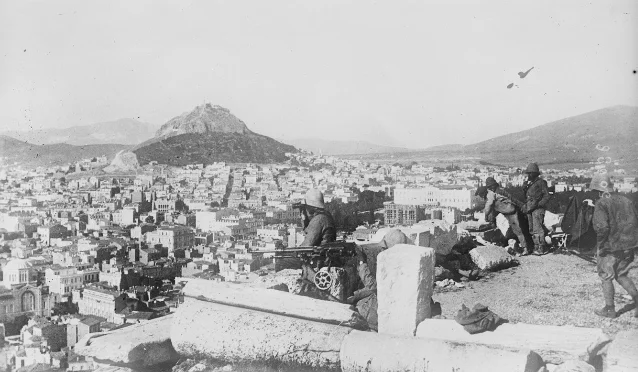
The numbers from the day itself are disputed. The historian George Leon put Allied losses at 194 dead and wounded and Greek losses at 82. 2 What the Venizelists did during the fighting is disputed too. Du Fournet wrote in his report that he had been caught up in a civil war; the contemporary writer George F. Abbott thought the royalist claim — that Venizelists fired from rooftops and balconies at royalist patrols — was probably true, and reported large caches of weapons packed in French military containers found in Venizelist strongholds. 2 The royalist historian Pavlos Karolidis, writing soon afterwards, said no Venizelist attacked their fellow citizens and that the only weapons found when prominent Venizelist houses were raided were knives. 2
The two days after the fighting
The Athens authorities treated the landing as a Venizelist insurrection staged with Allied help, and used it as grounds for a sweep against Venizelos's supporters, carried out with the reservists. General Konstantinos Kallaris commanded the troops of the Athens military district and General Anastasios Papoulas commanded the rest. 2
The violence outgrew its purpose. Politiki Epitheorisis, a respectable conservative paper that had begun by urging Greek justice to "smite mercilessly the atrocious conspiracy", was urging prudence by the end. 2 Houses and shops belonging to Venizelists were ransacked. Leon counted 35 people murdered and 980 citizens expelled from Athens by the epistratoi over the following two or three days; the historian Giannis Mourelos counted 14 civilians killed and another 14 wounded. 2 Mourelos put the number of people imprisoned across Greece at 922, many of them held in solitary confinement. 2 Emmanuel Benakis, the mayor of Athens, was among them. 2
On 3 December, Athenians gathered at Piraeus for the funeral of the Allied soldiers killed in the fighting, with representatives of the Entente powers present. The bodies were buried at the Anastaseos cemetery in Keratsini, near Piraeus, in a section of the Catholic cemetery reserved for France, and were repatriated in 1922. 2
What the Noemvriana settled
The day after the evacuation, Britain and France recognised Venizelos's government in Thessaloniki as the only lawful government of Greece, and on 7 December that government declared war on the Central Powers. 2 In Athens, a royal warrant was issued for Venizelos's arrest, and on 25 December the Archbishop of Athens anathematised him in a ceremony at which the crowd threw stones at an effigy. 2
The events also cost the men who had ordered the landing. Du Fournet was relieved of his command on 12 December and replaced by Vice Admiral Dominique-Marie Gauchet, and in France the premiership of Aristide Briand, who had argued for dealing with Constantine, was left hanging. 2 In Britain, H. H. Asquith and Sir Edward Grey resigned and were replaced by David Lloyd George and Arthur Balfour. Lloyd George was a known admirer of Venizelos, which mattered for what came next. 2
On 8 December the Allies imposed a naval blockade on Athens. Food ran short and people began dying of starvation, and the King held out. 2 What broke the deadlock was the fall of Tsar Nicholas II in Russia, who had previously refused the French proposals to remove Constantine from the throne. 2 In June 1917, Britain and France invoked their standing right as Greece's Protecting Powers and demanded the King's resignation. Charles Jonnart, acting for the Allied governments, sent French forces to take control of the Isthmus of Corinth and Thessaly. 2 Constantine accepted on 12 June and went into exile in Switzerland. His second son Alexander became king, and Metaxas and the former prime minister Dimitrios Gounaris left the country with him. 2
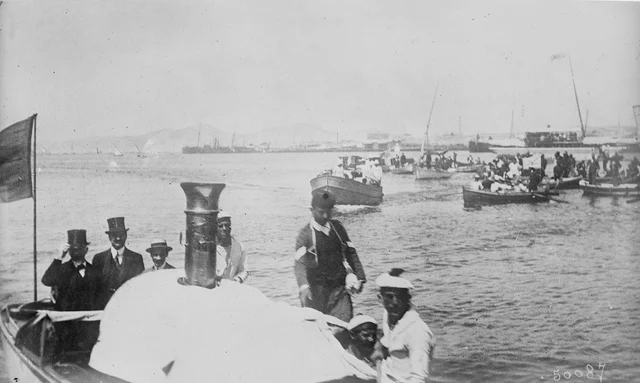
Venizelos returned to Athens under French escort in late June 1917 and formed a government on 28 June. Greece, now formally unified, entered the war on the Allied side. 2 In the autumn of 1918 the Greeks had 150,000 soldiers on the Macedonian front, the largest single national contingent in the Allied army there. 2 The Battle of Skra-di-Legen in May 1918 showed the Allies that the Greek army could attack, and on 14 September 1918 a combined Greek, Serbian, French and British force under the French general Franchet d'Esperey broke the Bulgarian line. Bulgaria signed an armistice on 30 September, and Belgrade was liberated on 1 November. 2 Greece's part in that advance earned it a seat at the Paris Peace Conference. 2
Four things the sources disagree about
- How many men came ashore. The 2,500 figure is an estimate by the historians Thanos Veremis and Helen Gardikas-Katsiadakis. The contemporary writers George Abbott and Vincent Seligman, both of whom published within a few years of the events, gave 3,000 and 2,000. 2
- How many Allied soldiers were killed or wounded. Captain Pugliesi-Conti reported to du Fournet on 9 December 1916 that the landing party had lost 57 dead and 134 wounded. Du Fournet's own memoir gives 60 dead and 167 wounded. When the French and British governments asked Athens for compensation in October 1918, their submission listed 50 French fatalities and 77 French injuries and no British casualties at all. 2
- What the Venizelists did. Du Fournet described the day as a civil war, Abbott treated the royalist account of snipers on the rooftops as probable, and Karolidis, a royalist writing while the events were recent, said the only weapons found were knives. 2
- How many civilians died in the days afterwards. Leon put the figure at 35 murdered; Mourelos counted 14 killed and another 14 wounded. The two men were counting over slightly different periods and from different sets of records, and they differ by more than a factor of two. 2
Verbatim quotes
"a small but honorable Greece"
The royalist slogan for Constantine's policy of staying out of the war, as against Venizelos's expansionism. 2
"bring the cannons on a platter"
The French naval intelligence officer Henri de Roquefeuil's description of what the Allies expected the Greeks to do, a view du Fournet shared. 2
"Not only has Mr. Venizelos' action put fresh spirit into its promoters here [Thessaloniki], but it has encouraged recruits to come forward from Macedonia where, as I have reported, very little enthusiasm had hitherto been manifested... The Committee of National Defence must now have at its disposal nearly twenty thousand men."
The British diplomat Albert Charles Wratislaw, writing from Thessaloniki to his colleague Francis Elliot in Athens in the autumn of 1916, on the recruits the provisional government was gathering. 2
"that it was absolutely necessary to do something to bring the King of Greece and his Government to their senses"
The conclusion of the Allied conference in London on 17 June 1916, five months before the marines landed at Piraeus. 2
The conservative paper Politiki Epitheorisis began by calling on Greek "justice" to "smite mercilessly the atrocious conspiracy" and to purge the followers of the "arch-conspirator of Salonika", then changed its line and urged prudence once the purge was under way. 2
A December event with a November name
The chronology so far has been the ordinary one. By the calendar most of the world now keeps, the marines landed on 1 December and the reprisals ran to 3 or 4 December. Greece in 1916 was still on the Old Style, or Julian, calendar, thirteen days behind, and in that reckoning the same days fall between 18 and 21 November. The events took their name from the month they fell in at home. 2
The royalists won the two days in Athens. The Allies got six batteries where they had demanded ten, buried their dead at Piraeus, and sailed away. Just over six months later the King was in exile in Switzerland and Venizelos was forming a government in Athens, and by the autumn of 1918 there were 150,000 Greek soldiers on the Allied side in Macedonia. The Noemvriana is remembered as the moment the country stopped arguing and started choosing, and the choice went against the men who won the shooting. The full account, with its citations, is at Noemvriana on Wikipedia. 2
References
- 1Wikipedia: Today's featured article/September 18, 2026
en.wikipedia.org
- 2Noemvriana - Wikipedia
en.wikipedia.org
- 3File: Constantineiofgreece.jpg - Wikimedia Commons
commons.wikimedia.org
- 4File: French artillery in Athens, 1917.jpeg - Wikimedia Commons
commons.wikimedia.org
- 5File: Venizelos returns to Athens, 27 June 1917.jpeg - Wikimedia Commons
commons.wikimedia.org
This story was produced automatically by a channel. One sentence is all it takes for Neodrop to keep producing for you.
Related content
More from this channel
- Misti: 12 kilometres from a million people, and the Inca children in its crater
- Ashton-under-Lyne: 75 cotton mills, an 870-metre mine shaft, and a Bronze Age skull in a peat bog
- Eternal Blue: a desert rental house, an NSA hacking tool, and Spiritbox's debut album
- Grace Coolidge: a raccoon, a collie, and a president's rules
- Melisende of Jerusalem: the royal marriage, the Tower of David, and the reign of a crusader queen
- Sir Thomas Hardy: the chaplain's scoop, the 200-ship convoy, and the battle over naval duty