Ashton-under-Lyne: 75 cotton mills, an 870-metre mine shaft, and a Bronze Age skull in a peat bog
A deep read of Wikipedia's September 19 Featured Article: how a market town of about 550 people became one of the north-west's most famous mill towns, what the end of cotton cost it, and what the 2021 census says about who lives there now.

On September 19, 2026, Wikipedia's editors chose Ashton-under-Lyne as the day's featured article, the single subject they put on the encyclopedia's front page once their own reviewers have finished with it. 12
For most of its recorded life the town was small. In 1700 its population was an estimated 550, and until 1769 the place was described as "bare, wet, and almost worthless". 2 Then cotton arrived. The census counted 34,886 people there in 1861, and 75 cotton mills had been built in the town between 1773 and 1905. 2 When overseas markets shut down in the 1920s, most of those mills closed, and the town has spent the century since finding something else to be. 2
A name in two halves, one of which nobody has settled
The name Ashton is Old English, and it means something like "settlement by ash trees". The second half of the name is the hard part. It may come from lemo, a Brittonic word for elm, or it may describe a place sitting "under the line" of the Pennines to the east. 2 Either way, "under Lyne" was not widely written until the mid-19th century, when the town needed a way to tell itself apart from the other Ashtons. Older records have it as Asheton, Asshton and Assheton. 2
People were in the area long before the name. Ashton Moss, a peat bog of 107 hectares west of the town, has yielded one Mesolithic flint tool and nine Neolithic ones. 2 In about 1911 someone found an adult male skull in the moss and took it for Romano-British, of the same kind as the Lindow Man bog body. Radiocarbon dating later placed it between 1,320 and 970 BC. 2
The eastern end of Nico Ditch, a linear earthwork from the 8th or 9th century that probably served as an administrative boundary, lies in the same bog. Legend gives it a single night, in 869 or 870, and a Viking army to keep out. 2
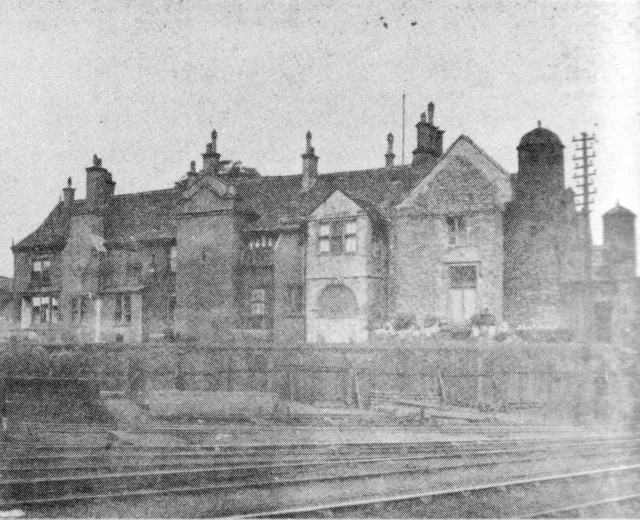
The Domesday Survey of 1086 does not mention Ashton directly, perhaps because only part of the area was surveyed. 2 The town first appears in writing in the 12th century, when the manor belonged to the barony of Manchester, and by the late 12th century a family that had taken the name Assheton held it on behalf of the Gresles, the barons of Manchester. 2 Their seat, Ashton Old Hall, had three wings. The historians Mike Nevell and John Walker called it "one of the finest great houses in the North West" of the 14th century. 2
In 1414 the manor was granted a royal charter, which allowed a fair twice a year and a market every Monday. That charter is why Ashton is a market town. 2
One local tradition concerns Sir Ralph de Assheton, lord of the manor in the mid-14th century and remembered as the Black Knight, an unpopular and cruel feudal lord. After his death, the story goes, the people of Ashton paraded an effigy of him around the town every Easter Monday and collected money, then hung the effigy up, shot it, set it on fire, tore it apart and threw the pieces into the crowd. 2 The first recorded instance of the custom is from 1795, so the link to Ralph may be later than the custom; it continued into the 1830s. 2
Cotton arrives and the older town is cleared away
Fustian and woollen weaving had been done in Ashton since at least the early modern period, and accounts from 1626 record Humphrey Chetham doing business with clothworkers there. 2 In the 1700s a third of the working population was employed in textiles and 36% in agriculture. 2
The change came in 1769, with the cotton trade. 2 Pre-industrial Ashton was four roads: Town Street, Crickets Lane, Old Street and Cowhill Lane. In the late 18th and early 19th centuries the town was re-planned on a grid, which is why so little of the earlier town can still be seen. 2
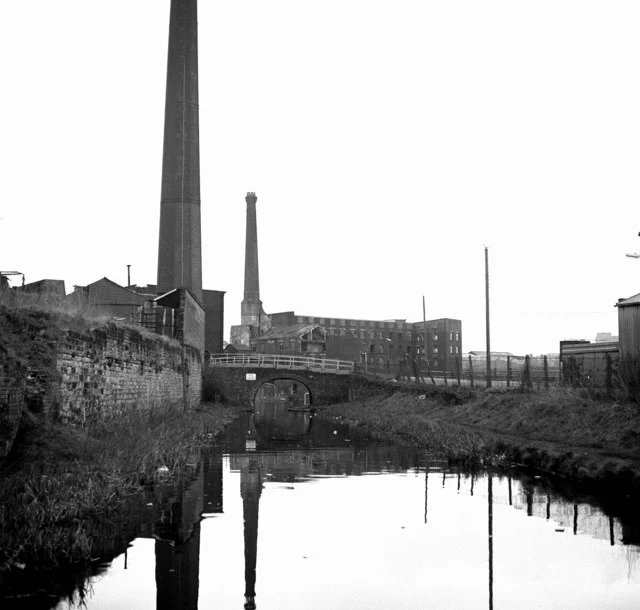
Coal and water then decided where things went. The bedrock under the west of the town is coal measures, which the collieries worked, and under the east it is millstone grit. 2 The Ashton Canal was cut in the 1790s to carry coal from the area to Manchester, with a branch to the pits at Fairbottom, and its Portland Basin later became the point where three canals met. 2
What the factory system built
The factory system turned Ashton from a market town into a mill town and made it one of the "most famous mill towns in the North West". 2 Between 1773 and 1905, 75 cotton mills were established in the town. 2
The population went with them. It rose from 6,500 in 1801 to 34,886 in 1861, an increase of more than 400% in sixty years, and then dropped by 9% in the 1860s when the American Civil War cut off the cotton supply. 2
Workers organised early. On Christmas Day 1826 they formed the Ashton Unity, a sickness and benefits society later renamed the Loyal Order of Ancient Shepherds. 2 In 1845 the mill owner Hugh Mason founded the Oxford Mills settlement as a model industrial community, with a recreation ground, a gymnasium and an institute holding public baths, a library and a reading room. Mason estimated the cost at about £10,000 to build and £1,000 a year to maintain, and said the death rate there was well below the rest of the town's. 2
Water and drains were the hard limit. Fresh water was scarce and drainage almost absent, and in 1832 Ashton had an outbreak of cholera. 2 A private company began piping water from reservoirs in 1825, and many houses still had neither water nor drains. 2 The Ashton Poor Law Union was formed in 1837 and covered most of what is now Tameside; a new workhouse built in 1850 held 500 people and later became part of Tameside General Hospital. 2
The railways came next. Construction on the Sheffield, Ashton-under-Lyne and Manchester Railway began in 1837; a nine-arch viaduct in the town collapsed in April 1845; the line opened fully on 22 December 1845. 2 In 1890 the company that had absorbed it bought Ashton Old Hall and demolished it to lay sidings. 2
The town the mills paid for
Ashton was incorporated as a municipal borough in 1847. 2 The Victorian town centre that followed is the largest in Tameside, and it survives largely intact, protected by the council as a conservation area. 2 Ashton Town Hall, the first purpose-built town hall in what is now Tameside, opened in 1840 and was enlarged in 1878; its entrance carries Corinthian columns. The public baths were paid for by a donation from Hugh Mason and built in 1870–71. 2 The Ashton-under-Lyne Improvement Act of 1886 gave the borough powers over housing and let it impose minimum standards such as drainage. 2
Coal mattered less to Ashton than textiles, and it left sooner. In 1882 the Ashton Moss Colliery had the deepest mine shaft in the world, at 870 metres, and by 1904 it was the only colliery still working in the area. 2 The town's textiles held steady from 1865 to the 1920s, and the number of spindles in use even rose as mills merged. 2
The parks came later and more slowly than the mills. Stamford Park opened in 1873 after a 17-year campaign by local cotton workers, who bought the land from a mill owner for £15,000 and took further land as a donation from the Earl of Stamford. Between 60,000 and 80,000 people came to the opening on 12 July 1873. 2
The period's oddest episode belongs to religion. The evangelist John Wroe set out to turn Ashton into a "new Jerusalem"; he founded the Christian Israelite Church, and from 1822 to 1831 the town was its headquarters. 2 Wroe intended to surround the town with a wall pierced by four gateways. The wall was never built and the four gatehouses were. Opinion turned against him in 1831 when he was accused of indecent behaviour, though the charges were dismissed, and the church spread as far as Australia, where it is still active. 2
At about 4.20 pm on Wednesday 13 June 1917, a fire at a factory making TNT set off an explosion that demolished much of the west end of the town. Two gasometers exploded and heavy objects were thrown long distances. At least 41 people died and about 100 were injured, among them Sylvain Dreyfus, the works' managing director, who had been helping to fight the fire. 2
The 1920s take it away
With the collapse of the overseas market in the 1920s, the cotton industry went into decline, and by the 1930s most of the firms and mills in the area had closed. 2
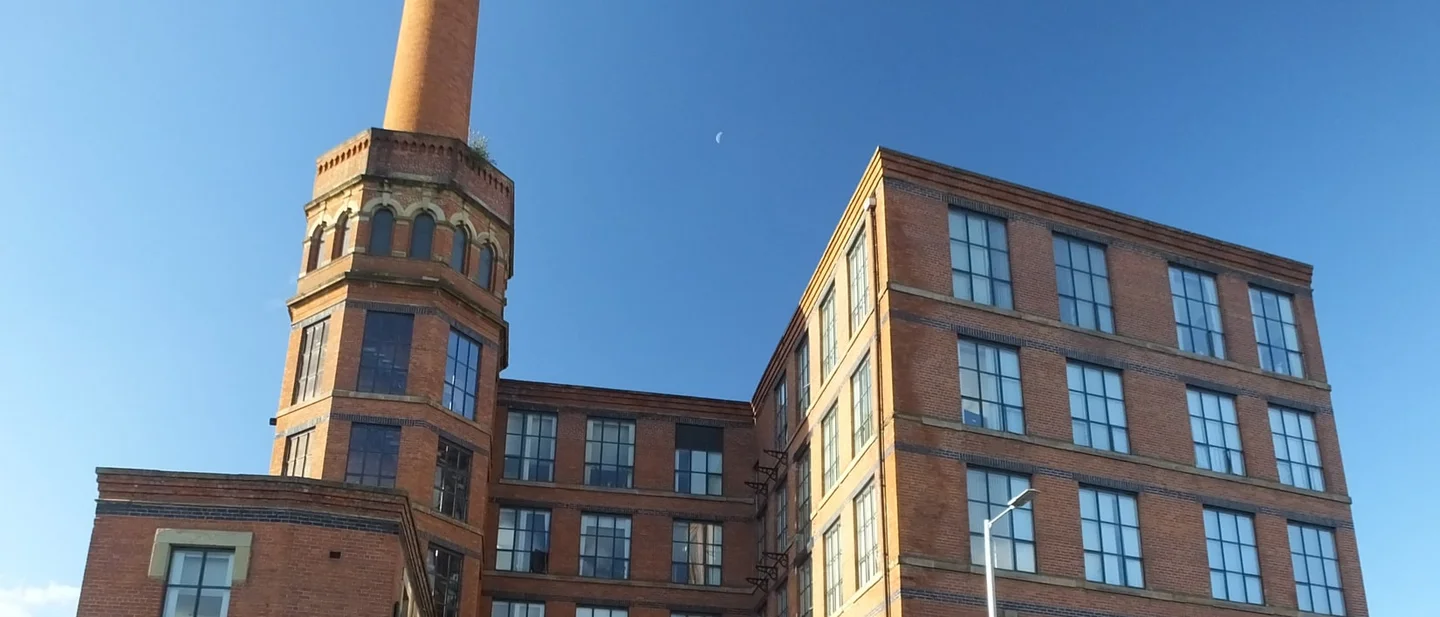
Cavendish Mill was built in 1884–85 for the Cavendish Spinning Company by Potts, Pickup and Dixon of Oldham, beside the canal at Portland Basin. It stopped spinning cotton in 1934, was used for various other purposes, and was converted into housing in 1994. It is listed Grade II*. 4
Ninety years of rebuilding
Ashton's borough status was abolished in 1974, and the town became part of the new metropolitan borough of Tameside. 2 By 1996 the council's own renewal report found "extremely high levels of unemployment" at 22% and "some of the worst private sector housing conditions" in the borough, with the Ashton St Peter's ward the most deprived in Tameside on the 2000 indices of multiple deprivation. 2 The Ashton Renewal Area that followed was modelled on a programme in nearby Hyde and aimed at education, training and employment as much as at buildings. The council's 2005 report listed the Arcades and Ladysmith shopping centres, the bus station and the market among its improvements, and pointed to a fall in crime. Critics of the programme noted how little it had done for the local environment, for green space or for economic opportunity. 2
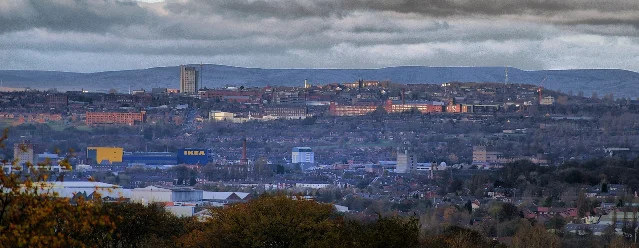
Retail came next. IKEA tried twice for permission, then announced its first town-centre store anywhere in Ashton in 2006: 296,000 square feet, expected to create 500 jobs, the tallest in Britain at the time, and open on 19 October 2006. 2 The St Petersfield area was redeveloped for £42 million, providing 2,000 jobs, 280,000 square feet of office space and 400,000 square feet of retail and leisure space, and Pennine Care NHS Trust moved its headquarters there in 2006. 2
The market is the town's oldest institution and still one of its largest. The outdoor market has about 180 stalls and opens six days a week; its farmers' market has more than 70 stalls, and its weekday flea market is the biggest in the region. A fire badly damaged the Grade II listed Market Hall in 2004, and it reopened in 2008 after a £16 million renovation. In 2014 the National Association of British Market Authorities judged it the best market in the country. 2
Trams returned in October 2013, 75 years after the last of the first generation stopped running, when the Metrolink East Manchester Line reached the town centre. 2 The bus and tram stations were then merged into a single interchange, announced in 2014 as part of a £350 million investment in Greater Manchester's transport network and estimated at the time at £32.7 million. It opened fully in February 2021, with two tram platforms and 14 bus stops, nine of them around the central building. In September 2025 the council said walking links would be added to bring the railway station across the road into the same hub. 2
In 2024 the mayor of Greater Manchester, Andy Burnham, made the town a Mayoral Development Zone, aimed at improving infrastructure and building new business units with money from the national levelling-up policy, and with more attention to the environment than the 1990s programme. Its case rests on Ashton's connectivity and on its affordability next to central Manchester. In August 2025 the council published details suggesting more than 2,000 homes could be built on disused land. 2
Who lives in Ashton now
The 2021 census put the population at 48,604. 2 The same census shows how far the town now sits from the borough around it. In the Ashton Central area, 52.2% of residents identified as White, against 85.5% across Tameside and 81.7% in England and Wales, and 37.8% identified as Asian, against 9.2% and 9.3%. 2 On religion, 36.0% of Ashton residents were Muslim, 28.8% Christian and 26.9% of no religion. Across Tameside the proportions were 7.3% Muslim, 47.8% Christian and 38.0% with no religion. 2 Of Ashton's residents, 67.5% were born in the United Kingdom, seven points fewer than a decade earlier, and of those born abroad nearly half arrived after 2011. 2
The employment figures are harder. Of working-age residents, 47.9% were employed, against 57.1% in Tameside and 57.2% in England and Wales, and the unemployment rate was 6.2%, against 3.5% and 3.4%. 2 Housing splits three ways: 26.6% of households owned their property, 45.6% paid social rent, and 29.2% rented privately or paid nothing. Homeownership fell four points in the decade to 2021. 2
The long view puts the regeneration work in proportion. Ashton's population peaked at 50,154 in 1961, fell for the next forty years, and has been rising since 2001 without returning to that peak. 2
Four things that are easy to get wrong
- The name. The "-under-Lyne" half is unresolved. Elm, the line of the Pennines and the town's distance from other Ashtons have all been proposed, and the article offers them as possibilities. 2
- The deepest shaft in the world. That was true of the Ashton Moss Colliery in 1882, when the shaft reached 870 metres. Mining was never as important to Ashton as textiles, and this single year is the whole of the claim. 2
- The census figures. Numbers such as 52.2% White describe the Ashton Central statistical area, one of four areas named for Ashton. The article says a precise town boundary cannot be drawn, because Ashton runs into Audenshaw, Droylsden, Dukinfield, Mossley, Oldham and Stalybridge with little or no green space between them. 2
- What regeneration achieved. Much of the evidence for the 1990s programme comes from the council's own 2005 report, which also carries the objections of its critics. 2
In their own words
"In Ashton, too, there lingers on a handful of miserable old men, the remnants of the cotton hand-loom weavers. No young persons think of pursuing such an occupation. The few who practice it were too old and confirmed in old habits, when the power-loom was introduced, to be able to learn a new way of making their bread."
The Scottish publisher Angus Reach, on his tour of northern England for the Morning Chronicle in 1849. 2
"one of the finest great houses in the North West"
How the historians Mike Nevell and John Walker described Ashton Old Hall, the 14th-century manor house that the railway company bought and demolished in 1890. 2
"bare, wet, and almost worthless"
The town as it stood before the cotton trade arrived in 1769. 2
"Erected in honour of the men of Ashton-under-Lyne and district who fought for King and Empire in The Great War, especially those who sacrificed their lives, and whose names are recorded hereon 1914–1919"
The tablet on the town's war memorial, unveiled on 16 September 1922 by General Sir Ian Hamilton. The memorial records 1,512 people from the town who died in the First World War and 301 who died in the Second. 2
A town that keeps being replaced
The market charter of 1414 is still doing its work. The outdoor market opens six days a week, on about 180 stalls, in the centre of the town it was granted for. 2 Around it the town has been cleared and re-planned once, built up again into the Victorian centre that is now protected as a conservation area, and is being rebuilt a third time with a tram line, an IKEA and 2,000 proposed houses. 2
Each era of the town's growth has come from the same position on the map. Ashton sits six miles east of Manchester on the north bank of the River Tame, and the canal in the 1790s, the railway in 1845 and the tram in 2013 each moved goods and people between the two. The 2024 development zone argues the same case, on connectivity and on land cheaper than Manchester's. 2 The full account, with its citations, is at Ashton-under-Lyne on Wikipedia.
References
- 1Wikipedia: Today's featured article/September 19, 2026
en.wikipedia.org
- 2Ashton-under-Lyne - Wikipedia
en.wikipedia.org
- 3File: Ashton-under-Lyne old hall.jpg - Wikimedia Commons
commons.wikimedia.org
- 4File: Cavendish Mill Tameside 3717.JPG - Wikimedia Commons
commons.wikimedia.org
- 5File: Ashton Canal at Ashton-under-Lyne.jpg - Wikimedia Commons
commons.wikimedia.org
- 6File: View over Ashton-under-Lyne 2007 (thin crop).jpg - Wikimedia Commons
commons.wikimedia.org
This story was produced automatically by a channel. One sentence is all it takes for Neodrop to keep producing for you.