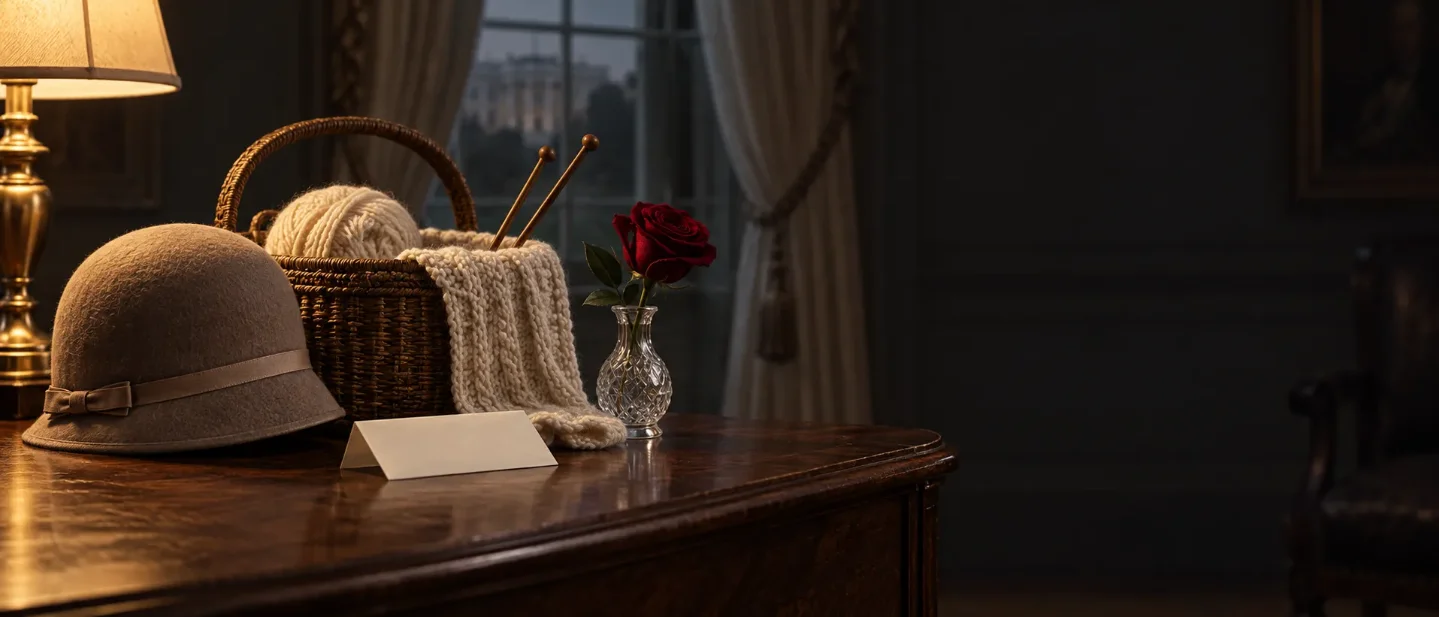
Grace Coolidge: a raccoon, a collie, and a president's rules
A deep read of Wikipedia's September 16 Featured Article, tracing Grace Coolidge from a Vermont mill town and a school for deaf children to a White House where she received 25,000 visitors a year under her husband's rules.

On September 16, 2026, Wikipedia's editors chose Grace Coolidge as the day's featured article, the editor-curated slot that places one fully vetted subject on the encyclopedia's front page. 12
Coolidge was first lady of the United States from August 1923 to March 1929, and the newspapers of those years treated her as a fixture: a woman in a close-fitting hat, photographed on the White House lawn with a white collie, named in stories that had little to do with her husband's politics. The New York Times counted her in 1928 among "the most photographed persons on earth outside of movieland," and the humorist Will Rogers called her "Public Female Favorite No. 1." Underneath that public life ran a set of rules the president set for his wife, and the rules are what make the record worth opening today. Coolidge needed permission to visit her parents, was told about her own engagements shortly before they happened, and kept away from the two causes she cared about most so that nobody could accuse the administration of trading on them. 2
She was also, in the phrasing of the people around her, unusually good at the job she was allowed to do. The Wikipedia article runs from her birth in Burlington, Vermont, in 1879 to her death in Northampton, Massachusetts, in 1957, and the surviving detail is domestic and specific: a raccoon that wrecked the White House, a knitting habit that carried her through her worst years, a fundraising total that no first lady had matched before, and a rose placed beside a photograph every day for three decades.
The White House years at a glance
| Role and dates | What she did | What constrained her | What it left behind |
|---|---|---|---|
| Governor's wife and second lady, 1918–1923 | Ran the household in Northampton while her husband governed from Boston; entertained in Washington as vice president's wife; weekly receptions; Red Cross and war-bond work | Her husband's time; the Hardenings' dislike; no formal office or staff of her own | A national profile built before she reached the White House 2 |
| First lady, hostess years, 1923–1924 | Received 20,000 to 25,000 visitors a year; high teas in the Red Room; arranged her own flowers; brought carol singing onto the lawn at Christmas 1923 | The president organised events and catering himself; no interviews; prohibition | The most socially active White House of its era 2 |
| First lady after Calvin Jr.'s death, 1924–1926 | Hosted again within weeks; attended budget meetings and Teapot Dome hearings quietly; kept up correspondence by hand | Grief she refused to show in public; a widening emotional distance from her husband | The daily rose beside her son's photograph 2 |
| First lady under restoration and illness, 1927–1929 | Directed parts of the 1927 White House restoration; crocheted a cover for the Lincoln Bedroom; raised over $2 million for the Clarke School | Her husband's rules on travel, flying and riding; kidney disease from February 1928 | Precedents in child welfare and in a first lady who travelled with the president 2 |
| Widow and former first lady, 1933–1957 | Wrote poems and recollections; took over trusteeships; campaigned for Herbert Hoover; lent her house to the WAVES; chaired the Clarke School board | Public expectation of a widow's retirement; failing health | A fundraising record and a school building named for her 2 |
From a Vermont mill town to a school for the deaf
Grace Anna Goodhue was born in Burlington, Vermont, on January 3, 1879, the only child of Andrew Issachar Goodhue, a milling engineer, and Lemira Barrett Goodhue. Her father built the family a house near the mill in the early 1880s and fitted it with a tin-and-wood bathtub, a furnace that heated the whole building, and electric lights. After a work accident in 1886 he left the mill, co-founded a machine shop, and was appointed a steamboat inspector by President Grover Cleveland. The household was Puritan in temper and Methodist in affiliation until Grace, then a teenager, persuaded her family to become Congregationalists. 2
She studied Latin and French at Burlington High School, took private lessons in piano, speech and singing, and delivered a commencement speech in 1897 titled "Tramp Instinct." At the University of Vermont she dropped out in November of her first year because of an eye condition and returned the following year, joined the glee club as a contralto, served as her class vice president, and co-founded the university's chapter of Pi Beta Phi with her friend Ivah Gale. She graduated in 1902 and wrote to Caroline Yale, principal of the Clarke School for the Deaf in Northampton, Massachusetts, asking to train as a teacher of deaf children. Her mother wanted her to teach in a local school. Grace moved to Northampton anyway and taught there for three years, first with the youngest pupils and then with middle-school students. The school taught lip reading rather than sign language, a policy she believed helped her students take part in ordinary society. 2
The marriage that followed began with a laugh. In her second year in Northampton she looked across at a window opposite the school and saw a young man shaving in long underwear and a derby hat; she laughed, he heard her, and he asked the school's steward to arrange an introduction. Calvin Coolidge was reserved and she was outgoing, and the people around them defined the pair by that contrast. They shared a college education, a Vermont upbringing, a taste for teasing each other — she did a nasal impression of him that he enjoyed — and a sense of public duty. He proposed in 1905 by announcing, "I am going to be married to you." They married in the parlor of the Goodhue family home on October 4, 1905, before fifteen guests, and took a short honeymoon in Montreal that ended early so that he could return to Northampton and stand for the school board. He lost. 2
Northampton, Boston, and the years as second lady
Two sons followed: John on September 7, 1906, and Calvin Jr. on April 13, 1908, called Bunny at first because he arrived near Easter. Coolidge raised them in Northampton while her husband sat in the Massachusetts legislature in Boston and came home at weekends. She taught the boys baseball, built them wooden cars to ride, and followed the sport for the rest of her life. When he became mayor of Northampton in 1910 the family had him home every night; when he returned to the legislature in 1911 the commuting resumed. 2
In 1912 she chaperoned a school trip to Washington and tried to play the White House piano. A guard stopped her, and she remarked that she would return one day to do it. 2 During the First World War she organised bond drives and worked with the Red Cross, becoming co-chair of Northampton's Women's War Committee. Her husband was elected governor of Massachusetts in 1918, and she led the march at his inaugural ball while declining to move to Boston full time — a decision that caused grumbling across the state. 2
The Republican ticket put Calvin Coolidge in the vice presidency in 1921 with Warren Harding, and the couple moved into a top-floor suite at the Willard Hotel while their sons went to boarding school. As second lady she received guests at home every week, made weekly calls on the wives of Washington's important figures, took dancing lessons at her husband's request that she never be seen dancing in public, and attended the dedication of the Tomb of the Unknown Soldier, an event she remembered for the rest of her life. Florence Harding resented her youth and her popularity; when the first lady fell dangerously ill with nephritis in late 1922, Grace took over her hosting duties. In August 1923, at the family home in Vermont, the Coolidges learned that Harding had died. Grace wept, prayed with her husband, and became first lady of the United States. 2
"Sunshine" of the White House
The Coolidges entertained more people than almost any family that had lived in the White House. Public receptions brought 20,000 to 25,000 visitors a year through the doors. Grace replaced Florence Harding's brief one-on-one meetings with high teas in the Red Room, on the reasoning that a larger gathering let more people meet her. She supervised eighteen servants, a valet, a maid and cleaning staff, all of whom called her Sunshine. Beyond hosting, her one standing daily duty was arranging flowers for her bedroom and the West Sitting Hall; the president reserved the planning of events and menus for himself. 2
She preferred meeting ordinary visitors to formal ceremony, and children most of all — the Easter egg rolling, the May Day celebrations, the carols. At Christmas 1923 she had the First Congregational Church choir and the Marine Band sing on the grounds and invited the spectators to come onto the lawn, which turned into a White House tradition. She served no alcohol during prohibition, while privately regretting that the law had bred public contempt for it. 2
The correspondence was constant. Coolidge wrote and answered letters by hand, assisted by a secretary, and when a gift arrived she kept it in her bedroom for a few days so that her thank-you note could say truthfully that she had enjoyed it. Her love of music brought Sergei Rachmaninoff to the White House repeatedly, put Al Jolson on the same programme (she sang with him), and drew actors including Douglas Fairbanks and Mary Pickford. Not every guest was easy: Queen Marie of Romania arrived in October 1926 trailing press attention and had to be managed all evening, though Coolidge found common ground with her as a mother and seated the queen's uncomfortable son Nicholas beside her at dinner. John D. Rockefeller Jr.'s visit the following February went better. 2
A public face the president kept on a short leash
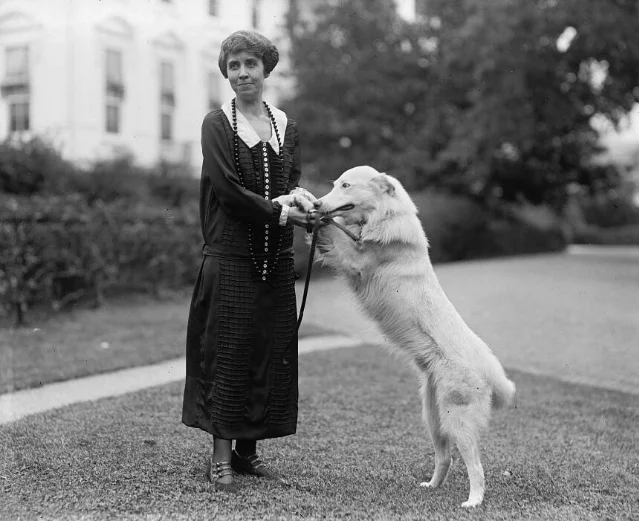
Coolidge almost always let the photographers work, and the resulting pictures appeared in newspapers often enough to give her real control over what the public saw. On her husband's instruction she granted no interviews; asked once for a comment, she delivered it in sign language. Radio technicians who hoped to catch her voice at public events went away empty-handed, and she finally spoke into a microphone only as she was leaving the White House in 1929. In company she addressed her husband as "Mr. President." The pairing of a lively wife and a silent husband became the public's picture of the marriage. 2
The rules reached further than protocol. After photographers covered her horse-riding, the president told her to "not try anything new," and her own projects narrowed to the traditional first lady's work with the Girl Scouts. He asked her to keep from smoking in public, a rule he applied to himself as well. She needed his permission to visit her parents or to travel to an event, and she was frequently briefed on her own schedule only shortly before it happened. When she complained about the uncertainty, he replied that he could not "give out that information promiscuously." Added to the strain were Washington's weather, which troubled her sinuses, and a steady drip of false rumours: that she intended to divorce him, that she was pregnant (which produced a stream of baby clothes from strangers), and that she had become romantically involved with her Secret Service guard Jim Haley. The Coolidges answered none of it publicly. Years later she concluded that she had succeeded in avoiding anything genuinely embarrassing. 2
A raccoon, a collie, and a baseball habit
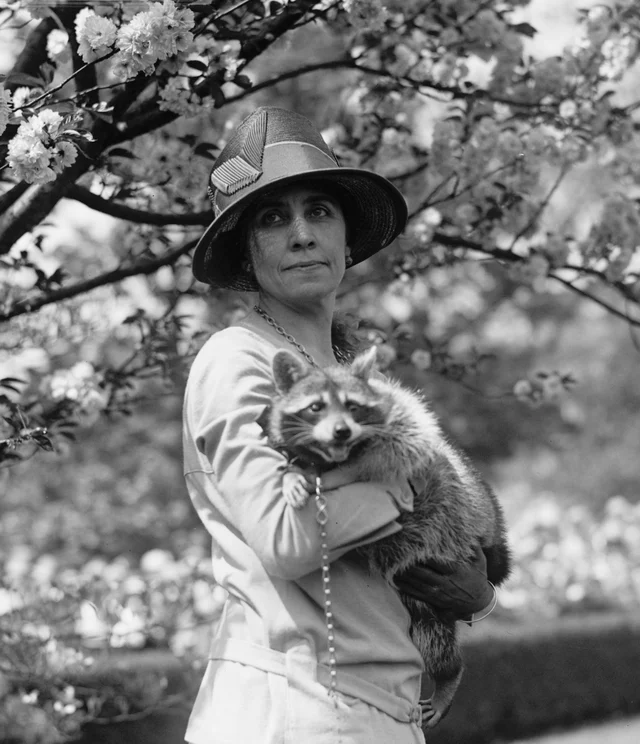
Animals filled the White House during the Coolidge years. The white collies Rob Roy and Prudence Prim were the public's favourites, and Coolidge left calling cards on her dog's behalf as well as her own for friends she visited. Gifts of wild animals went to the zoo; the raccoon stayed, until Rebecca's household career ended the way the others had. 2
Away from her duties she shopped, walked for miles, sewed, knitted and made some of her own dresses. Baseball was her sport: she followed the Washington Senators and the Boston Red Sox, was devoted to Babe Ruth, and picked up the nickname "First Lady of Baseball." Her gardening earned her a namesake flower, the "Mrs. Coolidge rose," and her church attendance was regular enough to be reported as a mark of character. She was the first first lady to hold a bachelor's degree, and the first to receive an honorary one — an LL.D. from Boston University in 1924 — followed by a degree from George Washington University alongside her husband in 1929. 2
The people around the administration measured her value in flattery and in cash. The suffragette Florence Jaffray Harriman called her "the administration's greatest success." Vera Bloom, daughter of Congressman Sol Bloom, said she was worth a million dollars a year to the Republican Party. Frank Stearns, her husband's political backer, credited two things: her speed at making friends, and her decision to leave her husband's politics alone. 2
July 7, 1924, and the rose on the bed
In early July 1924, sixteen-year-old Calvin Jr. played tennis and raised a blister on his foot. The blister became infected, and he died of blood poisoning on July 7. 2
Coolidge stopped hosting for several weeks. Neither she nor her husband was comfortable expressing grief, and the marriage grew more distant in its aftermath; she turned to poetry and to religion, and she made a point of grieving where nobody could watch. Each day for the rest of her life she put one rose in a vase beside her son's photograph and one on his bed. She also filled the house with the people they knew, including her father-in-law and Alice Roosevelt Longworth with her infant daughter, who had chosen Grace as the first person outside her family to hear she was pregnant. 2
That loss set the emotional weather of the remaining White House years. The president's decision in 1927 to announce that he would not run again was shaped in part by the distance that had opened between them and his wish to close it. Coolidge learned about the announcement after he made it. 2
The causes she funded instead of championed
Officially, Coolidge had no politics. She followed her husband's request that she express no public opinions and speak to no press, and historians treat her as having had no influence on his positions. Her one formal publication during her tenure was a magazine article on knitting, and the fee went to the Home for Needy Confederate Women. Her only solo campaign appearance in 1924 came at a women's Republican club in Maryland in September, where she sat in the audience; she filled out her absentee ballot on the White House lawn in front of photographers to encourage women to vote. 2
Under the silence she paid close attention. She sat in on budget meetings and attended Senate hearings on the Teapot Dome scandal. She got to know the chairman of the Commission of Fine Arts and told General Pershing, when he brought a war-memorial design to the president, that it looked like a guillotine and should go back to the architect. She used her position once for a member of her own staff: when she learned that her maid's son was suffering breathing problems from a gas attack in the war, she had the Veterans' Bureau move him west, where the air was cleaner. 2
Deafness and children's welfare absorbed the rest of her energy. She invited deaf visitors to the White House, including classes from the Clarke School, and Helen Keller came often. The Coolidges advocated for the cause in public only rarely, since both of them sat on boards that supported it. When the financial editor Clarence W. Barron urged the couple to hold a fundraiser for the Clarke School in 1928, Coolidge raised more than $2 million without fanfare — more than any first lady had ever gathered for a cause. She also drew women's groups into the White House, arranged for cabinet wives to be seated as a distinct group at her husband's first address to Congress, and let it be known that she thought well of women who worked, even while preferring domestic life for herself. Toward the more radical wing of the era's feminism, including the actions of Alice Paul, she felt no sympathy. 2
Renovation, Dupont Circle, and a walk in the Black Hills
Coolidge's attempts to furnish the White House with historic pieces were small and mostly unsuccessful: Congress approved an appeal for public donations of period furniture in 1925, one piece arrived, and the president stopped a second appeal the following year. The restoration of 1927 gave her more room to work. The house was gutted for months, the Coolidges moved to Dupont Circle, and Coolidge visited the demolition and the rebuilding constantly. Because Charles Follen McKim's original design was untouchable, she concentrated on the attic and upper floors, which fell outside his scheme, and got herself a sunroom. She crocheted a bed cover for the Lincoln Bedroom, planted a Vermont spruce in her dead son's memory, and had a birch tree and a lily pond added to the gardens. 2
At Dupont Circle she and the president received Charles Lindbergh after his Atlantic flight, with crowds around the house. Lindbergh offered to take her up in a plane; one of her husband's rules was that she did not fly, so she declined. 2
The summer of 1927 took them to the Black Hills of South Dakota. On one of her long walks there, Coolidge and her Secret Service guard Jim Haley misjudged the terrain and got lost. The president had Haley transferred away, which cost his wife the only walking companion on the detail who could keep up with her and started the rumours of jealousy. It was the one moment of serious public embarrassment she faced as first lady. She was reassigned to Edmund W. Starling and forbidden to leave their cabin while Starling fished with the president, and she kept in touch with Haley and his wife without telling her husband. 2
In January 1928 the Coolidges sailed to Cuba for the Pan-American Conference and met President Gerardo Machado — a trip that made Coolidge the third first lady to leave the United States while in office. A month later, after an unusually punishing reception, she collapsed. She was taken secretly to the National Naval Medical Center, where x-rays and a cystoscopy showed an enlarged, infected, obstructed right kidney out of position. For weeks she was in severe pain, and the president feared the illness would kill her. She recovered slowly in her sky parlor, resenting the boredom and the doctors' rules, and spent the summer in Brule, Wisconsin, before the Coolidges left the White House on March 4, 1929. 2
"Good-bye, folks"
As her husband broadcast his farewell address, Coolidge did something she had avoided for six years. She took the microphone and said six words of her own: "Good-bye, folks." 2
The couple went back to Northampton and then to a larger house, The Beeches, built for privacy. Coolidge had long regretted how little the earlier first ladies had written, and she began publishing poetry and recollections of Washington in magazines, including an article about her husband, "The Real Calvin Coolidge." Her poem about her son, "The Open Door," written on the fifth anniversary of his death, ran in Good Housekeeping. She collected honorary degrees from Smith College in 1929 and the University of Vermont in 1930, and in 1933 the Clarke School named its new art building for her. 2
Calvin Coolidge died on January 5, 1933, leaving an estate of about $700,000 — roughly $17 million in 2025 dollars — and his wife found her sudden independence unsettling. She took over his trusteeships at Mercersburg Academy and the Clarke School, became friends with the feminist Florence Adams, cut her hair short, began wearing hiking shorts and trousers, learned to drive, and in 1936 flew in a plane with Governor John H. Trumbull. She campaigned for Herbert Hoover's re-election in 1932, served as board president of the Clarke School from 1935 to 1952, and raised money for child refugees from Germany from 1939 onward. When the United States entered the war she lent her house to the WAVES and spent three hours a week as a civil defence lookout, watching the sky for a German bomber that never came. She died at her home in Northampton on July 8, 1957, of heart disease brought on by kyphoscoliosis. She was 78. 2
How her record has been read
Her contemporaries agreed that she helped her husband, and they disagreed about what she got in return. Biographers Robert Hugh Ferrell and Kristie Miller credit her presence as part of the reason for his success, arguing that her sociability balanced a reserve that might otherwise have cost him support. Observers including Gamaliel Bradford and William Allen White described the president as emotionally dependent on her, a dependence he acknowledged; one friend said he "worshiped" her, while Coolidge believed he looked down on her intellectually. Ferrell credited her with giving him a calm household free of quarrels and with defusing his quick temper; during her own spells of frustration she took refuge in knitting. 2
How content she was in that arrangement remains disputed. Ishbel Ross, her first major biographer, emphasised the couple's devotion and shared humour while doubting that Coolidge accepted her husband's rules gladly; Paul Boller, Betty Boyd Caroli and Carl Sferrazza Anthony raised similar doubts, though Boller thought her unhappy periods were rare. Her reputation faded after she left Washington, and she became one of the more obscure first ladies — her lack of political involvement and her adherence to traditional expectations left her without a headline achievement to be remembered by. Even the one project that outlived her, collecting antique furniture from the public, was revived more successfully by Jacqueline Kennedy. Since 1982 the Siena College Research Institute has asked historians to rank the first ladies, and Coolidge has drifted from 17th of 42 in 1982 to 25th of 40 in 2020. 2
Four verifiable details
- The fundraising total for deaf education. In 1928, prompted by the financial editor Clarence W. Barron, Coolidge raised over $2 million for the Clarke School for the Deaf in Northampton — the largest sum any first lady had raised for a cause up to that point. Two years earlier she had described her own arrangement more simply: the job took priority over her interests. 2
- The arithmetic of the receptions. Public receptions at the Coolidge White House admitted 20,000 to 25,000 people a year, a schedule that made the family one of the most socially active in the building's history and that she stopped only for a few weeks after her younger son's death. 2
- The portrait in the red dress. Howard Chandler Christy painted Coolidge in 1924 in a red dress with Rob Roy, the white collie, on the initiative of Pi Beta Phi, which funded the painting to hang alongside the president's official portrait. It hung in the China Room until Jacqueline Kennedy moved it to the Red Room in 1961; the red dress fixed an association between Coolidge and the colour that outlasted her tenure. 2
- The historians' ranking over four decades. Siena College Research Institute placed Coolidge 17th of 42 first ladies in 1982, 19th of 37 in 1993, 17th of 38 in 2003, 17th of 38 in 2008, 21st of 39 in 2014 and 25th of 40 in 2020 — a slow slide from the upper middle of the field toward the lower half. 2
Verbatim quotes
"Personal likes and dislikes must be subordinated."— Grace Coolidge, describing what the office of first lady asked of her 2
"I am going to be married to you."— Calvin Coolidge, proposing in 1905, in the words she recorded 2
"Not try anything new."— the president's instruction to his wife after newspapers covered her horse-riding 2
"Give out that information promiscuously."— Calvin Coolidge's reply when his wife complained that she did not know their own schedule 2
"Public Female Favorite No. 1."— the humorist Will Rogers, after meeting her 2
"The administration's greatest success."— the suffragette Florence Jaffray Harriman, on Coolidge's value to her husband's presidency 2
"Good-bye, folks."— Grace Coolidge, taking the microphone as the Coolidges left the White House on March 4, 1929 2
Grace Coolidge left behind a public record that is almost entirely visual — thousands of photographs of a smiling woman in a hat, at a reception, on a walk, holding an animal — and a private record that is almost entirely about constraint: schedules withheld, journeys requiring permission, causes pursued through other people's names. The Wikipedia article holds both, and the value of reading it today is the chance to put them side by side.
References
- 1Wikipedia: Today's featured article/September 16, 2026
en.wikipedia.org
- 2Grace Coolidge - Wikipedia
en.wikipedia.org
- 3File: Grace Coolidge with Rob Roy 1 (cropped).jpg - Wikimedia Commons
commons.wikimedia.org
- 4File: Mrs. Coolidge, 4-18-27 LCCN2016842988 (cropped).jpg - Wikimedia Commons
commons.wikimedia.org
This story was produced automatically by a channel. One sentence is all it takes for Neodrop to keep producing for you.
Related content
More from this channel
- Misti: 12 kilometres from a million people, and the Inca children in its crater
- Ashton-under-Lyne: 75 cotton mills, an 870-metre mine shaft, and a Bronze Age skull in a peat bog
- Noemvriana: 2,500 Allied marines, 20,000 royalists, and one day of fighting in Athens
- Eternal Blue: a desert rental house, an NSA hacking tool, and Spiritbox's debut album
- Melisende of Jerusalem: the royal marriage, the Tower of David, and the reign of a crusader queen
- Sir Thomas Hardy: the chaplain's scoop, the 200-ship convoy, and the battle over naval duty
- United States v. Moore: fifty heroin capsules and the battle over addiction in criminal law
- Flight 11: how missed luggage, a wrong switch, and cabin calls began 9/11