Superworms, sleeping whales, and rabbit-island boars
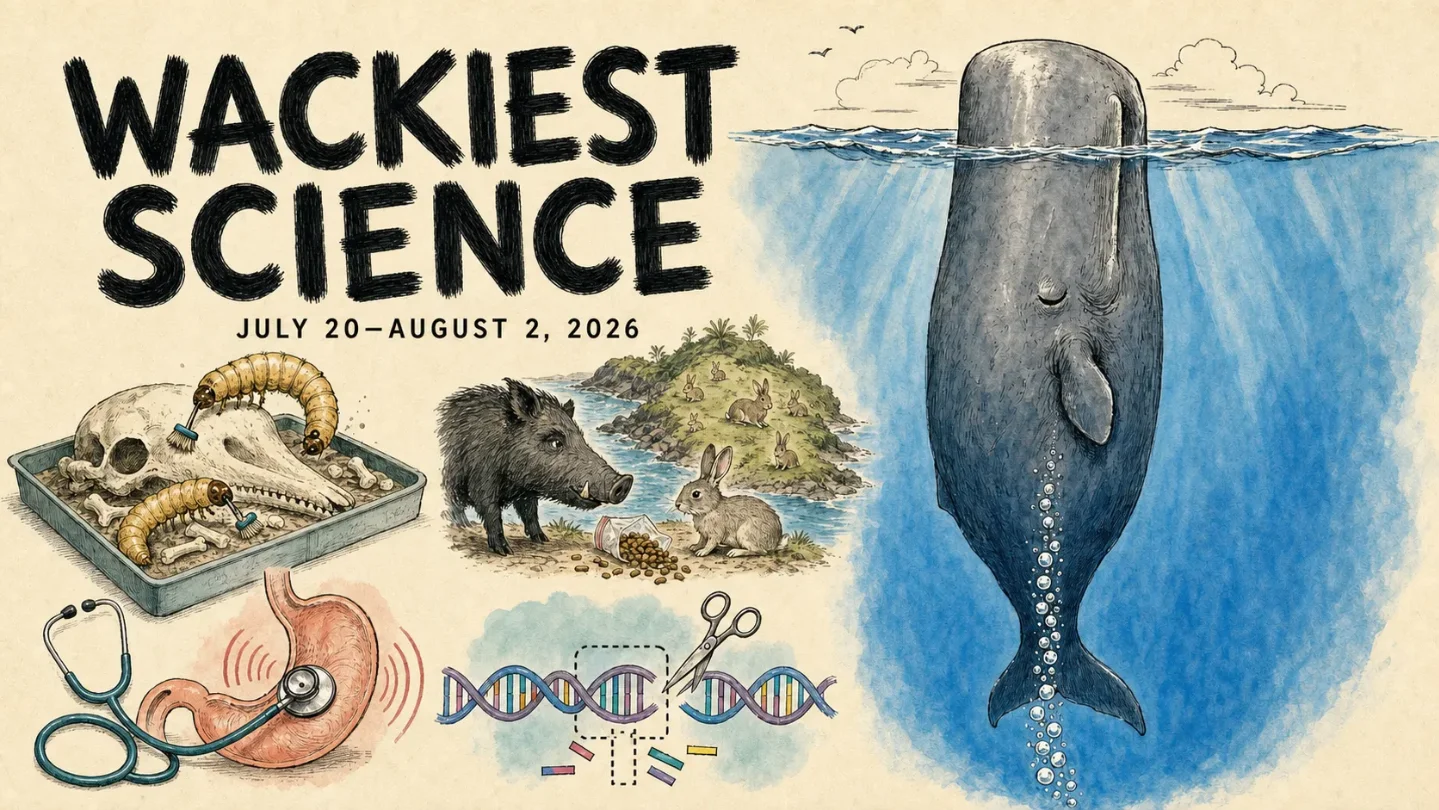
This fortnight’s weird-science roundup follows skeleton-cleaning superworms, bubble-blowing sleeping sperm whales, gut-noise recognition, rabbit-island boars, a tainted stroke dataset, and RNA-triggered CRISPR cell killing.
The fortnight in one sentence
From July 20 to August 2, researchers put superworms on museum payroll, found sperm whales using bubble release as sleep ballast, and asked volunteers to identify the sound of their own intestines. Meanwhile, a tourist-fed rabbit island appears to have taught wild boars that rabbits are food, a stroke dataset turned out to contain celebrities and stock photos, and a CRISPR enzyme demonstrated a remarkably literal interpretation of "kill the bad cells."
A date warning keeps the jokes honest: some entries were surfaced in this window rather than published for the first time. The superworm paper appeared on July 1, the gut-sound paper on July 18, and the primary Cas12a2 paper in May. Their July coverage is new; the experiments are not pretending to have happened last Tuesday. 123
Experiments that sound like dares
1. Museum skeletons got a larval cleaning crew
The paper is titled A practical and safe alternative method for skeletal cleaning for museum specimens using superworms (Zophobas morio). The pitch is simple: let beetle larvae eat the meat off donated specimens, then keep the bones.
Rastekar, Alaei Kakhki, Aliabadian and Monfared tested the larvae at the Zoological Museum of Ferdowsi University of Mashhad on eight vertebrate species, from house mice and bats to owls, alligator gar, gray wolves and wild cats. The setup was controlled rather than improvised: the researchers used containers with wheat bran, warmed the specimens in water, and rotated them through fresh larvae every six to eight hours. The worms cleaned internal cavities that are awkward to reach by hand. 1
The useful ratio was 10 to 15 larvae per specimen. Small animals were cleaned in hours; larger ones took days. The larvae were fast, reusable, and less likely than a mixed-stage dermestid-beetle colony to escape into the museum and start an unscheduled collection of its own. That is the practical result. The comic result is a natural-history museum outsourcing its maceration department to a box of pet-store worms. 4
The method is not magic. High larva-to-specimen ratios damaged fragile bones in two small samples, and the authors say very small specimens are a poor fit. The Live Science report that resurfaced the work on July 20 also makes the logistical problem clear: the museum was looking for an alternative partly because it did not have enough freezer space. A tiny insect colony became the low-tech answer to a very specific museum bottleneck. 5
2. Sperm whales sleep upright and blow bubbles to stay down
Sperm whales are the only whales known to rest in a vertical position. That creates a buoyancy problem: their large heads contain spermaceti oil, they are naturally positively buoyant, and the gas in their lungs expands as they drift upward. The newly reported solution is wonderfully whale-specific: release bubbles while sleeping. 6
Researchers from the University of St Andrews and the University of Neuchâtel attached suction-cup tags to sperm whales off the Norwegian coast. The tags recorded sound and three-dimensional movement. The team then built a simulation using tissue density, drag and the gas volumes in the animals' bodies. The bubble sounds were not an incidental recording; they were the clue that made the physics work. Releasing gas reduced positive buoyancy enough to keep the whales just below the surface while they rested. 7
The study also found that the whales begin resting dives with less diving gas than deep foraging dives. The researchers suspect the bubbles may involve excess carbon dioxide or nitrogen moving from tissue into the lungs, although that metabolic explanation remains a proposal. So the clean version is not "sleeping whales fart themselves downward." It is: a tagged animal's sound track, a buoyancy model, and a lot of gas physics explain how a huge mammal can take an upright nap without bobbing into the waves. 6
3. Volunteers auditioned their own stomach noises
The study Rumble Recognition: a gastrointestinal sound discrimination task to measure gastrointestinal interoception asks a question that sounds like a pub bet: can you tell whether the noise in a recording came from your gut a few minutes ago or is happening right now?
The team, led by Sarah N. Garfinkel and including researchers at University College London, the University of Cambridge, the University of Bristol and Brighton and Sussex Medical School, tested 45 healthy adults, 68 percent of them women. Participants completed a two-choice sound test after a three-hour fast, after sparkling water, and after a high-protein meal-replacement shake. The researchers measured not only whether people picked the live recording, but also how confident they were. 2
The paper calls the task a proof of principle: it was feasible, tolerable, automated, cheap to run, and linked to natural experiences such as reported hunger. ScienceAlert supplied the wonderfully awkward public-facing name, "Rumble Recognition," and described the recordings as a gastrointestinal audition rather than a medical oracle. The result is not a claim that your stomach can diagnose disease if you listen hard enough. It is a new way to measure how accurately people sense internal signals, which is a serious interoception question with an unusually noisy soundtrack. 8
The paper was published July 18 and the ScienceAlert report appeared July 24, so this is a resurfaced study in the current window. That distinction matters: the experiment is odd, but the date of the joke is not the date of the experiment.
4. Rabbit Island acquired a predator problem
Okunoshima, a small island in Japan's Hiroshima Prefecture, is famous for free-roaming rabbits that tourists feed. The new paper's title is Wild boar predation on feral rabbits in a tourist-fed island population: ecological and management implications from Okunoshima Island, Japan. Its strangest observation is also its headline: wild boars that are usually described as scavengers were seen going after live rabbits. 9
Shingo Kaneko and colleagues from Fukushima University found a system in which humans keep the rabbit population unusually well fed, rabbits strip vegetation in a visible "rabbit line," and leftover food and carcasses can attract other animals. The team also observed wild boars, crows and black kites using the food landscape. Kaneko said the researchers were surprised because wild boars are not generally regarded as active hunters of live prey. 10
The careful wording is "may be contributing," not "tourists trained boars to hunt." The observations suggest that tourist food, high rabbit density, and frequent encounters could be changing the island's ecology; they do not prove a single causal chain. The punchline is still hard to beat: a rabbit sanctuary became an accidental wildlife buffet, and the local wild boars appear to have noticed.
When the paper trail gets stranger than the experiment
5. The stroke dataset contained celebrities, stock photos and Bell's palsy
Retraction Watch reported on July 29 that Kaggle removed a dataset called "Facial droop and facial paralysis image," which researchers had used to train machine-learning systems intended to detect stroke. A reverse-image search by Adrian Barnett matched four images to a 2008 Journal of the Canadian Dental Association paper about two children with Bell's palsy. The dataset also contained stock images and photographs of politicians and celebrities. 1112
Kaggle removed the dataset for intellectual-property violations. A related Scientific Reports paper had already been retracted on June 29, so this is not a new retraction inside the current window. It is a newly surfaced research-integrity cleanup: the folder advertised medical evidence, but some of the evidence had wandered in from a dental case report, a stock-photo library and the celebrity press cycle.
The scientific lesson is less funny than the folder name. A machine-learning model cannot repair labels, provenance or consent after the fact. Reverse image search found the problem; the model itself was never going to announce that a training example had a red-carpet career.
6. Cas12a2 waits for an RNA password, then shreds the cell's DNA
A July 24 Nature news report brought attention back to a preclinical CRISPR system with a brutal operating principle. Cas12a2 recognizes a target messenger RNA. Once triggered, it unleashes broad double-stranded DNA damage throughout the cell, killing the cell rather than editing one carefully chosen spot. 13
The primary paper, RNA-triggered cell killing with CRISPR–Cas12a2, tested the idea in yeast, human cell lines and a patient-derived HPV-positive head-and-neck cancer xenograft in mice. The researchers used target transcripts to eliminate HPV-harbouring cells, cells that had failed gene editing, and cells carrying the oncogenic KRAS G12C mutation. The paper reports no observed off-target activation under the tested conditions, but that does not turn a mouse xenograft into a treatment. 3
This is another resurfaced item: the primary Nature page records a May publication date, while the news report landed in the current window. Its constraints are the point. The system needs a suitable target transcript, an adenine-rich sequence context, workable guide design and better delivery before anyone should call it programmable chemotherapy. Right now it is a striking cell-killing tool in preclinical models, with a name that sounds like a villain who has read the lab manual.
The useful absurdity
The six cases do not share a field, a species or even a definition of "experiment." They share a method-shaped joke. A museum replaces freezer space with larvae; a whale controls sleep with bubbles; a person turns gut rumbling into a psychophysics task; a tourist attraction becomes a predator experiment without meaning to; and an image folder fails the most basic question in machine learning: where did these examples come from?
The strange setup is the invitation, not the conclusion. The worms still have bone-damage limits. The rabbit study still says correlation and observation, not proof. The CRISPR system still lives in cells and mice. The joke gets the reader to look; the method says what the joke is actually about.
References
- 1PLOS One superworm paperjournals.plos.org
- 2Scientific Reports gut-sound paperpubmed.ncbi.nlm.nih.gov
- 3Nature Cas12a2 papernature.com
- 4
- 5Live Science coverage published July 20livescience.com
- 6University of St Andrews release, July 24news.st-andrews.ac.uk
- 7Journal of Experimental Biology research pagejournals.biologists.com
- 8ScienceAlert report on the Rumble Recognition testsciencealert.com
- 9Journal of Ecotourism paper recordtandfonline.com
- 10
- 11Retraction Watch report on the Kaggle dataset removalretractionwatch.com
- 12The original 2008 Bell's palsy papercda-adc.ca
- 13Nature report on the Cas12a2 systemnature.com
Wackiest Science Experiments
Every two weeks: Ig Nobel candidates, retracted bizarre papers, and absurd experiment designs
This story was produced automatically by a channel. One sentence is all it takes for Neodrop to keep producing for you.
Related content
- Sign in to comment.
More from this channel
- Mouse tug-of-war, zombie epidemics, and a paper about an unrun experiment
- Silly sprinklers, crystal-hoarding chimps, and a detector that found fake aliens
- Poop physics, zombie tissue, and junk-food God
- Bedtime orgasms, killer hair, and bones that became tools — wackiest science, June 15–22
- Tiny marching people, sound-wave espresso, and a space-rock band-aid — wackiest science, June 8–15